

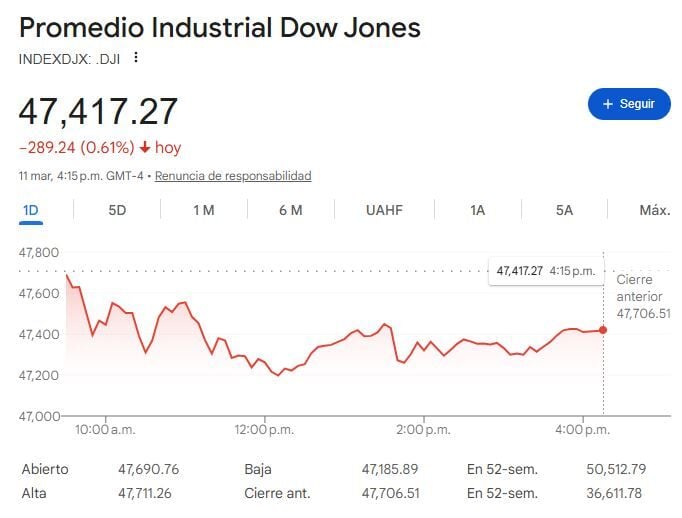
He conflict in Iran is still the main theme and catalyst in financial marketswhich also impacts the oil price and its effect on global inflation. This keeps the bearish pressure about him DOW JONES Ind Average y S&P 500at the close of Wednesday in a -0.61% to 47,417 points and -0.08% to 6,775 points respectively. While the NASDAQ 100 is saved by a few points by +0.08% to 22,716 points respectively.
In the midst of this and as we have commented before, the International Energy Agency announced the release of 400 million barrels of oil from its reserves to ease supply shortages and curb a dizzying rally in oil that briefly sent prices up to 120 dollars per barrel on Monday according to Yahoo Finance. This action constitutes the largest emergency oil release by the agency in its history.
“Recent increases in energy prices were not fully reflected in this report and could boost headline inflation in the coming months,” he said. Gargi Chaudhuri, Chief Investment and Portfolio Strategist for the Americas at BlackRock in Yahoo Finance. “The impact on core inflation and overall economic growth is likely to be more limited…energy volatility does not indicate a return to widespread inflationary pressures.”
But some analysts are not so pessimistic about the conflict in the Middle East. «Despite the view that this conflict is not short, but probably long, we still expect March to be a bullish month,» he wrote. Tom Lee from Fundstrat In a recent note according to Yahoo Finance.
However, Lee argues that, historically, stocks have rallied once a war starts. “The saying sell accumulation, buy war has largely remained in place in the last eight major conflicts,” Lee said.
«The increase in oil prices is the main impact of this conflict. And, in our opinion, The United States is a net beneficiary of rising oil prices,» Lee added.
Among the economic data we had the IEA crude oil inventories with a result of 3,824M compared to the expected 2,800M, the IEA weekly Cushing crude oil inventories with 0.117M compared to the previous 1.564M and the February federal budget balance with a result of -308.0B compared to the expected -304.4B.
We also had 10-year public debt auction (T-Note) with a yield of 4,217%.
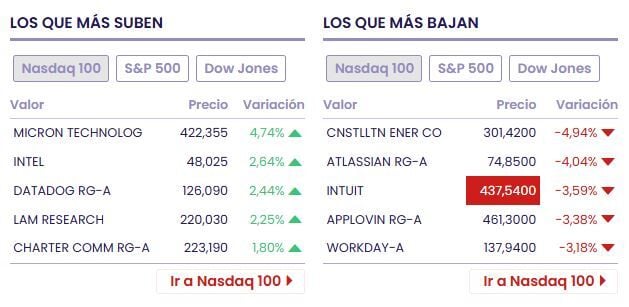
Among the winning actions we have Micron Technolog (+3.84% to $418.60), CF Industries Hl (+9.11% to $120.08) and Chevron (+2.95% to $191.78)
Micron rises after qualification “better performance” on the part of Wolfe Research increasing your target price 350 to 500 dollars after the memory manufacturer’s update, according to Investing.
The firm updated its memory model to reflect higher price assumptions. The model assumes a 100% YoY increase in DRAM prices for the calendar year 2026 and a 95% YoY increase for NANDwith more modest year-on-year increases for calendar year 2027.
The firm’s analysis suggests that DDR5 is increasingly becoming a major driver of demand for DRAM for AI. The analysis examined both the content of HBM like the content of DDR for roadmaps NVIDIA y Alphabet-A until the calendar year 2027. The consumption of DDR+HBM for the total of Google TPU and NVIDIA platforms increases approximately one 124% in calendar year 2026 and approximately 143% in the calendar year 2027.
CF Industries It does not rise due to a specific fact, but rather due to a combination of factors. The reduction in fertilizer supply increases its value and drop in the price of natural gas reduces their production costs.
Chevron rises when benefited by the closure of the Strait of Oromuzaccording to Investing.
The stock recently hit an all-time high of approximately $190.75with gains of around 12% in the last four weeks and just over 20% in the last 12 months as investors flock to the stock.
The data shows that the stock has surpassed a series of multi-year highs through February, underscoring how the energy sector has distanced itself from a broader, more volatile stock market.
The flow of news around the conflict has effectively added a “geopolitical risk premium” to Chevron’s already improving fundamentals.
The company’s exposure to American shale already offshore projectscoupled with a strong capital return program, means higher crude oil prices quickly translate into free cash flow and buybacks.
While that has lifted valuation multiples above some peers, bulls argue that in a world of tight supply and increased risk in the Middle East, large integrated names like Chevron are precisely the assets global investors want to own.
Among the losing stocks we have Cnstlltn Ener Co (-5.17% to 300.69 dollars), Fair Isaac (-9.38% to $1,164) and Sherwin-Williams (-2.28% to $322.81)
Constellation Energy falls due to oil price impactwhich raises fears about the inflation and a delay of Federal Reserve interest rate cuts according to AP News. This ends up reducing the attractiveness of utilities because their cash flows are valued more when bond yields are low.
Fair Isaac falls after announcing its intention to offer $1 billion aggregate principal amount of Senior Notes due 2034 in private offeringsubject to market conditions and other conditions according to Investing. The company currently has $3.2 billion in total debt with a market capitalization of $30.7 billion.
The company plans to use the net proceeds to repay indebtedness under your existing unsecured revolving line of credit and to finance the full redemption of $400 million in aggregate principal amount of its 5.25% Senior Notes due 2026 which were issued in 2018. Proceeds will also cover related fees and expenses and general corporate purposes, which may include common stock repurchases.
Sherwin Williams is also affected by geopolitical tensions and the increase in oil prices. Which invites investors to close positions in the real estate and consumer sectors.
Before finishing with the rest of the quotes, technical analyst of Investment Strategies,Jose Antonio Gonzálezshares an analysis of the Future Mini Nasdaq:
The Future Mini NASDAQ 100 (NQ) keeps alive the rebound recorded throughout the session last Monday, March 9, a movement in favor of purchases that allows it to directly attack the viability of the decreasing guideline that starts from annual highs and, whose surpassing at the close of the daily candle is considered its next bullish milestone in the very short term.
In the positive scenario of managing to close a daily candle above such a decreasing guideline, the next objective will be updated in the attack on the viability of the horizontal intermediate resistance area identified from 25,452 / 25,414 points. For its part, if the price of the index under study (i) continues to show itself unable to resolve this bearish trend upwards, as well as (ii) register a daily candle close below its 200-period or long-term simple moving average, identified in the attached graph in red and which is currently trading at 24,747 points, it would force us to update the next bearish objective towards the secondary or medium-term support area, comprised around 24,420 / 24,160 points. And be careful with drilling this zone of soils, since you would be drilling a medium-term lateral process that would force us to project its width from the bearish vanishing point. At the moment, tense calm in the market.
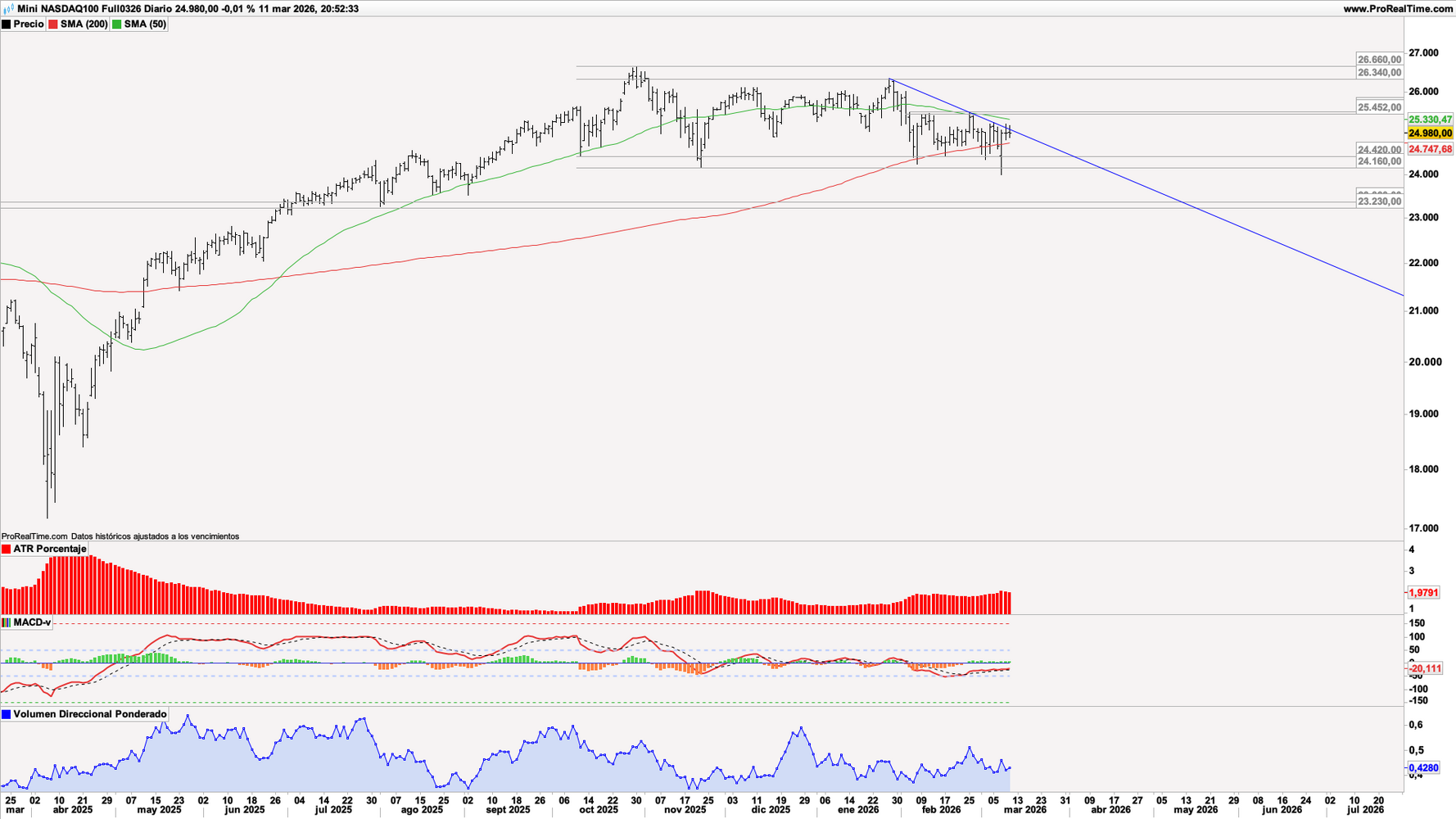
Mini NASDAQ 100 Future (NQ) on daily scale with volatility (upper center chart), MACD (lower center chart) and trading activity (lower window). Source: ProRealTime and own elaboration.
Los Oil futures WTI they go up a +5.74% to $88.24 y Brent +5.67% to $92.78.
He Orofalls a -1.06% to $5,186 per ounce and the Plata -3.89% at 86.10 dollars.
The pair EURUSD falls a -0.33% a 1.1571.
Bitcoin upload a +0.44% to $70,553.
The 10-year US bond yield go up +2.15% a 4.224 already 30 years +1.99% to 4,867.
You can follow more analysis at estrategiasdeinversion.com