
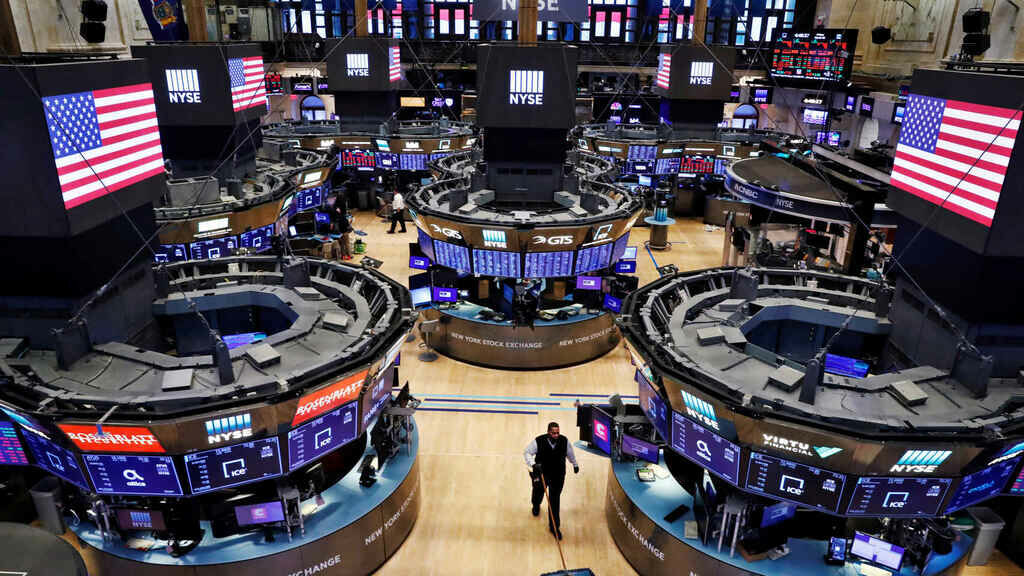
The DOW JONES index rose 750 points or 1.65% to 46,327.82 points. Leading the increases is NVIDIA, which scores 2.57%, while Home Depot advances 2.48%. Among the negative values, the oil company Chevron fell 1.4% affected by the declines in oil prices.
The S&P 500 advances 1.44% to 6,599.87 points, while the Nasdaq rises 1.57% to 21,986.94 points
Wall Street is coming off a punishing week last week: the DOW JONES and the Nasdaq they fell about 2% each, while the S&P 500 lost 1.5%. The Dow Jones accumulates four consecutive weeks of losses, something that has not happened since 2023, and is very close to entering correction territory.
The stock market continues to be marked by news about the iran war. Today, unexpectedly, the president of the United States, Donald Trumphas fueled hopes that the conflict will soon come to an end. “I am pleased to report that the United States and the country of Iran have maintained, over the past two days, very good and productive conversations about a complete and total resolution of our hostilities in the Middle East,” Trump writes in a Truth Social publication.
«I have ordered the War Department to postpone all military attacks against Iranian power plants and energy infrastructure for a period of five days”
Over the weekend, US President Donald Trump had given Iran a 48-hour deadline that ended tonight to open the Strait of Hormuz under the threat of suffering the destruction of its power generation plants. The ayatollah regime had responded by threatening to completely close the strait and attack the energy facilities of its Arab neighbors.
“The market was desperate for any good news, and this seems to be, at least at first glance, the best news we could hope for,” explains Art Hogan, chief market strategist at B. Riley Wealth Management, in statements reported by the CNBC. “If we could see any downward pressure on energy prices, the market would be like a compressed spring looking for a reason to go up.”
In fact, the turn of events has caused a sudden change of course in oil prices, which have skyrocketed for three weeks due to the closure of the Strait of Hormuz. The international benchmark Brent crude oil, which advanced 2.54% shortly before Trump’s message, fell 7.01% at the time of the US opening to $98.95 per barrel, falling below the $100 threshold for the first time in a week. US West Texas futures, which rose 2.74%, turned around to fall 7.51% to $90.85.
Ahead of Trump’s post, Goldman Sachs raised its oil price forecasts, now expecting Brent to trade at $110 per barrel during March and April, up from a previous forecast of $98 per barrel for the same period. The investment bank predicts an average price in 2026 of $85 and $79 per barrel for Brent and WTI, respectively, compared to the previous estimate of $77 and $72 per barrel for both benchmark indices. In 2027, Goldman Sachs expects Brent and WTI to average $80 and $75 per barrel, respectively.
The truth is that oil levels are still very high. To try to alleviate the situation a little, the International Energy Agency (IEA) is consulting with the governments of Asia and Europe about the possibility of releasing more oil reserves «if necessary», according to its executive director, Fatih Birol, who has clarified that there is no specific level of crude oil price that could trigger this release.
One of the market’s great fears is that rising oil prices will end up leading to a scenario of stagflation, that is, a period of lower economic growth and greater inflationary pressures.
Gold, also this time, is not serving as a safe haven asset. Today the yellow metal in its spot variety falls 1.83% to reach $4,425 per ounce and has already erased practically all of its gains for the year. Haven demand has been overshadowed by higher energy prices, a stronger dollar and changing rate expectations.
In the business sphere, the airline sector had been one of the most penalized since the start of the Iran war. In that sense, United Airlines recently announced a reduction in flights and an increase in prices. The reduction in flights will affect the least profitable ones and is expected to last for the next two quarters. Furthermore, the conflict in the Persian Gulf causes a sharp increase in fuel prices, which will be passed on to the final consumer. Today, however, the fall in the price of oil boosts its shares by almost 5%.
Pfizer, one of Wall Street’s pharmaceutical giants, currently has several programs in development. Either through own products or through acquisitions. This is presented as the key to the future that would lead to a new era of growth.
Software company MongoDB rises more than 4% after a recommendation upgrade from Mizuho. While fears of artificial intelligence disrupting the software sector have worried the group ahead of 2026, the Japanese bank says MongoDB differentiates itself from its competitors as AI will strengthen the company, not weaken it.
Synopsys rises 4.5% in the New York morning in the heat of information from The Wall Street Journal which ensures that the activist firm Elliott Investment Management owns multibillion-dollar stake at the chip company. The report adds that Elliott believes there is an opportunity for the company’s financial performance to better reflect its value.
The shares of Vertiv, Lumentum, Coherent and EchoStar rose more than 2% after joining the S&P 500 index in this Monday’s session, confirming the trend of concentration of AI companies in the benchmark index. These four companies, which operate in the data center, optical networking and satellite communications sectors, replaced Match Group, Molina Healthcare, Lamb Weston Holdings and Paycom Software in the index as part of the S&P’s quarterly rebalancing.