
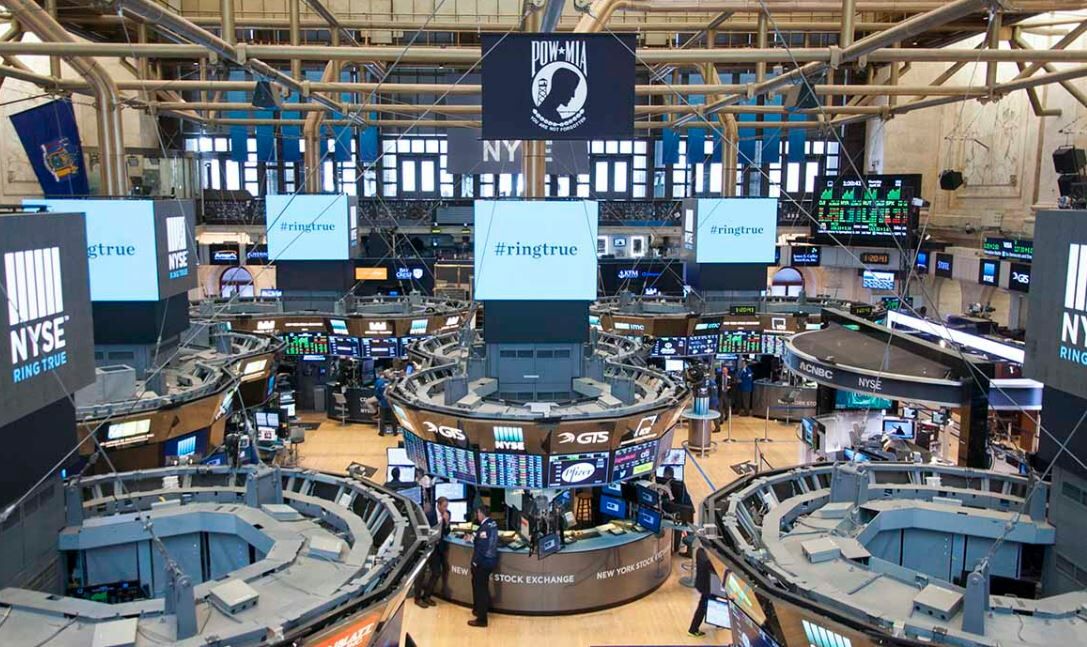
The DOW JONES index fell 0.19% to 47,960 points, while the S&P 500 added 0.57% to 6,884.31 points. The NASDAQ 100 gained just over one percentage point, to 23,486.23 points.
This Friday’s day is the first of 2026, after Wall Street was closed yesterday Thursday for the New Year. On Wednesday, the major indices had their fourth consecutive negative day: the Dow Jones fell 0.63%, while the S&P 500 fell 0.74% and the Nasdaq Composite fell 0.76%.
But despite this correction in recent days, which greatly complicates the so-called Christmas rally, the truth is that the New York market closed a fairly positive year. The S&P 500 maintained a gain of 16.39% in 2025its third consecutive double-digit annual advance. The Nasdaq Composite took advantage of AI enthusiasm to advance 20.36% and the Dow Jones advanced 12.97%.
Looking ahead to 2026, which is now beginning, the outlook invites more optimism. All Wall Street analysts followed by Bloomberg they predict that stocks will rise for the fourth year in a row. However, many risks remain: the AI boom could falter, the US economy could surprise and, of course, President Trump remains an unknown, while the fate of their reciprocal tariffs could become clearer this month.
Among the top issues on Wall Street’s list for 2026 is the Federal Reserve. At the December meeting, the institution cut rates by 25 basis points, the third consecutive cut, but the decision was highly divided. For now, most traders expect the central bank to hold interest rates steady later this month, although bets are more divided for the March meeting.
Furthermore, throughout January it could be known the name chosen by President Trump to replace Jerome Powell at the head of the Fed. Powell will leave the presidency in May.
In fixed income, always closely monitoring monetary policy, Treasury bonds fall on the first trading day of 2026, raising the yield on 30-year bonds to their highest level since early September, as optimism about the US economic outlook curbs demand for safe-haven assets. The yield on the 30-year debt rose four basis points, to 4.88%, while that of 10-year bonds reached 4.19% before relaxing to 4.159%.
Among the values to follow is Berkshire Hathaway, after yesterday Thursday veteran Warren Buffett officially handed over the baton to Greg Abel. In his last interview as CEO, Buffett assured CNBC that Berkshire “has a better chance of being here in 100 years than any other company I can think of.”
During his six decades at the helm of Berkshire Hathaway, the Oracle of Omaha turned a struggling textile factory into a multibillion-dollar conglomerate that also has more than $300 billion in cash on its balance sheet for new purchases. Its shares fell 0.7% in the first minutes of trading, above $498.79.
Investors are also paying attention to the price of Tesla, which registered increases of more than 1.4% at the New York opening. this friday the company run by Elon Musk will publish its fourth quarter delivery figures. According to data compiled by Bloomberg, Tesla is expected to have delivered about 440,900 vehicles in the fourth quarter, down 11% from a year earlier. Tesla took the unusual step this week of releasing its own average analyst estimates, which is even more pessimistic, predicting a 15% drop.
Home goods retailers, such as Wayfair and Williams-Sonoma, rise after Trump’s decision to delay a 30% tariff increase on upholstered furniture. Wayfair added 6% and RH 7.04%, while Williams-Sonoma scored 2.7% at the opening.
The United States has granted chipmaker TSMC its annual license to import its equipment to China, sending shares up 2.9% in the first minutes of trading.
Warby Parker shares are up about 2% after Loop Capital named the eyewear maker one of its favorite stocks for 2026, citing the firm’s expanding EBITDA margins. The firm likes the risk/reward balance and said Warby Parker remains «one of the most compelling organic square footage growth stories in our coverage universe.»
In raw materials markets, oil prices barely move on the first trading day of 2026, having recorded their biggest annual drop since 2020 last year, at a time when Ukrainian drones target Russian oil facilities and a US blockade puts pressure on Venezuelan exports.
US West Texas futures fell 1.1% to $56.78 per barrel, while international benchmark Brent crude settled at $60.64, down 0.35%.
Gold and silver posted their best annual performance since 1979 last year, driven by factors including the impact of US rate cuts, tariff tensions and strong demand from ETFs and central banks. Gold, which rose 64% in 2025, pays $4,837.20 per ounce, while silver stands at $73.91 after rising 150% in 2025.
The euro fell 0.23% against the dollar, leaving the exchange rate at $1.1719 for each single currency.