
-
Rising interest in stablecoins reduces deposits and cuts loans, according to the study.
-
The ECB proposes the digital euro with holding limits to protect bank deposits.
The European Central Bank (ECB) published a report documenting how the adoption of stablecoins shifts funds from retail bank deposits to digital assets in the euro zone. The research indicates that this phenomenon increases banks’ dependence on wholesale financing, increases their costs and reduces the granting of credit to companies.
Economists Carlo Altavilla, Miguel Boucinha, Lorenzo Burlon, Ramón Adalid, Roberta Fortes and Franziska Maruhn analyze confidential granular data from Eurozone banks and public attention time series extracted from Google Trends.
The study identifies a deposit replacement mechanism such as the increase in interest in stablecoinsmeasured by Google searches, and is associated with a measurable decline in retail deposits and a reduction in bank lending to businesses.
Our analysis shows that the growing interest and attention towards stablecoins is associated with an appreciable decline in retail bank deposits and a reduction in bank lending to businesses. In other words, stablecoins can reduce the amount of credit that banks extend to the real economy.
ECB report.
The main mechanism is substitution. This is because funds leaving retail deposits (a cheap and stable source of financing) can migrate to stablecoins. In many cases, issuers invest reserves in US Treasuries, drawing liquidity out of the eurozone banking system. This forces banks to resort more to wholesale financing (bond issues or interbank loans), which is more expensive and volatile, raising their funding costs and reducing the volume of loans to the real economy.
Although the global stablecoin market reaches approximately $280-300 billion (with Tether’s USDT and Circle’s USDC as the main issuers), in the Eurozone the volume remains marginal. This because stablecoins denominated in euros are around 400-600 million euroscompared to about 17 trillion euros in total bank deposits. The current impact is therefore limited, but could be expanded with greater adoption.
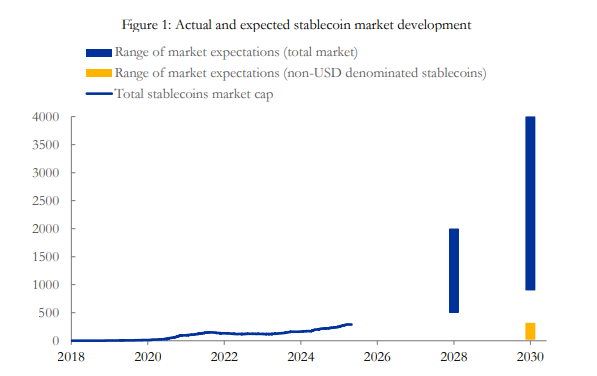
It is likely that its diffusion [de las monedas estables en moneda extranjera] increases banks’ dependence on wholesale financing in foreign currency… indicating a weakening of the transmission of monetary policy and a possible erosion of monetary sovereignty.
ECB report.
The authors point out that this dynamic can import financial conditions external to the euro zone, for example, changes in the FED’s monetary policy or in global confidence. This, weakening the effectiveness of the ECB’s interest rate decisions and eroding its control over inflation and economic activity in the region.
The digital euro as a public alternative
As a strategic response, the document presents the digital euro as a public alternative to mitigate these effects. The authors highlight that, through limits on individual holdings (in analysis between 500 and 3,000-4,000 euros per person), the digital euro is designed as a mainly transactional instrument, protecting the deposits of commercial banks and reinforcing financial stability.
This limit seeks to ensure that the asset functions exclusively as a payment instrument (transactional) and not as a store of value that competes directly with bank savings. In this way, the ECB attempts to protect the commercial deposit base and ensure that its interest rate policy remains effective.
By limiting individual holdings, the digital euro is explicitly presented as a transactional instrument, thus protecting the deposits of commercial banks and reinforcing financial stability.
ECB analysts.
The study emphasizes that the impacts depend on the scale of adoption, the design of the assets and the regulatory framework. What the analysts do not detail in their report is that the current volume of stablecoins backed by the US dollar in Eurozone remains limited by approximately €17 trillion in total bank deposits.
Although the volume of stablecoins in the region is still small compared to the total deposits, the ECB already applies the MiCA regulation to supervise issuers.
This conflict is a challenge to the heart of the banking business that has prevailed for centuries. Historically, banks have functioned as trust stores where customers deposit their savings in exchange for security, and they use that capital to issue loans and earn interest. However, stablecoins introduce more efficient native competitioncapable of moving value instantly and at a lower cost, which seduces depositors and leaves traditional entities without their essential raw material to operate.
The integration of both sectors now seems inevitable, but the success of this coexistence will depend on the banking’s ability to renew itself. If financial institutions fail to offer added value, whether through better services, greater legal certainty or a drastic reduction in their fees, the shift of deposits towards digital assets will cease to be a statistical anecdote.
What we are witnessing is the beginning of a forced restructuring where the banking system, as we know it, will have to demonstrate its usefulness in a world where money no longer needs intermediaries to move.