
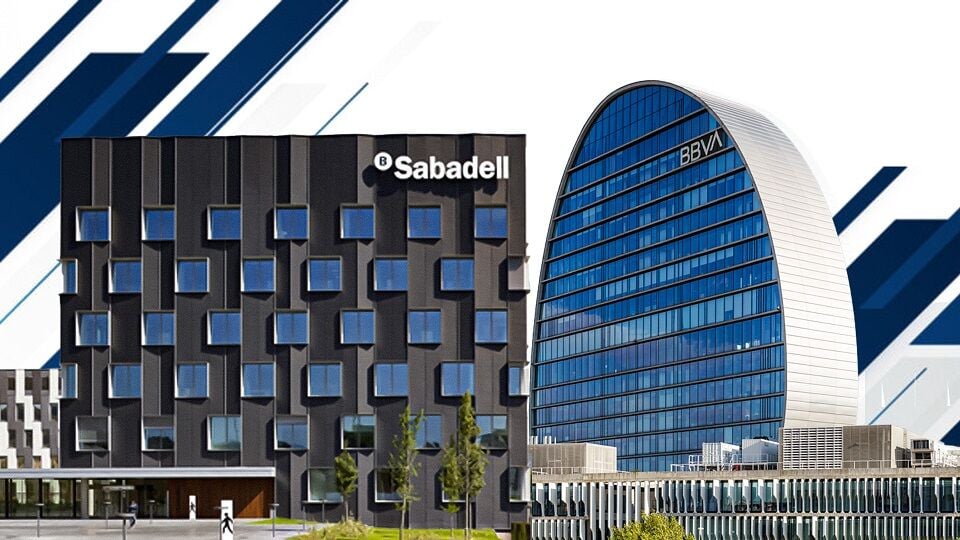
The ‘Financial Times’ has approached in an opinion column the evolution of the OPA that BBVA wants to launch on Banco Sabadell and believes that, once the antitrust concerns are overcome, the shareholders are those who should have the last word, «and not the protectionist bureaucrats.»
The column, signed by Patrick Jenkins, mentions the speeches given by both the European Commission and the Spanish government itself on promoting European competitiveness in the face of the increase in geopolitical risk and the US trade war. However, he points out that, despite this rhetoric, «there has been a strong opposition.» «In no other country is more true than in Spain,» he adds.
It indicates that any fusion must go through the competition analysis and to obtain the support of the EU, something that BBVA’s OPA on Sabadell already has. «So why does the operation arouse so much controversy in the government of Sánchez?» Asks the journalist of the ‘FT’.
He explains that at the beginning of the operation, in May 2024, the first problem was the opposition of the Banco Sabadell Board of Directors to the offer made by BBVA, which caused this last entity to launch a hostile OPA directed directly to the shareholders. «The moment [de anunciar la OPA] It couldn’t have been worse. It happened a few days after the regional elections in Catalonia «, place of origin of Sabadell.
This would unite that mergers «can be problematic for the socialist government of [Pedro] Sánchez, whose priority is to protect employment. «
It also collects statements from the president of BBVA, Carlos Torres, who came to say that the OPA was «unstoppable.» «Right now, those statements seem fantasy,» says the British newspaper, taking into account that the process has been «complicated» and that BBVA «was especially upset by what he considered a politicization of the antimonopoly process of the National Commission of Markets and Competition.»
At the end of last April BBVA obtained the ‘approval’ by the CNMC, although after agreeing and in phase 2, which has given rise to the opening of phase 3, that is, that the government has to review the operation now and decide whether it hardens, maintains or softens the conditions agreed with CNMC.
In addition, the ‘FT’ affects the public consultation «unprecedented» that the Government made in early May to collect opinions among citizens about the operation.
«Alarmed by the level of interference, the European Commission warned last month to Spain that did not have the legal authority to block the operation,» says the column. The author points out that «everyone» is aware that if Sánchez is «stubborn», he can «frustrate the operation.»
«Although dilatory decisions could trigger legal actions of the EU, the years would take to initiate an infringement procedure would make any ongoing offer unfeasible,» he adds.
For the British newspaper, an example to follow could be the current president of Telefónica, Marc Murtra, who seems to have achieved that «his own mergers agenda both in Spain and in Europe» has the support of the government. As a counterpart, Murtra would support the type of diversified technological investments defended by the government.
«The problem for Torres? Murtra, an exceptional entrepreneur and friend of the Sánchez government, was placed in his position by the Executive after acquiring a 10% participation in the company and expelling his predecessor» [en referencia a José María Álvarez-Pallete].
The column indicates that if Torres manages to «overcome Sánchez’s animosity» with promises of investments or other incentives, «at the same time avoiding a more invasive interference,» the OPA could end up in the hands of Sabadell’s shareholders. He also believes that the president of BBVA may be right that the economic interests of Spain and Europe would be favored by the agreement.
«But in any case, once the antitrust doubts dissipated, now the shareholders should be, and not the protectionist bureaucrats, who have the last word,» he concludes in this regard.