
For the country’s credit, and despite spells of volatility related to interest rates, regional banks and tariffs, this period has been defined by strong returns. This result has reflected factors such as fundamental strength, a very low level of defaults and an abundant supply of capital for issuers, which have created a strong technical background across all leveraged finance sectors.
In this favorable environment, credit spreads have continued to narrow, leading investors to wonder how much upside there might be left for the asset class in 2026. It is worth remembering that, Although the spreads seem low in historical terms, they are not so low if we take into account the composition of the American high yield market of today. Current spread levels are supported by a near-record percentage of BB bonds, near an all-time low for CCC securities, an all-time high for covered bonds (35%), and lows in duration and bid-ask spreads (i.e., improved liquidity).
That said, the abundant supply of capital has led to increased corporate indebtedness in certain areas of the global leveraged finance universe, particularly at the lower end of the credit spectrum in the large syndicated loan and unlisted debt markets. Recently, there has been increased attention to notable default cases and investor unease over the risk of contagion in credit markets.
Chart 1: Composition of the US high yield credit market based on a selection of ratings
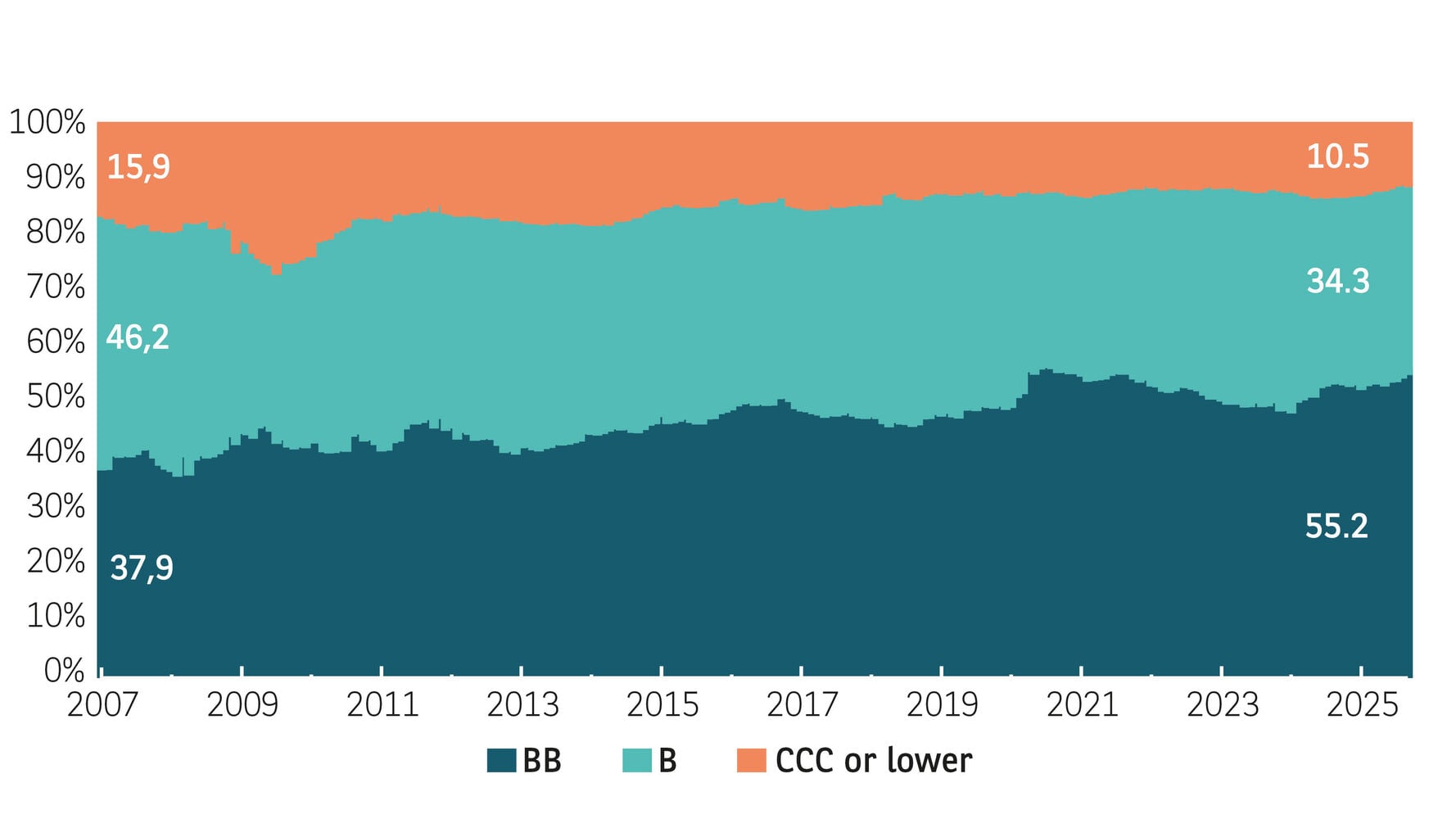
Data as of September 30, 2025. Source: Bank of America, HY Research
While we anticipate that liability management exercises will continue to be prevalent in 2026, we believe that default activity in the high yield segment should remain moderate and likely dominated by individual company circumstances.
In this context, an active and disciplined approach to investing in lower quality corporate debt markets could be justified. Despite macroeconomic uncertainty, our expectation is that high yield spreads will continue to fluctuate in a relatively tight range, with the segment supported by continued demand from investors focused on the total return potential available as cash rates decline.
We think that the Instruments with low duration will continue to be attractive due to their ability to mitigate interest rate and spread volatility, while providing access to the most liquid part of the market. For investors seeking higher levels of profitability within the American high yield market, any decline in the segment (such as the one suffered in April 2025) could give rise to attractive purchasing opportunities in higher risk instruments.
To benefit from the full range of opportunities in 2026, investors could consider a flexible and concentrated approach to investing in high yield credit, taking advantage of its unique diversification advantages within a broader asset allocation.