
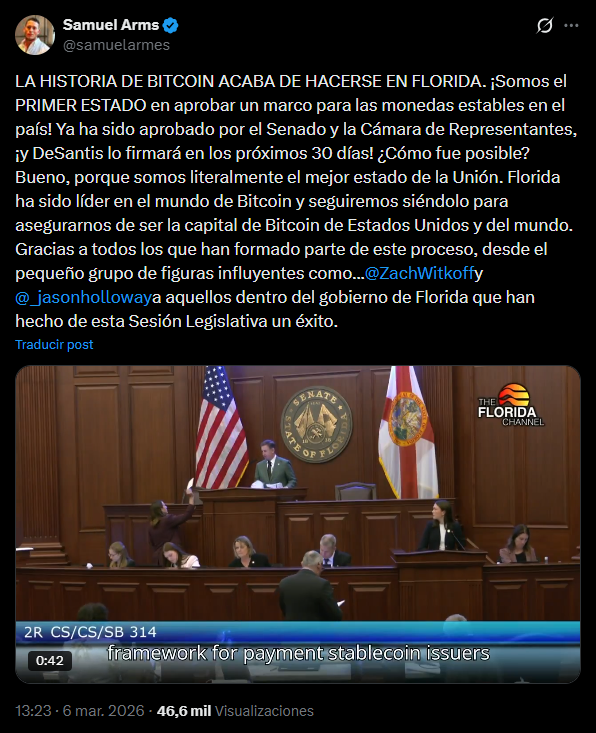
The Senate of Florida, in the southeast of the United States, approved this Friday, March 6, 2026, the first state regulatory framework for stablecoin issuers in the region. The measure seeks to harmonize local rules with the GENIUS Law signed last year.
The initiative, approved with a unanimous vote of 37 to 0, introduces structural changes to the state’s current Law to Control Money Laundering in Service Businesses.
Upon entry into force, it will be strictly prohibited to operate as a stablecoin issuer without a specific license or formal exemption. Therefore, Applicants must undergo a rigorous evaluation process before the Florida Office of Financial Regulation (OFR), the entity that will assume primary supervision.
In specific scenarios, the OFR may exercise joint oversight with the Office of the Comptroller of the Currency (OCC) at the federal level. A key point of the rule is that stablecoins that meet the requirements of “qualified payment currencies” will no longer be considered securities.
After passing the procedure in both chambers and being ordered for official registration, The legislative initiative is awaiting the governor’s signature Ron DeSantis to take effect immediately. However, its deployment will be staggered. This is because the period to request licenses from the Office of Financial Regulation would open on July 18, 2026, while the requirement to have a permit to operate in the state would not be effective until July 1, 2027.
For a stablecoin to be considered qualified under the CS/CS/HB 175 bill passed today, it must meet a clear definition aligned with the GENIUS Act. It means that the issuer is obliged to redeem the stablecoins it issues for a fixed amount of monetary value (for example, 1 USD for each unit), and must maintain a reasonable expectation of stability in that value. Besides, The standard requires 1:1 reservations, consumer protectionsanti-money laundering compliance and prohibits paying interest if vetoed by federal law.
For companies to operate as a “qualified payment stablecoin issuer” they must be a legally incorporated entity in the state of Florida and have approval from the state OFR.
It cannot be an uninsured national bank chartered by the OCC, a federal branch, a depository institution insured by the Federal Deposit Insurance Corporation (FDIC), or any subsidiary of these entities. These requirements seek to limit issuance to regulated actors at the state level, avoiding overlaps with traditional federal banking supervision.
The approval of the law occurs amid tensions, as reported by NoticiasVE. This is because traditional banks have expressed their concern about what they consider asymmetric competition and systemic risk. They fear that stablecoins could pose risks to the global financial system.
This clash of interests between banks and cryptocurrency companies in the United States has been, precisely, the main obstacle for the national Senate to advance broad legislation that covers the entire digital asset ecosystem.