
How does the idea of Indexa Capital arise? You positioned yourself as the first Roboadvisor and you have become the greatest. How many customers do you have right now and what volume?
Indexa was founded by Unai Ansejo, Ramón Blanco (founder of Self Bank) and me. The idea was born from UNAI’s experience in pension management, where he saw that diversification, low costs and indexation were key. Inspired by platforms such as Wealthfront or Betterment in the United States., We decided to adapt that model to the Spanish market. We started the regulatory process in 2014, and in 2015 we launched the service as a stock agency.
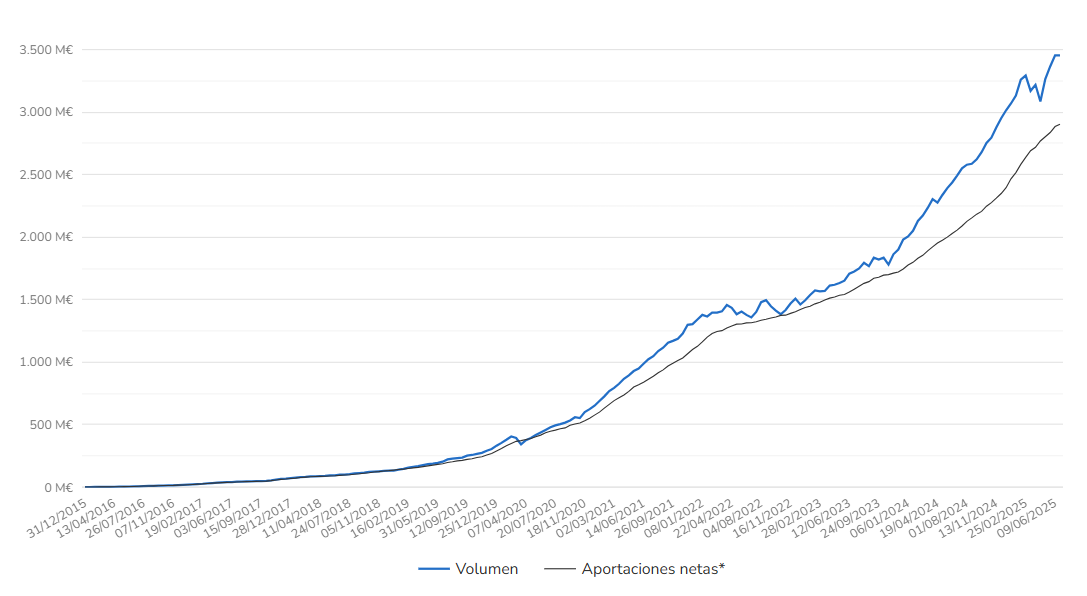
We start with a new customer every two days. Today we already have more than 112,000 customers, we capture a new one every 20 minutes and manage 3.4 billion euros.
What is the client profile that you have? What does it invest in?
Our clients invest in wallets of indexed funds with global diversification, designed according to their risk profile. 90% of the volume is in fund portfolios and the remaining 10% in pension plans (individual, employment or for freelancers).
We have 11 risk profiles, from 0 (monetary, minimum risk) to 10 (90% shares). The minimum investment is 2,000 euros. For accounts of less than 10,000 euros we use two global funds (indexed to MSCI World and an index of global bonds). From that figure, we invest in more funds, indexed on indices such as S&P 500, MSCI Europe or Emerging Markets.
The funds are mostly avant -garde, but we also use Ishares or other managers. Always with an approach without sectoral or geographical biases, unless the client opts for the socially responsible version (ISR).
What commission do your portfolios have in front of other options in the market?
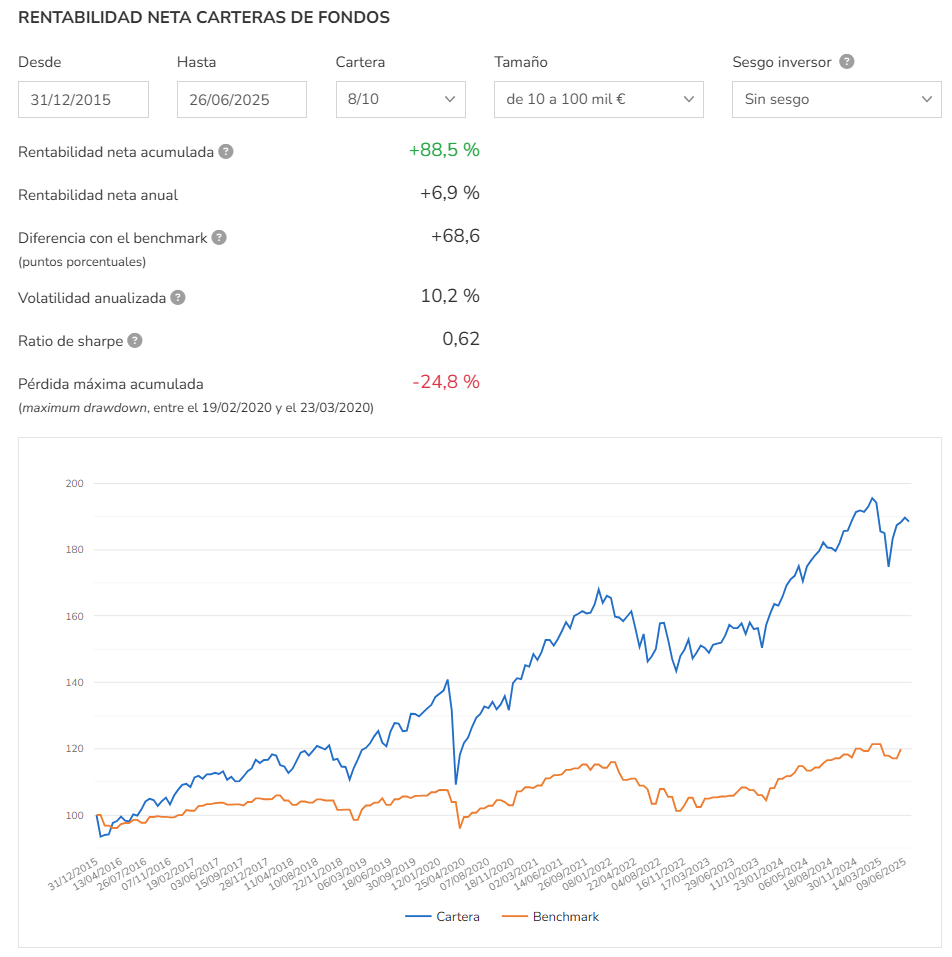
The average total cost for the customer is around 0.50% annual, including funds, management and custody. It is more than 80% cheaper than the average cost of the traditional banking sector, which exceeds 3%. In the long term, this difference translates into a much higher profitability: a portfolio profile 8 in Indexa has generated 80% accumulated in 10 years, compared to 20% of the average of the comparable Spanish investment funds (see lower image)
Do you have products for those who seek to generate income or live on the dividend?
Yes. We have a income generation service with which client can request a periodic income, but we do not invest in distribution funds, but accumulation. Thus, the dividend is reinvested and benefits from compound interest. The client can withdraw the amount you want, and the system automatically reimburses from funds with less fiscal impact.
This allows clear tax optimization: dividends are taxed by 100% received, while in a portfolio withdrawal it is only taxed by the part won. It is a more efficient way to generate income and increase net profitability in the long term.
It is often said that in Spain there is little financial culture. Do you agree with that statement from your experience in Indexa?
It would surprise you. It is true that there is a generalized perception that in Spain there is little financial culture, but our experience with Indexa says otherwise. We have been present in Belgium for five years – I am Belgian and it was a natural market to expand – and in France for a couple of years. What we see is that, in our sector, that of indexed funds, there is more financial knowledge in Spain than in France. In France, indexed investment is coming later. And although compared to the United States Europe still goes behind – indexation in the United States. It started in the 70s with Boggy – within Europe the level in Spain seems quite good.
From Indexa we work hard to foster this training: we publish articles on financial education, we send them to our clients, and recently compile a large part of that content in a book, less costs, more profitability, written by Unai Ansejo, co-delegate delegate of Indexa, and Carlota Corral, our Investment Director.
It is very aligned with our philosophy: training, sensible investment and cost reduction.
In a geopolitical environment so changing and with such volatility, do you make forecasts on the evolution of markets in the US or Europe?
No. Precisely because we are very aware that we know only the market. We assume that the information is already incorporated into prices and that trying to anticipate is a very expensive game and with few probabilities of success. We do not do tactical assignment. We never make decisions based on a vision of the market. Our strategy is global diversification and automatic readjustments.
If a customer has a 50/50 portfolio in shares and bonds and the actions rise a lot, we automatically readjust to return to the risk profile. If they go down a lot, we do the opposite. All that without emotional intervention of the manager. We do it with automatic rules, without having someone «convinced» or «crowded» making decisions. This model generates an added value of about 0.4% annually against portfolios without readjustment.
Have you recently launched a new product?
Yes, we recently launched a new 100% Variable Income Fund. It is not part of our automated portfolios – where we manage more than 3,000 million euros – but responds to the demand of some clients who prefer to invest in a single background instead of in a portfolio. It is also useful for those who do not reach the minimum investment of 2,000 euros, since with the funds they can start from minor amounts. These funds are deposited for rent 4 and available on most platforms.
And we are working on new services. One of them – although it is still in the exploration phase – is to include exposure to private markets in our portfolios. We see the possibility of increasing diversification in that direction, but our challenge is to do it with low costs. Current vehicles in private capital, infrastructure or debt usually have total commissions that, between commissions and success commissions cascades, often reach 6% total costs. We want to find a formula that combines diversification and low cost.
You have talked about consolidating the market. At what level: national or European?
We focus mainly on Spain, France and Belgium, which are our current markets. Our priority is to lead in countries where we are already, rather than open new. In Spain we have a very clear leadership position in automated management. In fact, Indexa has more volume than the rest of independent automated managers together.
In France and Belgium we are still small. That is why we see more sense to buy local actors somewhat larger than us in these countries. For example, in France we recently bought from Caravel, which had about 7 million managed. Although it is a modest figure compared to what we have in Spain, it helped us gain local traction and credibility.
Thanks to our IPO in 2023, we now have more capacity to make acquisitions combining shares, box and, if necessary, some debt.
What are the financial results of Indexa and your forecasts?
In the first quarter of 2025, we invoice 2 million euros (Indexa Capital Group), which is equivalent to about 8 million annually. We obtained a net profit of 500,000 euros in that quarter, so we could close the year with about 2 million net profit, or more if we continue to grow as until now.
We have a positive net treasury position. We have no net debt because, as a stock agency and manager, we must meet very demanding solvency requirements. Even so, we have available credit lines in case any acquisition opportunity is presented.
Our strategic plan is clear: moving from the current 3,400 million to 10,000 million in 2030. That would make us the largest independent manager in Spain. At this rate, we estimate a turnover of 30 million and a net benefit around 12 million by then.
What would you say to someone who is considering investing in Indexa as a client or as a shareholder?
As a client, to begin by opening an account – without the need to contribute immediately – and, if you have doubts, to try the minimum (2,000 euros). Almost half of our customers begin with that amount to test the service. The average, yes, is in about 10,000 euros, but we have customers from 2000 euros to more than 10 million euros. Many clients with high heritage also begin with small amounts to test the service. And if you already have funds elsewhere, you can make a transfer without fiscal impact.
We also recommend periodic contributions to diversify the moment of entry.
I would also recommend that you look at the possibility of taking the tax advantages of pension plans – including autonomous, which allow to contribute up to 4,750 euros a year. Our pension plans have very low costs (around 0.5%), five times less than the sector average and a profitability similar to fund portfolios.
As a shareholder, I would emphasize that we are a company with a very predictable model and with solid growth. Right now we are in BME Growth with an assessment around 150 million euros. The Per has dropped from 400 to 75 and continues to fall as our benefits grow.
We are working to increase the liquidity of the action, increase the number of shareholders and, in the medium term, move on the continuous market. We have the objective of staying independent, because we believe that this is key to continue offering our independence, in the best interest of the client.