
-
Currently, Knots v.20 is established as the second option among node brokers.
-
In early January, a bug was revealed in Core v.30 that could lead to the loss of funds.
The detection of a bug in the v.30 versions of Bitcoin Core, reported on January 5 and which could cause the loss of funds after migrating old wallets to new formats, once again brought into discussion the use of different clients to connect to the Bitcoin network.
However, and despite this debate, the data does not reflect an immediate reaction on the part of Bitcoin node brokers.
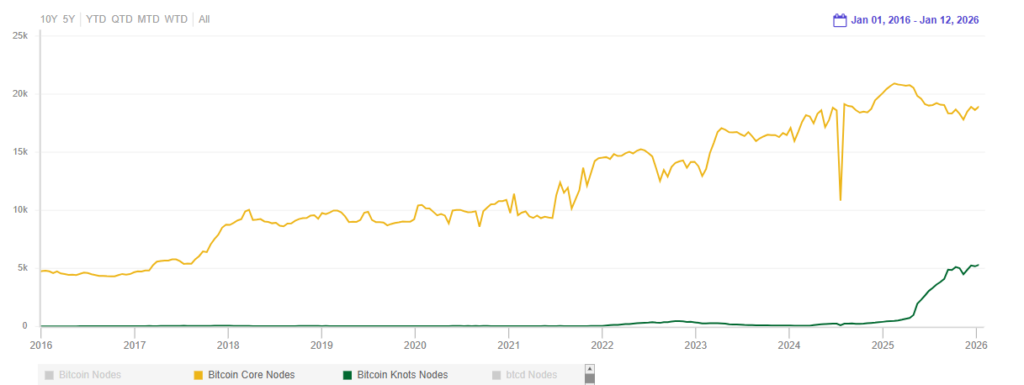
According to statistics, the evolution of Bitcoin Core and Bitcoin Knots operators there is no evidence of a direct impact attributable to that eventalthough there is a recent rebound in operators of both software.
Knots’ growth is explained in time
The photo changes when the time horizon is expanded. Throughout 2025, the use of Bitcoin Knots showed sustained growth, as reported by NoticiasVE.
For example, last November, Core v.30 had about 2,500 nodes, which represented 10.66% of the total at that time, and Knots v.20 was in third place with about 2,200 nodes, equivalent to 9.35%.
At the time of writing, those numbers have grown significantly. Core v.30 maintains its leadership and is currently around 4,000 nodes, close to 16% of the total, which implies an approximate increase of 60% compared to November.
Knots v.20, now in second place by versionadds almost 3,200 nodes, close to 13% of the total, a growth of close to 45% compared to the November record.
Although the detection of the bug in v.30 is recent, the data suggests that the adoption of Knots responds more to a cumulative dynamic than to specific reactions to specific incidents.
Even so, Bitcoin Core, considering all its versions, concentrates 19,283 nodes out of a total of 24,717. This represents approximately 78% of the visible nodes on the network. Bitcoin Knots, meanwhile, brings together nearly 5,400 nodes, which is equivalent to around 22%.
The background of the debate between clients
The distribution of nodes suggests continuity rather than rupture. To understand why some node brokers choose Knots, it is relevant to look at the underlying debate.
The Knots client applies stricter rules against certain uses considered «spam»: adding information that takes up space in the network file without a clear monetary purpose.
That difference was reflected in opinions such as that of an X user identified as Bitcoin_To_The_Oblivion, a recent node operator with Knots.
According to him, after the appearance of «malware» (as he calls Core v.30) the growth of unnecessary data on the network was not significantly reduced and, on the contrary, large records began to appear that almost did not exist before.
That stance was accompanied by a graph showing the evolution of Bitcoin’s UTXO pool size.
The image shows that, after a marked reduction during November, new growth was recorded in December.
Increasing the size of the UTXO set implies a higher data load than nodes must store and processa phenomenon that for Knots defenders reinforces the idea that certain recent policies have failed to contain the accumulation of data without a clear monetary function.
In his opinion, this not only made Bitcoin more vulnerable to spam, but also affected its monetary properties.
In a critical tone, the user maintained that the adoption of Knots and more restrictive rules is a form of resistance against decisions that, from his perspective, harm the network.