
After three years of conflict, the ruble reflects the pulse of a sanctioned, militarized economy and, yes, with a growing disconnection of western markets.
Despite moments of apparent stabilization, the Russian currency has suffered a structural depreciation against the main international currencies, pressured by commercial sanctions, restrictions on access to capital markets and a growing dependence on non -Western economic allies such as China or India.
Is the ruble a Russian economic health thermometer in a prolonged war context?
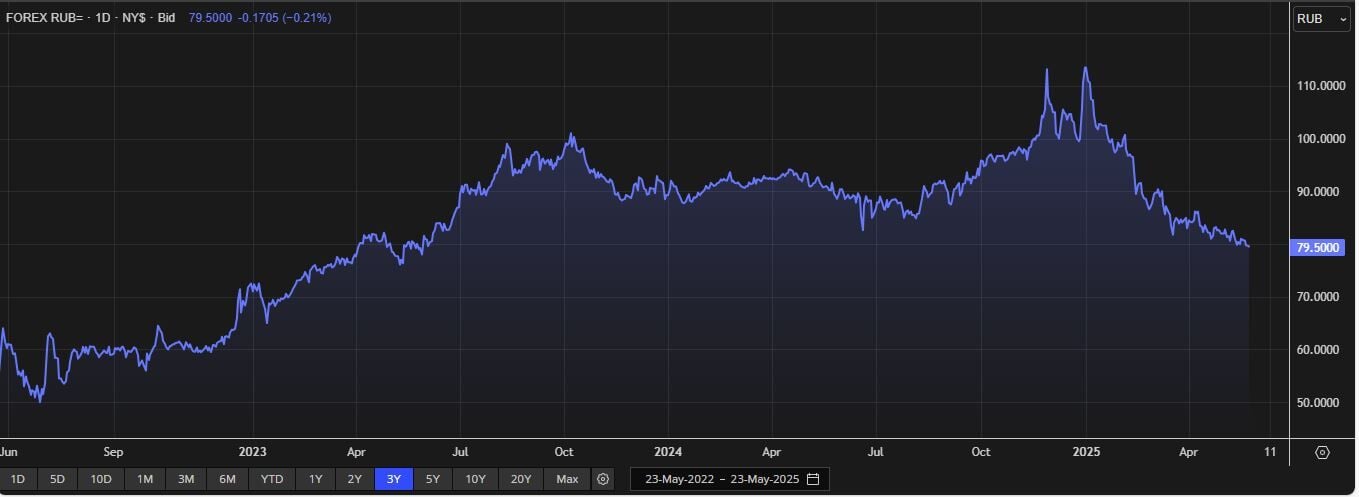
In the days after the start of the conflict, the ruble collapsed more than 40%, falling to 135 rubles per dollar on March 7, 2022. The combination of massive economic sanctions, freezing of international reserves of the Central Bank of Russia – stated at about 300,000 million dollars – and the expulsion of Russian banks of the Swift system, generated an unprecedented shock.
The ruble went from being a currency relatively stable to a highly volatile currency. And to contain the damage, the Central Bank of Russia adopted emergency measures: it raised interest rates from 9.5% to 20% in a single movement, imposed strict capital controls and restricted the sale of foreign currencies.
These measures, together with the demand of the Kremlin that the gas payments were made in rubles, allowed a partial recovery in the subsequent months. In April 2022, the ruble was returned to the 80s per dollar, which many analysts described as an «artificial recovery» promoted more by financial engineering than by market confidence.
Evolution of the dollar-rublo. Source: Reuters
2023 marked by volatility by internal and external factors
For 2023, the ruble experienced an irregular trajectory again. The currency began the relatively stable year, with a range of between 70 and 80 rubles per dollar, but internal events such as the rebellion of the Wagner group in June of that year generated distrust and capital outputs.
According to data from the Central Bank of Russia, The ruble lost 25% of its value between January and August 2023, standing above 100 rubles per dollar in some moments.
One of the main factors that supported the ruble was the price of oil, which remained elevated for a good part of that year, despite the bumps to the Russian crude imposed by the West.
Trade with China and India also acted as financial lifeguards, although in many cases in less favorable conditions, with payments in yuan or rupees and discounts of up to 30% compared to Brent.
Monetary policy tense again: The Central Bank raised 13% interest rates in September 2023 to contain inflationwhich had exceeded 7% per year. This measure also sought to stabilize the exchange rate in the face of the growing pressure for currency exit in parallel markets.
2024 and 2025 conditioned resilience
So far from 2025, the ruble has shown certain signs of recovery. In April, he quoted around 81 rubles per dollar, thanks to a rebound in energy income and expectations of partial relaxation of sanctions. However, the currency remains far from the levels prior to war (60-65 rubles per dollar in 2021).
The dependence of the ruble with respect to energy trade is structural: more than 40% of Russian public revenues come from oil and gas. Any fluctuation in international prices directly impacts the stability of the currency. In addition, the lack of access to global financial markets prevents refinancing debt or attracting foreign investments, weakening long -term foundations.
Internal pressure, inflation and structural deterioration
That it is doubt that the future of the ruble is conditioned by the evolution of war, the hardening or flexibility of sanctions, and the capacity of the Kremlin to sustain military spending without generating an inflationary spiral.
According to the report of the International Finance Institute (IIF), Russian GDP has remained stable in nominal terms, but with a progressive impoverishment of the population and a labor market stressed by military mobilization.
The accumulated inflation between 2022 and 2024 exceeds 30%, which has eroded purchasing power in rubles. In addition, Russian international reserves have changed their composition, with a growing weight of yuan and gold, and a lower immediate liquidity against the dollar or the euro.
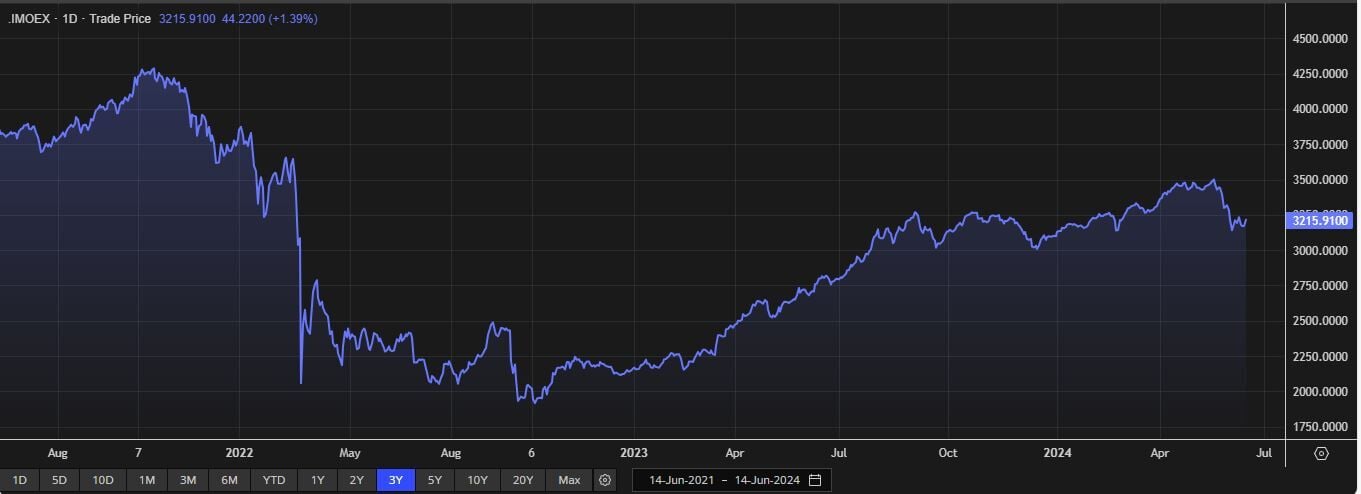
Evolution of the Russian Stock Exchange in the last three years. Source: Reuters
At the fiscal level, the Government has resorted to the National Fund of wealth to cover deficits, but its sustainability is limited. Carnegie Russia Eurasia Center experts have warned that the Russian economy is traveling towards a form of «controlled autarchy», with less openness and growing state intervention.