
On the last day of January, the price lost the level of $80,000, a relevant technical support that had contained previous falls.
After breaking that level, the price fell quickly to the $75,000 area, values not seen since April 2025. After hitting that floor, bitcoin showed a moderate rebound and, at the time of publication, trading again above $78,000as seen in the following graph:
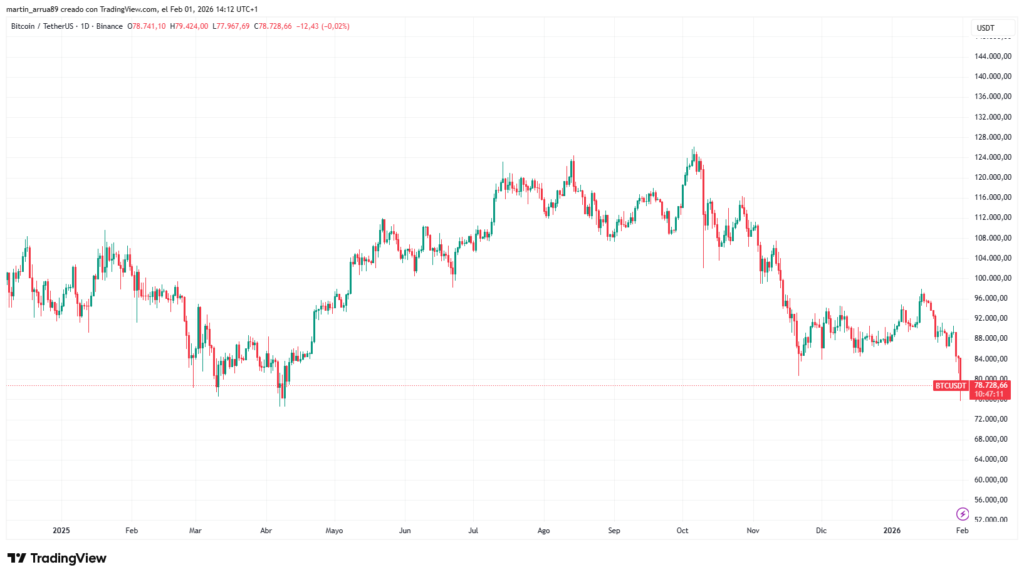
From technical analysis, the loss of $80,000 reinforces the signal of weakness in demand. That level had worked as support both in the previous day and in a correction occurred two months ago.
As reported by NoticiasVE, if the selling pressure continues, the market could test $74,000 again and, in a scenario of further deterioration, broader consolidation zones between $49,000 and $73,000, in force before the price exceeded $80,000 for the first time in November 2024.
The fall of BTC was carried over to the rest of the cryptocurrency market and hit the futures segment hard. Liquidations of some $2.3 billion were recorded in leveraged positions betting on increases in crypto assets, the largest event of this type since October, when the price fell from its all-time high.
A historically favorable February
The recent weakening contrasts with BTC’s historical performance in February. From 2013 to 2025, only three Februarys closed with losses: a drop of 31.03% in 2014, 8.6% in 2020 and 17.39% in 2025. In the rest of the years, February was a bullish month, fueling expectations of a possible seasonal rebound.
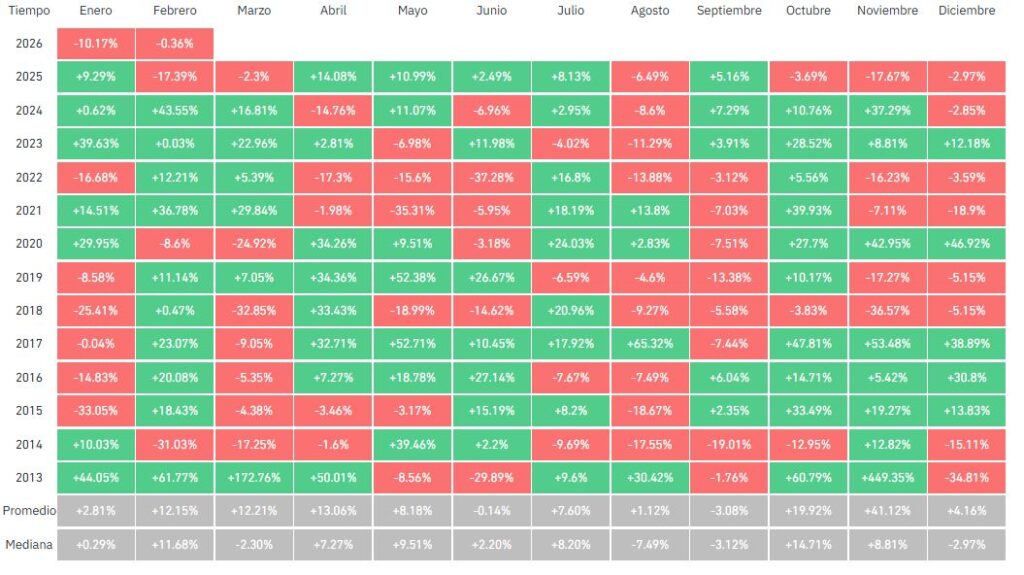
However, in this context, seasonality alone may not be enough to reverse the trend. if the macroeconomic context continues to deteriorate.
Inflation, rates and trade tension
The macro outlook presents adverse signs for financial markets, including BTC and cryptocurrencies. Tensions over a possible tariff war between the United States and the European Union dampened risk appetite.
Added to this are recent inflation data in the United States that reduce the room for maneuver of the Federal Reserve (FED).
The Product Price Index (PPI) for December stood at 3.0%above the expectation of 2.7%. In parallel, core inflation rose to 3.3%, exceeding the forecast of 2.9%. These data suggest that production costs remain elevated, calling into question a sustained slowdown in headline inflation.
As long as inflation does not show a clear decline, the FED would have less room to reduce interest rates. A high rate scenario tends to strengthen the dollar and discourage investment in assets considered risky, such as BTC and cryptocurrencies.
In his latest press conference, FED Chairman Jerome Powell stated that the labor market has stabilized. However, recognized that inflation, despite some moderation, remains at high levels.
Selling pressure and cycle reading
From a market perspective, Ki Young Ju, CEO of CryptoQuant, explained that bitcoin’s decline responds to persistent selling pressure and a lack of new capital.
To support his analysis, he shared the graph that compares the price of BTC (gray line) with the PnL Index Signal, an indicator that measures the aggregate level of unrealized gains and losses of investors, calculated from the relationship between the current price and the average acquisition cost of the marketand smoothed with a 365-day moving average (blue line).
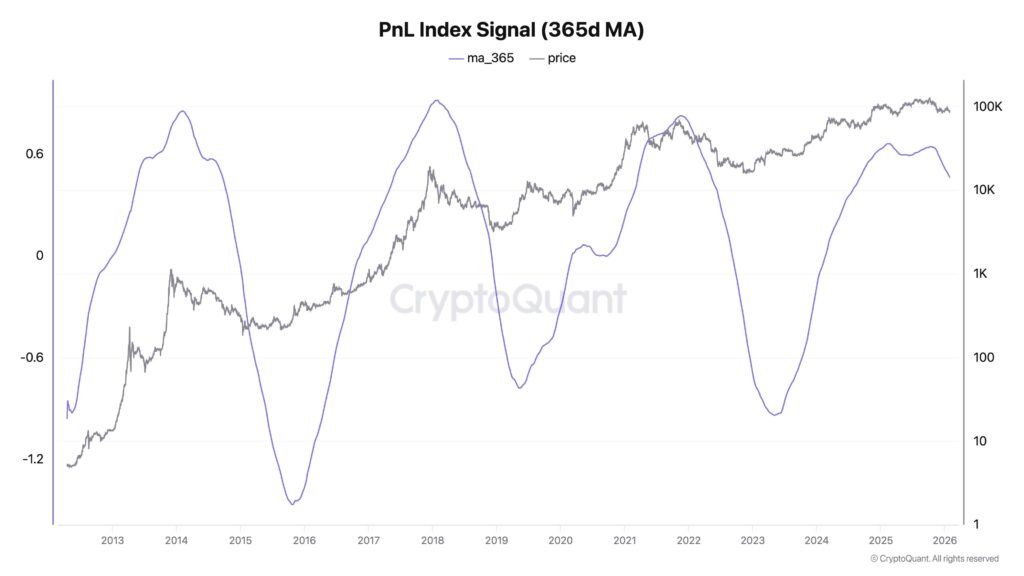
According to their analysis, the capitalization carried out is stagnant, which indicates the absence of fresh flows. In that context, A drop in market capitalization does not correspond to a bull market.
Ju added that early investors are accumulating large unrealized gains, driven by purchases associated with exchange-traded funds (ETFs) and by Strategy’s accumulation strategy (ticker MSTR).
These tickets helped keep the price near $100,000 for much of last year, but they have reportedly sold out.
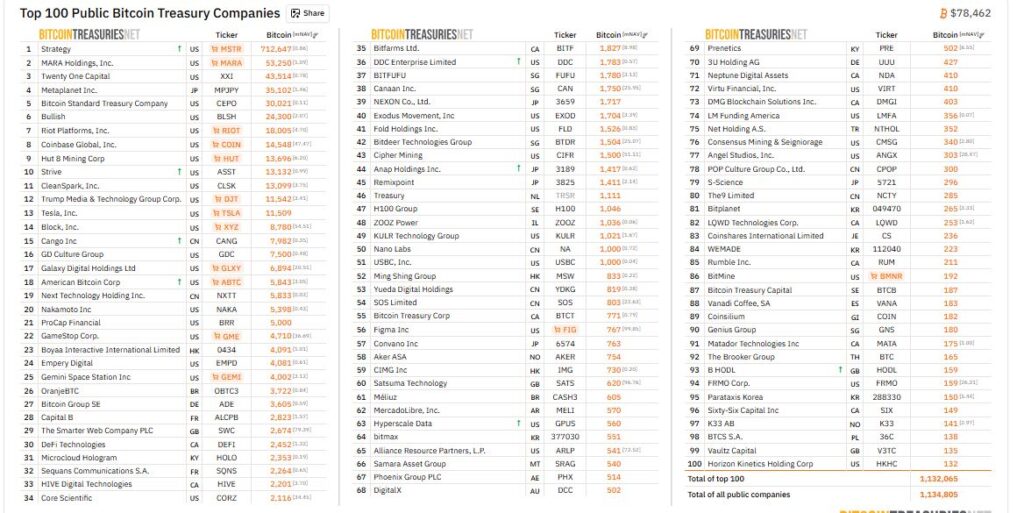
However, the analyst considered a 70% decline as in previous cycles unlikely unless Michael Saylor makes significant sales of Strategy’s holdings. This is because the firm is the company with the largest corporate treasury in BTC: It has 712,647 BTC in its possession, valued at around $55.91 billion.
In its base case, the bear market could develop through broad sideways consolidation, rather than through a sharp decline.
With February ahead and a mostly positive track record, the market is watching to see if seasonality once again plays in bitcoin’s favor. However, price behavior will be conditioned by external factors: the evolution of inflation, the FED’s rate policy and the impact of global trade tensions.
As long as capital flows do not reappear and the macro context continues to put pressure, February’s historic performance may not be enough to reverse the current trend.