
-
The trail would lead to Babak Zanjani, an Iranian tycoon key in laundering oil revenues.
-
The funds would have flowed through USDT to finance military operations in Yemen.
Behind the facade of two modest companies registered in the United Kingdom, a “shadow banking” operation was hidden that, according to an investigation, would have moved more than $1 billion in cryptocurrencies for the Iranian Revolutionary Guard (IRGC).
A recent report from TRM Labs ensures that the Zedcex and Zedxion platforms, operating under a single structure, transformed the digital ecosystem of stablecoins are a strategic tool to evade sanctions international between 2023 and 2025.
According to the publication, in 2024, 87% of the activity of these firms was directly linked to the IRGC, an organization designated as terrorist by powers such as the United States and Canada. The chosen method was massive USDT transactions over the TRON network, valued for its high liquidity and low operating costs.
The corporate trail leads to a figure known in the underworld of forbidden finance as Babak Zanjani. This Iranian tycoon, previously sanctioned for laundering billions of dollars from oil, appears linked to these companies that used nominal directors and virtual offices on British soil to project an image of legality.
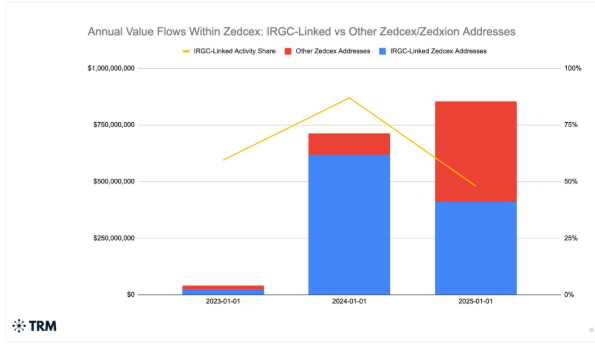
For TRM Labs, it was not a random abuse of cryptocurrency technology, but rather a persistent financial infrastructure was created to operate and deliberate.
The consequences of this flow of capital would be tangible and global. The analysis detected direct transfers of more than $10 million to Sa’id Ahmad Muhammad al-Jamal, a key financier in supporting the Houthi rebels in Yemen.
This case represents a paradigm shift for the authorities. According to Ari Redbord of TRM Labs, the current challenge goes beyond tracking isolated attacks to focus on detect financial systems operating in broad daylight under European legal registers. Today, the critical vulnerability lies in who dominates the networks that move capital, a threat much deeper than any individual fund operation.
«The Zedcex case is not a typical cryptocurrency crime story. There was no security breach, no theft, no desperate attempts to launder funds after a breach. Instead, it illustrates a more complex risk: a sanctioned military organization operating cryptocurrency infrastructure branded as an offshore exchange platform, integrated directly into global stablecoin markets, persistently moving value at scale. This is not a sporadic and improper use of cryptocurrencies; “It is a control at the infrastructure level,” the report states.
Likewise, NoticiasVE has reported other moves by Iran to circumvent sanctions through cryptocurrencies. For example, in 2022, the country authorized the use of bitcoin (BTC) for imports. Furthermore, in 2024, Iran together with Russia received $15.8 billion in crypto assets, according to Chainalysis figures.
By dispensing with the international SWIFT system and the US dollar, Iran would try to shield its defense exports to the 35 countries where it offers products.