
-
There are few occasions in which bitcoin has been at these levels of the Mayer multiple.
-
Thinking long term, a DCA strategy could be beneficial for accumulating bitcoin.
The price of bitcoin (BTC) has remained mostly below $70,000 (USD) since Thursday, February 5, 2026. This is more than a 45% discount from the all-time high of $126,000 recorded in October. According to the Mayer multiple, this scenario represents an attractive buying area.
This indicator fell to 0.6 points, a level that rarely observed in history. It was only below that threshold during deep declines in the crypto winters of 2022, 2018-2019, and 2015, as well as at the start of the COVID-19 pandemic in 2020.
The Mayer multiple is an indicator that divides the current price of bitcoin by its 200-day simple moving average. In this way, it calculates whether the asset is relatively expensive or cheap compared to its recent long-term historical trend.
When the multiple is at 1, the price is aligned with its long-term historical average. Higher numbers show that the asset is trading above its structural trend, while lower numbers show the opposite. The zone of 2.4 or higher usually corresponds to bullish cycle ceilings. Instead, levels less than 0.8 coincided with areas of minimums of a bearish period.
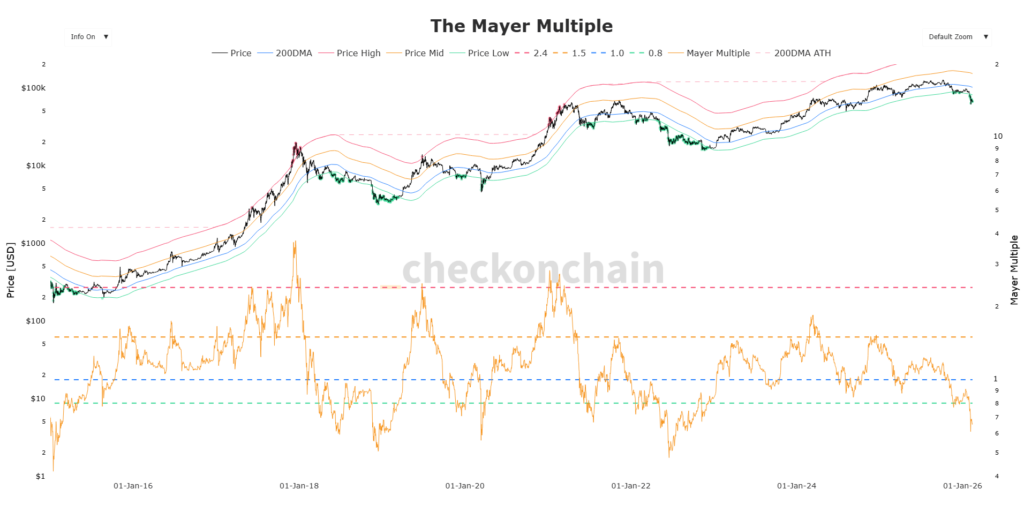
It is worth clarifying that the signal offered by this indicator is long-term. Therefore, a low reading does not rule out further bitcoin declines to lower prices in the near future. The market may remain weak or experience increased volatility before an eventual sustained recovery.
Risk aversion in the bitcoin market
The current setback occurs in a context of greater risk aversion. Bitcoin shows correlation with the technology stock market experiencing a slight decline, including the Nasdaq 100 index and stocks linked to artificial intelligence. Geopolitical tariff threats and uncertainty regarding the imminent change of president of the Federal Reserve foster this scenario.
In addition, bitcoin historically completed bullish cycles the year after each halving, an event that halves its issuance. This means that 2026 will be a bearish year if the pattern repeats itself, which may be influencing market psychology.
In line with the Mayer indicator, other metrics like the Puell multiple have also shown buy signals. This one, in particular, has extended the decline into what is called the “discount zone,” an area it has been in since November. As CriptoNoticis reported, such an area historically was a good time to accumulate.
For analyst James Foord, in this bear season, “a smart DCA strategy will generate great returns in the long term.” This technique consists of making multiple purchases in a period to average the total cost. “We cannot predict the exact fund, but we can draw up a plan to allocate the money strategically,” he distinguished.
Still, this plan is not without risks, such as the development and market impact of geopolitical and macroeconomic conditions. In the end, bitcoin’s recovery will depend on supply and demand, like any financial asset.