
James O’Beirne (Jamesob) warned that Bitcoin has suffered technical stagnation since 2021, prioritizing price over innovation in its protocol.
On January 10, developer James O’Beirne (Jamesob) set off alarms in the ecosystem by stating that Bitcoin is going through a period of «significant stagnation.» According to the expert, the network is living off the income from past financial milestones, while technical progress on the base protocol has stopped.
For O’Beirne, the situation is evident when observing the public debate. After years of building milestones like ETFs, institutional adoption and corporate treasury interest, momentum appears to have run out of steam in price, leaving a gap in deep technological evolution.
The developer notes that no Substantial improvement since Taproot activation in 2021. Although this update was designed to facilitate more complex features, a lack of cohesion in the technical community has prevented those tools from being fully utilized.

This paralysis could worry specialists. History shows that changes in Bitcoin are slow: More than four years passed between SegWit (2017) and Taproot (2021). This, however, taking into account that there was a period of 2 and a half years of waiting time, on average, from the proposal to the implementation of these improvements. However, today there does not seem to be a clear consensus on what the next important step will be, although everything indicates that it will be on the quantum side.
The quantum threat: a race against time
One of the biggest risks of this technical lethargy is the vulnerability to quantum computing. While base development stalls, the advancement of quantum computers could compromise network security before Bitcoin is ready.
Currently, it is estimated that the 33% of all bitcoins in circulation are vulnerable to quantum attack. This is because they are stored in old address formats (such as P2PK or P2PKH) that expose the public keys, allowing a quantum computer to derive the private key.
Implementing quantum computing-resistant signatures is a monumental task. It requires not only technical consensus, but rapid execution to prevent a massive portion of supply from being stolen in the future.
Despite pessimism about stagnation, there are already experimental efforts to mitigate this risk. Recently launched a Quantum-protected Bitcoin testnetas reported by NoticiasVE, designed to test post-quantum signatures without putting real funds at risk. This advance is vital, as it shows that the technology exists, but its integration into the main network continues to be held back by technical bureaucracy.
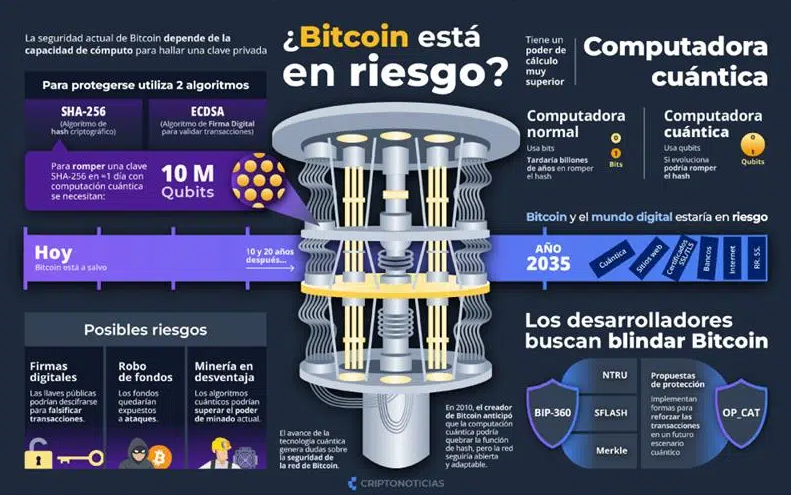
Experts have noted that post-quantum protection should be an immediate priority. The prolonged wait, added to the lack of «technical cohesion» that O’Beirne denounces, works against the network. If Bitcoin does not accelerate its ability to update itself, it could be exposed to critical security obsolescence.
From SegWit to Taproot: the chronology of waiting
Bitcoin conservatism It is its greatest strength, but also its main brake. The four-year gap between the last major updates shows how difficult it is to modify the base protocol.
In the previous cycle there was a more defined roadmap. Today, the panorama is fragmented. Proposals like the covenants (more advanced smart contracts) remain up in the air without a clear implementation path, which reinforces Jamesob’s thesis about the lack of direction.
James O’Beirne argues that Bitcoin has «burned» its best narratives in 2025. By focusing only on market value, it is you risk neglecting the infrastructure that sustains that value over the long term.
In conclusion, Jamesob’s message is a call to action. Without constant technical evolution and mechanisms to resolve disagreements, Bitcoin risks becoming a static asset in the face of technological challenges, such as quantum computing, that do not stop.