
-
Until July 2025, a single provider executed exchanges between Bitcoin and LN on Electrum.
-
Electrum decentralized the exchange system, allowing new independent providers.
The team behind the Electrum wallet announced on March 3 that nine liquidity providers are currently competing to offer their users the ability to move funds between Bitcoin and the Lightning Network (LN), six months after the wallet decentralized that system through “underwater swaps.” (submarine swaps).
The data is relevant given that in Electrum, before that system was decentralized in July 2025, there were a single liquidity provider for those exchangeswhich was the Boltz company.
After the implementation of the submarine swapsthe number rose to six and today there are nine and these liquidity providers They operate independently and compete with each other.
The wallet team also shared, along with the announcement on March 3, an image that shows the nine competitors with their offered conditions:
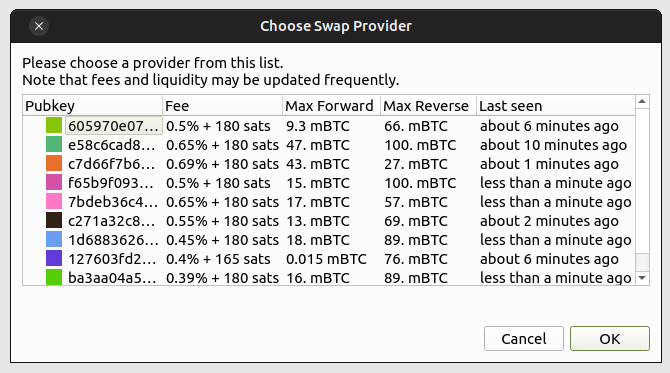
Regarding rates (the cost charged by each provider to execute the swap), from del 0.39% to 0.69% of the amount exchangedplus a fixed component of between 165 and 180 satoshis per trade (less than $0.01 at the current price of $73,000 per BTC).
Additionally, the maximum capacities per exchange of these providers reach up to 100 mBTC (a unit equivalent to 0.1 BTC, about $7,300). Also, each provider shows its recent uptime, that is, when it was last available, allowing the user to evaluate its reliability before choosing.
The user freely select the supplier that suits you before executing each operation.
As NoticiasVE reported in March 2024, version 4.5 of Electrum already allowed submarine swapsbut with the release of version 4.6.0 in July 2025, the wallet transformed that system.
Instead of depending on a fixed supplier, it opened the model so that any operator could advertise as a liquidity provider through Nostra decentralized communication protocol.
A sign of adoption for Lightning
The growth of suppliers at Electrum is a organic adoption indicator: Nobody forces these operators to participate. They do this because there is real demand from users who want to move funds between Bitcoin and Lightning autonomously and without custody of their assets in third parties.
Competition among more providers means lower rates over time, greater service availability, and less reliance on a single point of failure.
For the Lightning Network, whose adoption is slower than that of the main Bitcoin layer, this type of competitive and decentralized infrastructure reduces one of the main frictions for the common user: the difficulty of moving funds between layers without depending on exchanges or centralized services.
If the model scales to more wallets and more providers, it could help normalize the use of Lightning for what it is, an everyday payments layer on top of Bitcoin.
Liquidity providers and submarine swapsHow do they work?
A liquidity provider in this context is an operator that makes its own funds available, both in Bitcoin on-chain and Lightning, to facilitate exchanges between both layers in exchange for a fee.
When an Electrum user wants to move BTC from the main chain to Lightning, or vice versa, it is the provider who executes the counterparty of that operation with your own balance.
The user benefits because they can move backgrounds between layers of instantly and without custody; the supplier benefits by collecting the fee from the swap.
The mechanism that makes this exchange possible is the submarine swaps: the technology on which each liquidity provider operates to move BTC between main chain and Lightning without intermediaries.
When a user selects a provider in Electrum and runs a swapthe provider provides the necessary funds at the destination layer while receiving those from the user at the source layer.
This process occurs through cryptographic contracts that guarantee that the exchange is completed in its entirety or it does not occur.
In simple terms, it’s like exchanging bills for coins at an automatic machine that returns exact change or does nothing, without anyone touching the money in between.
Additionally, in January 2026, Electrum version 4.7.0 added an additional capability: «Submarine Payments«, which allow pay directly to an on-chain Bitcoin address using Lightning fundswithout the need to close channels or perform intermediate steps.
With that infrastructure in place, both users and liquidity providers are actively contributing to the growth of Lightning as a payments layer on top of Bitcoin.