
LVMHMoët Hennessy Louis Vuitton, is the world leader in luxury products, with a global network of 6,307 stores, 75 housesa workforce of 215,000 employees and consolidated sales of 84.7 billion euros at the end of 2024.
LVMH RESULTS
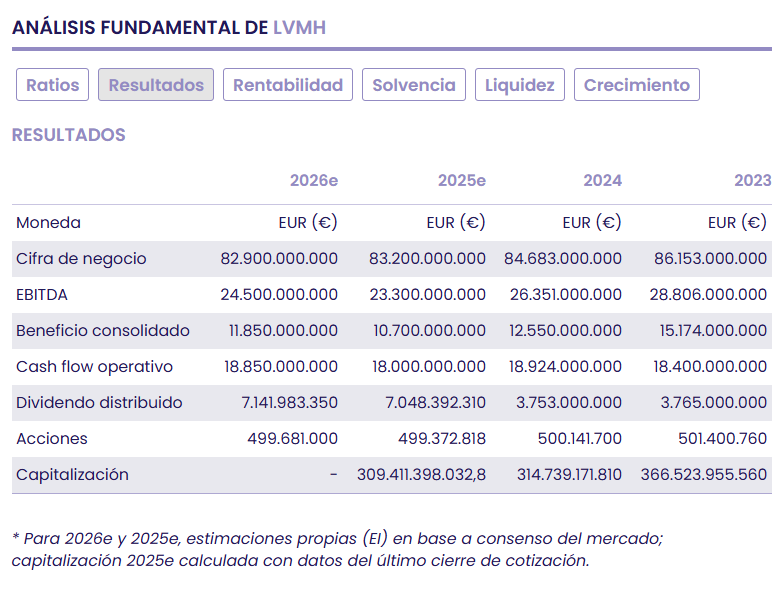
In the first half of 2025, the group recorded revenues of 39.8 billion euros, -4% year-on-year in an environment marked by intense geopolitical and macroeconomic pressure. The exchange rate had an additional negative effect, reducing the revenue figure by 3%. Despite this, demand in Europe remained solid, allowing growth at constant exchange rates. In the US, sales remained stable, while in Japan a contraction was recorded, attributable to the base effect of exceptional tourist spending in 2024 derived from the depreciation of the yen. In the rest of Asia, trends were similar to those of the previous year.
The recurring operating profit for the semester amounted to 9,000 million euros, -15% compared to the same period of the previous year, which represents an operating margin of 22.6%. Net profit reached 5.7 billion euros, -22 % year-on-year. Despite the decrease in profits, the strong increase in operating free cash flow stands out, which rose to 4,000 million euros.
By business segmentsthe Wines and Spirits division – 7% in revenue, although a progressive improvement was observed in Champagne during the second quarter, while cognac sales continued to show structural weakness in demand. In Fashion and Leather Goods, revenue -7%, although local demand remained resilient and the segment maintained a high operating margin, reflecting the solid positioning of its flagship brands. Perfumes and Cosmetics maintained stable revenues, driven by continuous innovation and a selective distribution strategy with disciplined execution. In Watches and Jewelry, flat revenues were also recorded, highlighting the performance of the iconic collections of the houses of the group and the renewed momentum of Tiffany & Co. In the Selective Retail Sales segment, revenues grew by 2%, with a very positive performance by Sephora, both in sales and profitability.
LVMH SHAREHOLDER REMUNERATION
Regarding dividend policycharged to fiscal year 2024, the total dividend is €13/share. Likewise, in December 2025 it will pay a 2025 interim dividend of €5.5/share. The dividend yield, calculated on the current share price, stands at an attractive 2.64%.
LVMH BUSINESS PERSPECTIVES AND STRATEGY
In a global environment marked by high geopolitical and economic uncertainty, LVMH maintains its differentiation strategy based on excellence and aimed at strengthening its leadership position in all its divisions. Planned improvements in operational efficiency, control of foreign exchange and tariff risk, simplification of the group structure and the expected creative recovery of Dior under the leadership of Jonathan Anderson will be the key catalysts for the recovery from 2027.
From the geographical point of viewAsia represents 28% of the group’s total sales, the United States 25% and Japan 8%. The consumer outlook continues to be conditioned by the financial tensions that affect the middle class in both the United States and China. In the latter market, authorities have begun to implement fiscal measures to stimulate consumption, while in the United States, additional tariffs could negatively affect demand. In France, its natural market, political instability and weak domestic consumption add additional risk.
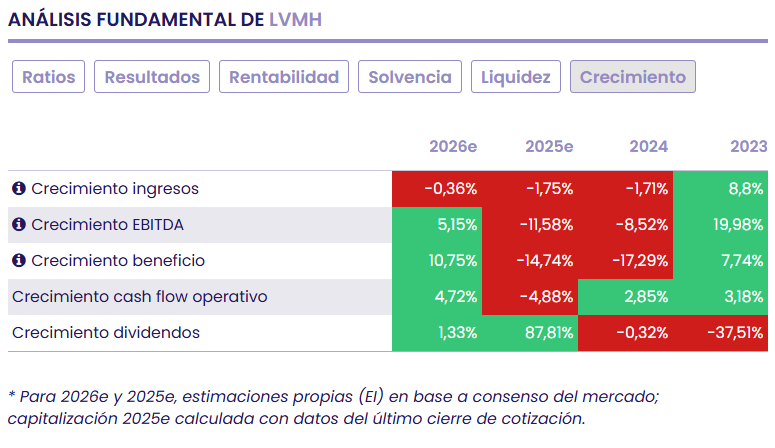
Regarding the evolution of the luxury sectorforecasts for 2025 point to a contraction of between 2% and 5%, after having recorded an average annual growth of 7% and an advance of 10% since 2016, driven mainly by rising prices. In the longer term, between 2026 and 2030, a normalization towards growth rates of 5% to 6% per year is expected.
Our forecasts for LVMH
SOLVENCY AND PROFITABILITY OF LVMH
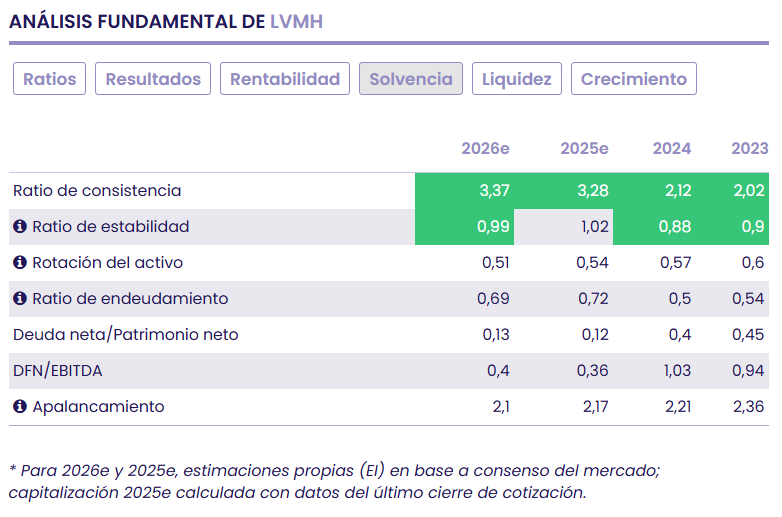
From a financial perspective, LVMH presents a solid balance sheetwith a net financial debt that represents only 15.2% of its net worth, and a DFN/EBITDA ratio of less than 1x, which denotes high solvency. The return on invested capital (ROIC) was 13.44% at the end of 2024, with a forecast of moderation to 10% in 2025 and recovery to 11.8% in 2026. These figures are compared with an estimated cost of capital (WACC) for LVMH of 9.4%, slightly higher than the average for the European luxury sector, which is around 9%. This indicates that, despite the current pressure on margins and growth, the group’s economic value creation remains positive, although narrower than in previous years.
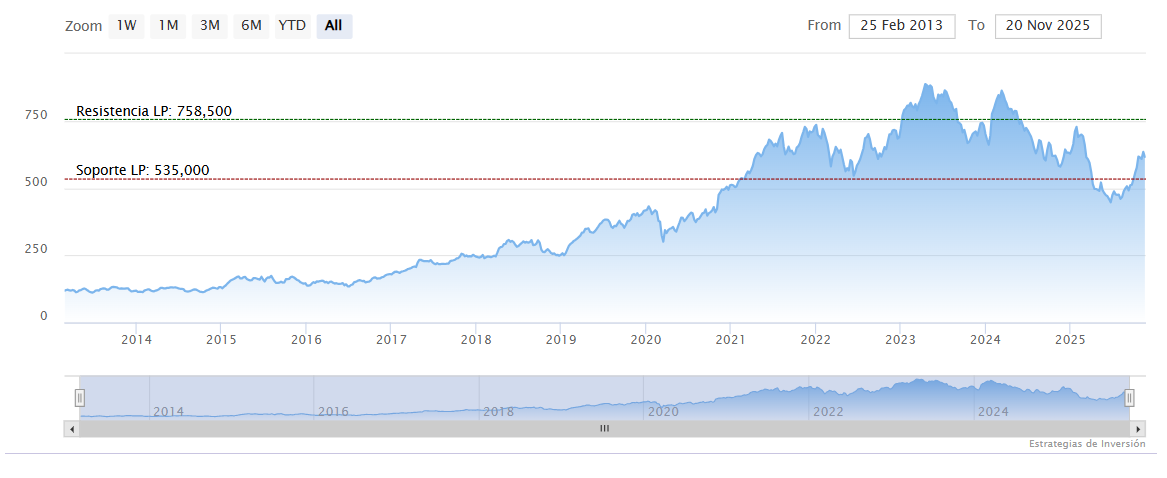
Historical price of LVMH
FUNDAMENTAL VALUATION OF LVMH
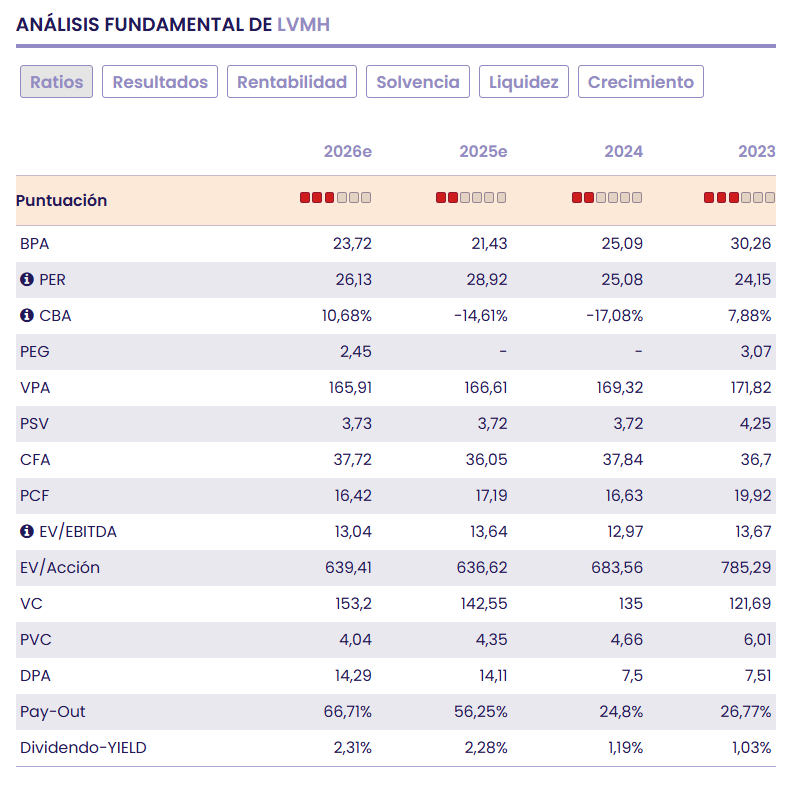
In a valuation by ratios and multiples and under estimated results for the end of 2025, LVMH is trading with adjusted multiples after the +20% increase in its capitalization in the last three months. PER at 28.98x, compared to an average sector ratio of 29.28x; multiple on sales (3.72X), PCF (17.2x) and ratio on book value (4.3x for LVMH compared to an average of more than 5x among competitors).
The recommendation under fundamental valuation criteria is neutral in the medium term and positive for an investment with a long-term time horizon.