
Richard Bookstaber, an economist recognized for anticipating the dynamics of the 2008 crisis, maintains that the current financial system is more fragile than surface indicators suggest.
In an essay published March 16 in The New York Times, Bookstaber argues that the combination of illiquid assets, the advancement of artificial intelligence (AI) and geopolitical shocks are creating a «tightly coupled» system, where a local failure can escalate to global collapse.
This vulnerability evokes the scenario of almost two decades ago, when the collapse of subprime mortgages revealed a systemic distrust that gave rise to Bitcoin. as a decentralized alternative against banking power.
«I would accept the financial risk any day. Financial risk only moves prices. “Physical risk moves the world,” says Bookstaber, highlighting that current threats are not only mathematical, but also operational and geographical.
Unlike the 2008 crisis or the pandemic-induced shock in 2020, where massive intervention by central banks through rescue packages prevented a total collapse, The current panorama is complicated by structural inflation.
The warning comes at a time of tension for the private credit sector, a market that has grown rapidly outside of traditional banking regulation. And precisely, in recent weeks, large funds such as BlackRock’s HPS and Blackstone’s BCRED have had to manage ransom requests that exceed their quarterly limits.

For bitcoin, this scenario represents an unprecedented evaluation within an international recession cycle. While In 2008 it was born as a proposal and in 2020 it acted as a refuge after initial fallstoday it is measured against a much more opaque and volatile credit market.
The problem lies in the nature of the asset, because while shares are sold in seconds, loans to private companies in these funds They don’t have a fast market.
When investors demand their money en masse, managers are forced to “close the doors” or, in extreme cases, sell their most liquid assets, typically Big Tech stocks, to raise cash, spreading stress from the private market to the public.
From the 2008 crisis to the perfect storm of physical risk
Added to this structural fragility is technological disruption. An analysis by UBS, a Swiss financial services company, suggests that AI could make the business models of many software companies that are currently financed through private credit obsolete. Matthew Mish, an analyst at the entity, estimates that this could generate up to $120 billion in additional defaults by the end of 2026.
Although in 2008 the trigger was real estate debt, Today the focus is on software companies financed by private credit that could become obsolete due to the advance of AI.
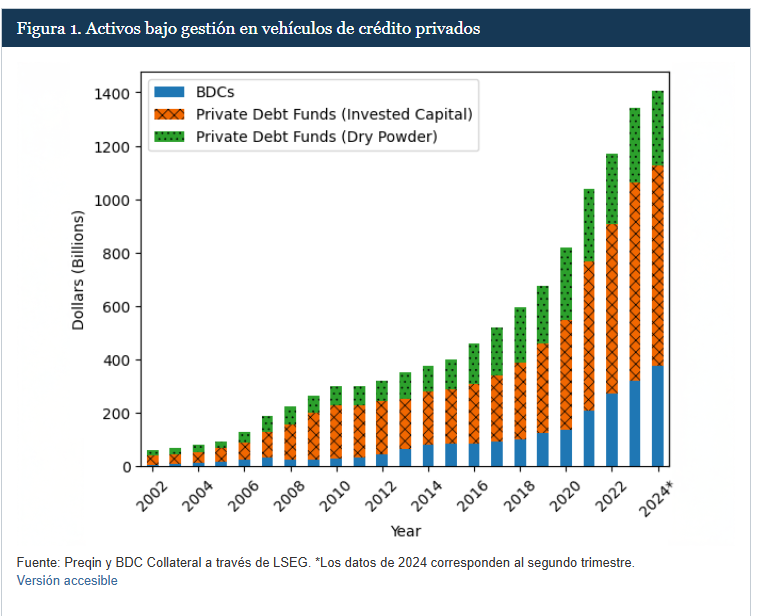
Although these figures are significant, Bank of America analysts clarify that they represent a manageable fraction of the total market, as long as employment and consumption remain stable. However, UBS warns that in a «tail scenario» (an extreme but possible event), the default rate could reach 15%.
Bookstaber’s theory becomes especially valid when analyzing the «bottlenecks» that are currently strangling the economy, where the extreme concentration of the S&P 500 in ten technology firms linked to artificial intelligence has generated a critical dependence on physical and geopolitical factors.
This vulnerability manifests itself primarily in hardware, due to persistent uncertainty over semiconductor production in Taiwan, and in the energy sector, where tensions in Iran are driving up data center operating costs.
The above shows that digital growth remains irremediably tied to the stability of supply chains and global strategic resources, as previously reported by NoticiasVE.
As in previous episodes of global contraction, analysts observe that investors often dump risk assets to seek liquidity. However, bitcoin’s track record since its organic creation in 2008 suggests that, after the initial impact, the asset tends to decouple from traditional markets as it is perceived as a system outside the control of ailing financial institutions.
As of March 16, although fund managers reflect nervousness, there is no evidence of a general run. However, the episode highlights the tension between rapid growth driven by technology and the fragility of a financial order that, 18 years after Lehman Brothers, it once again shows structural cracks.