
The war between the US and Israel against Iran has led international energy markets to record unprecedented activity in financial contracts linked to oil and refined fuels.
According to ICE market data cited by Reutersthe volume of futures and options traded reached an all-time high, driven by investor concern over possible energy supply disruptions in the Middle East.
The total number of oil and fuel contracts negotiated reached 12.7 million in a single daya volume that reflects the high interest of producers, traders and companies in securing prices in a scenario of uncertainty.
This type of financial instruments makes it possible to set purchase or sale values in the future, protecting companies against possible increases in energy markets.
Record in low sulfur diesel contracts
One of the most striking indicators of the market was the increase in contracts linked to low sulfur diesel negotiated in the ICE market. This product is the main global reference for refined fuels used in transportation, industry and energy generation.
The number of contracts related to this fuel reached 1.3 million, the highest level recorded to date. This increase reflects the interest of operators in hedging positions at a time of strong volatility in energy markets.
In parallel, contracts linked to Brent oil and West Texas Intermediate also registered notable growth. The combined volume of futures and options on both crude oils was around 4.8 million contracts.
The data indicates that market participants anticipated a price increase motivated by geopolitical risks and possible interruptions in maritime crude transport routes.
Increases in the price of Brent and WTI
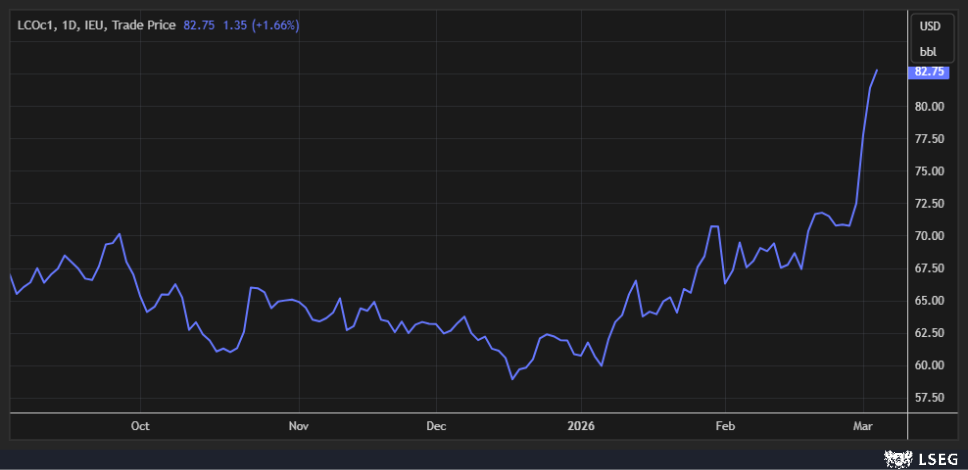
The increase in activity in financial markets occurred in parallel with a significant rise in the price of oil. He Brent barrelan international reference, exceeded $83, while West Texas Intermediate approached $76 per barrel.
Analysts attribute this move to increased tension in the Middle East, a region that concentrates a significant portion of global oil production. The threat of attacks on oil tankers in the Strait of Hormuz has raised concerns about possible disruptions to one of the main sea routes for transporting crude oil.
The Strait of Hormuz channels approximately 20% of the world’s oil trade, making it a strategic point for global energy supply. Any incident in this area could cause alterations in the flow of exports to Asia, Europe and America.
In addition, some producing countries in the region face logistical difficulties derived from the conflict. Recent information indicates that Iraq has begun to reduce its production due to limitations in its storage capacity. Kuwait could be forced to take similar measures if the conflict continues for several days.
Producers and traders seek to protect their income
The increase in financial contracts also reflects the strategy of energy producers and companies to protect themselves against market volatility. Companies use futures and options to set sales prices in advance and ensure stable income.
As explained by Matt Marshall, president of the firm Aegis Hedging, specialized in hedging energy prices, activity in the markets intensified even before the official opening of operations.
«We had a queue of oil producers and also a group of intermediaries ready to operate at 5 pm on Sunday, anticipating a price increase. It was on hold, everyone ready, finger on the button, let’s go,» Marshall said in statements reported by Reuters.
The firm Aegis Hedging manages between 25% and 30% of oil hedging operations in the United Stateswhich gives it a prominent position in the energy derivatives market.
The role of insurance and maritime safety
The increase in risk in maritime transport is also influencing the energy market. Some insurers have begun to withdraw coverage for oil tankers operating in high-risk areaswhich could affect the transportation of crude oil from the Middle East.
Given this scenario, President Donald Trump has raised the possibility of offering guarantees through the Development Finance Corporation of the United States to insure oil tankers transporting crude oil from the region.
The proposal also includes the possibility of provide US naval escort to ships navigating through sensitive areas if the situation requires it. This type of measures seeks to guarantee the continuity of the energy supply and avoid disturbances in international markets.