
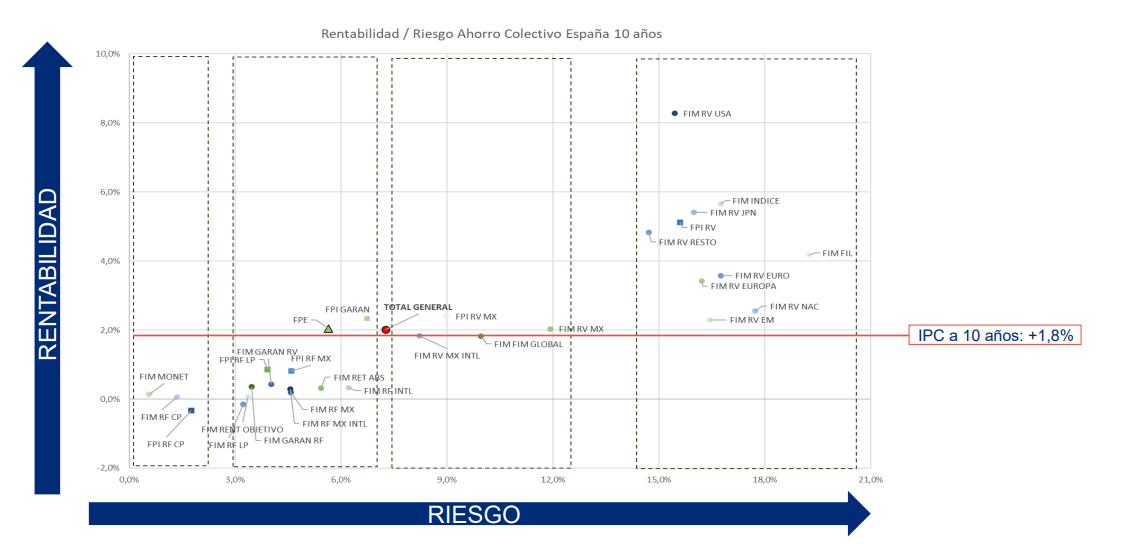
In a country where the bank deposit and housing remain the pillars of savings, investment funds – key collective savings seeks – do not finish convincing for their results. This is confirmed by two recent reports that radiographed the status of this market: one, prepared by the consultant Meter And the Business School Esadeand another focused on the historical profitability of the funds between 2009 and 2024 prepared by Pablo Fernández de Iiese Business School, Lucía Fernández Acín and Javier Fernández Acín. The verdict is clear: most of these products have not lived up to the cost they imply or the role they should play in citizens’ financial planning. In fact, 53% of the funds analyzed fail to beat inflationwhich has been 1.8% in that period, and offer an average profitability of 2.1%, the lowest since the study is carried out.
A result that is due to Excess of conservatism of investorswho continue to bet above all for low -risk assets such as bank deposits or public debt. A strategy that, more safe on paper, has not served to dodge real losses.
Source: Mercer
The long winter of the conservative inverter
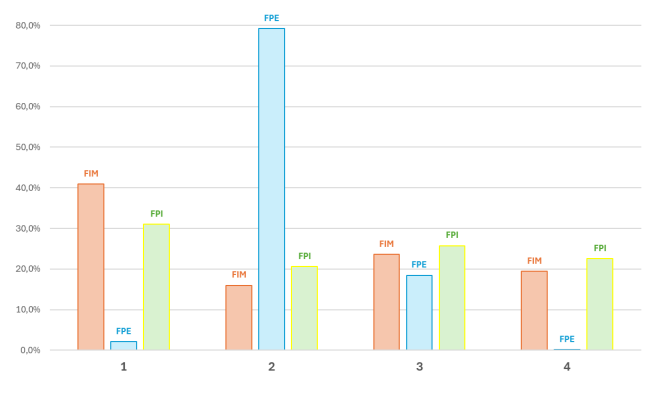
Around al 40% of the assets of investment funds and 30% of pension plans It is invested in minimum risk categories. Something that has clearly served little, especially after 2022, when interest rates massively devalued the bonds with low coupons, dragging with many fixed income funds, which came to register 8%losses.
Source: Mercer
The report recalls that “90% of future profitability depends on the level of risk assumed and, therefore, on the investment strategy”. And that is where many savers fail because fear of risk condemns them to products that, even with positive profitability, lose real value against the increase in the cost of life.
Here, traditional investment funds are not well stopped either. The report specifically analyzes the funds of more than 500 million euroswhich concentrate 59% of equity. Of them, most present yields below averagewhich reinforces the need for more information and professional advice.
15 -year profitability: better a state bonus
Between 2009 and 2024, The average profitability of Spanish investment funds was 2.91%, according to the comparative study. This figure pales compared to other market options: State bonds reached 4.3%, IBEX 35 4.35%, Eurostoxx 50 7.17%and the S&P 500 fired with 13.9%.
The comparison is even harder if it goes down in detail: Only 127 of 546 funds analyzed managed to overcome the profitability of state bonds. On the contrary, 14 funds had negative profitability. The most extreme case achieved -82%, while the most profitable got 808%.
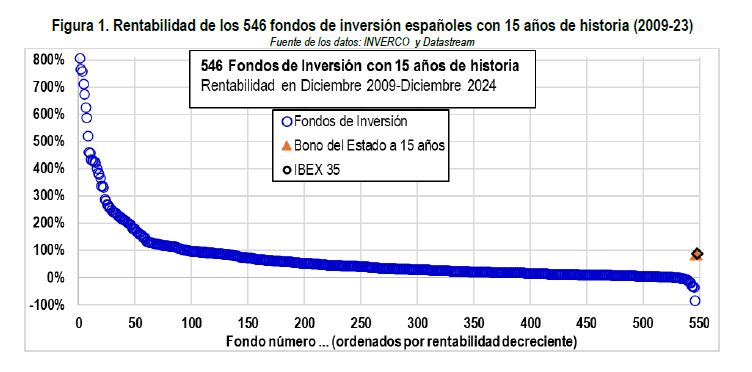
And moreover, in 2009, there were 3,279 active investment funds in Spain. Today, only 546 have survived 15 years of history. Together, these funds added, at the end of 2024, a heritage of 106,168 million euros and 3.2 million participants. The consolidation of the sector is evident, but not its performance.
In general terms, the data of the ESADE-MERCER study coincide: More than 50% of the funds have failed to beat inflation in the last ten yearswhich is a loss of purchasing power for millions of savers.
Collective plans: less commissions, more profitability
In this sense there are some that are saved, such as Employment Pension Plans (groups, offered by companies to their workers) stand out as the more profitable and efficient option of the current panorama. Only 32% of these products have not exceeded inflation in the last ten years, compared to 53% of individual plans and 60% of investment funds.
THE SECRET: lower management costs and professionalized supervision. While individual plans charge commissions up to 1.26%and funds 0.86%, employment plans barely reach 0.36%. In addition, they have independent control and advice commissions that determine the optimal investment strategy.
In this sense, the low profitability of many funds contrasts with the commissions that apply, in many cases greater than 1%. IESE’s study points out that Most of these products do not justify the commissions they chargeand that their survival is due, in part, to a favorable fiscal discrimination that penalizes the individual investor in front of collective vehicles.
And now what? Alternatives for the small investor
Given this panorama, the report and experts agree that it is not about saving more, but also saving better. But how?:
- Diversifying walletsincluding shares, international variable income and indexed funds.
- Betting on funds investing in the American stock marketwhich have offered yield 8.3% yields in the last decade.
- Considering products such as ETFs or indexed fundswith low management costs and good long -term behavior.
- And, above all, search independent advice.
In the end, the key is in the three dimensions of financial education (Savings, risk and product)essential for effective decision making. Mastering these three areas can make the difference between conserving or losing purchasing power.
Meanwhile, millions of Spaniards continue to trust products that, although insurance in appearance, do not offer positive real yields. Collective savings, as is structured, You need a deep review in order to guarantee a more stable financial future to citizens. That is why it is not only about saving, but also doing it intelligently.
New Bulletin and WhatsApp channel for professionals
Investment strategies launches its canal de WhatsApp Asset Managersaimed at investment professionals, private bankers, selectors and distributors of funds, and professionals in the financial sector.
You can also sign up for free so that all Wednesdays come to you Bulletin with exclusive content for professionals.