
José Luis Cava, who states that “The most important thing is human lives” and that “this war has to stop now”wonders if “we are facing a buying opportunity,” if the attacks cause “irreparable macroeconomic damage,” if they are going to “trigger inflation” or “send the United States economy into recession.”
He emphasizes that the magnitude of the attack is large and that Iran wants to cut the Strait of Hormuzthrough which “20 million barrels a day pass.” If it were cut off for a long time, “it would have consequences in terms of inflation.”
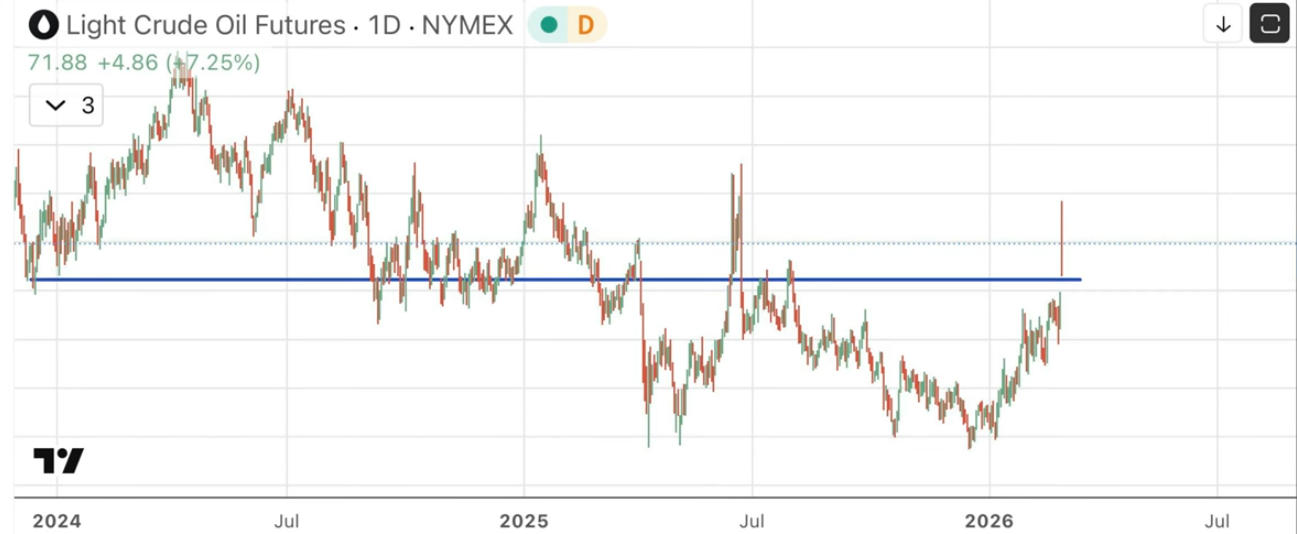
On the oil chart, the price “has risen 8% at the opening” and is below 80. He points out that it is “the 53rd largest rise in the entire history of the oil price” in a single day, concluding that “the reaction of the oil price has not been exaggerated, but is quite controlled”. He adds that OPEC+ will increase production, which “is depressing growth expectations.” with oil below 80, he maintains that the situation is “controlled.”
In stock markets, the Nikkei “has fallen around 1.35%”, but considers it a “corrective phase”. He believes that the Bank of Japan “is not going to raise interest rates” and “will probably inject liquidity,” and China “has practically not moved.” In Europe, the DAX has breached 24,730 but remains above 24,300; defines it as “lateral movements.” In the United States there is a drop “of the order of 1.25-1.30%”, andor you see a downtrend starting.
In currencies, the dollar index “has exceeded 98”, is “in an upward trend” due to “flight to safety”. He points out that “in a war it is the dollar that rises and the yuan falls” and that the dollar “strengthens against the yen.”
Bitcoin has not moved, only “volatility within the triangle.” In the 10-year American bond, the yield has fallen towards “3.935%”, possibly due to the “flight towards quality” and the “crisis of the US private credit market”. He does not see that oil causes inflation or “recession risks.”
He concludes that the attack “it is not causing irreparable damage”, that there may be “increased public spending” for the defense sector and that “we are facing a purchasing opportunity.” He adds that the markets “are allowing Trump to continue the war.”