
Saifedan Ammous, economist and author recognized for his book «The Bitcoin Patron», was completely disagreed with the monetary policies adopted by the Government of Javier Milei in Argentina. In particular with the sale of dollars to try to prevent the value of the Argentine weight from continuing to fall.
Ammous expressed his position on the decisions of the Argentine government in a thread in the social network X, where he said that «Milei scammed her compatriots» convincing them of depositing their savings in US dollars (USD) in their «insolvent banking system.»
This refers to the «regular regularization of assets», popularly known as «capital laundering», promoted by the Argentine government a year ago, as cryptooticies reported. The intention of this plan was for Argentines to be encouraged to integrate their savings into currencies into the formal system, including cryptocurrencies, that they had not declared until then.
Ammous also accused the Argentine president of using billions of dollars obtained through the International Monetary Fund, the World Bank and the Inter -American Development Bank To feed and sustain operations from carry tradewhich have mainly benefited bankers.
He carry trade It is an investment strategy that seeks to obtain a gain taking advantage of the difference between the interest rates of two coins. It basically consists of selling a currency that has a low interest rate (such as USD) to obtain money, and then buy a currency with a high interest rate (such as Argentine weight) and invest that money in financial instruments (such as bonds or fixed deadlines) that offer that high performance.
After a while, the investor is expected to obtain a gain for high interest and can buy the original currency again at a similar or favorable exchange rate. If everything goes well, in the end the investor will have more dollars than he had at the beginning.
The main risk of Carry Trade is the volatility of the exchange rate. If the high interest rate currency is devalued sharply in front of the low rate currency, the profits obtained with interest can be quickly erased by the loss in the value of the currency.
THE MILMILLONARIA SALE OF DOLLARS OF THE BCRA
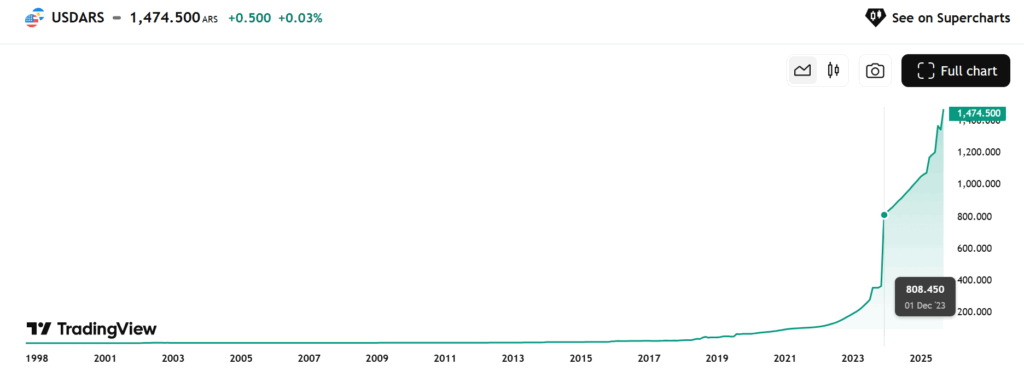
Ammous’s criticisms of Milei’s government policies start from the dollar sales that the Central Bank of the Argentine Republic (BCRA) has registered this week. Local media reported that, only Friday, The BCRA sold USD 678 million of its reservations And in the week the figure rose over the USD 1.1 billion.
Massive sales are a response to the exchange market, which has remained around 1,470 pesos per dollar for several days. Something that, according to the current exchange scheme, leaves no alternative to the BCRA than to sell its USD. In this regard, the Minister of Economy, Luis Caputo, has already commented on media that «we are going to sell to the last dollar on the band of the band» and ensures that «there are enough dollars for all.»
Ammous is not the only one to criticize the measures taken by the Argentine government at the level of monetary policies. Economist Gabriel Rubinstein said that «the Central Bank cannot continue with negative reserves and the treasure needs dollars to pay bonds. You have to reformulate the exchange scheme because, as is, it is fragile.»
The Argentine economist and former Minister of Economy, Martín Guzmán, explained recently that, although the policy of selling reservations to sustain the exchange rate is a strategy that has an end, If the lack of a comprehensive plan is not resolved, the final result will be a deeper crisis.
It is worth noting that the interventionist measures that are being taken in economic matters in Argentina contradict Milei’s initial promise to dismantle the Central Bank.
Despite the confidence expressed by the Milei government in its exchange strategy, the criticism of experts such as Ammous, Rubinstein and Guzmán exposes a background dilemma. While the Central Bank sells reservations to sustain a scheme, analysts warn that this policy is unsustainable and risky, as it only postpones an inevitable correction of the exchange rate.
The central debate revolves around whether the current government approach can solve the structural problem of distrust in the Argentine peso or if, on the contrary, the «defense» of the dollar only aggravates the country’s economic vulnerability.