
-
Months ago, bitcoin had become more valuable than silver.
-
Both silver and gold are emerging as store-of-value assets.
The commodities market has taken an unexpected turn at the beginning of 2026, positioning silver in a dominant position, in a value race that challenges the hegemony that it had been gaining (BTC).
In January of this year, the metal hit an all-time high of $117 before stabilizing at $112 an ounce. In January 2019, the price per ounce of silver was only $15. The increase is substantial in the last 7 years.
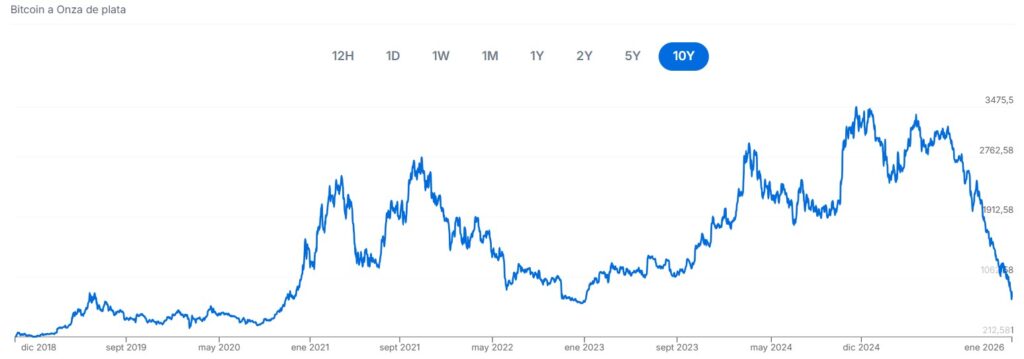
This evolution, which is gaining ground at the beginning of 2026, It is an indication that bitcoin is losing ground against silver, placing its current valuation around 781 ounces of silver per BTC. Such a fact represents a considerable loss of the relative advantage that the digital currency had accumulated.
It then happens that while silver experiences a significant rise, bitcoin suffers a correction. This has made the silver/bitcoin ratio fall to its lowest levels. And although the general trend since 2019 remains largely favorable to bitcoin, the cumulative performance of silver has been outperforming the digital currency from early 2021 to early 2026.
The following graph illustrates a long-term bullish trend in which bitcoin gained value against silver, highlighting the peaks reached between 2024 and the end of 2025, when the capitalization of BTC managed to surpass that of the metal.
In this scenario, the projections look favorable for silver, as Bank of America analyst Michael Widmer predicts that the metal could reach between $135 and $309 per ounce in 2026. This is based on the historical compression of the gold-silver ratio during bull markets in precious metals.
AI boosts the price of silver
Analyst and investor Victor Dergunov argues that there are several fundamental catalysts driving the rise in silver prices.
Date between them the low global supply and the robust demand for the metaldue to its industrial use and the advance of artificial intelligence (AI). Add the increase in demand for safe haven assets, amid geopolitical uncertainties and the increase in the money supply.
Particularly, silver is key in the development of artificial intelligence, since It is the metal that best conducts electricity and heat. Its qualities are vital in the centers where AI models are trained and executed, where signals need to be transmitted at high speed, without losing energy.
This entire process requires the use of silver, which is useful for manufacturing electrical connectors, switches and the contact layers in the most advanced chips and semiconductors.
Thanks to the metal, signals travel faster, with fewer losses and without overheating the components as much. Without this component, next-generation chips would not be able to handle extreme AI workloads without burning out or consuming excess power.
It is understood, therefore, that with the boom that AI technology is taking, increase demand for silver.
China also plays in favor of silver
Another catalyst for market growth is the high demand for silver, as a haven of value.
Regarding this, a Bloomberg report indicates that this record rally in silver is being supported by growing physical demand, combined with speculative interest in a relatively illiquid market. In that sense, there are signs that show that buyers in China are leading that push.
Experts draw attention to the fact that investors in the Asian country are turning to silver as a more accessible alternative to gold. Faced with this situation, the government has implemented policies that limit silver exports to consolidate its local supply, which increases the pressure on the international price.
This demand is intertwined with the needs of modern technological infrastructure, where silver is an essential component. The market is now at an inflection point, where physical scarcity of silver competes directly with the digital scarcity of bitcoin in the preference of big capital.
However, despite this growing interest, Dergunov advises caution. “I remain bullish on silver in the medium and long term, but, in the short term, this rally needs a breather.”
Bitcoin slows down due to fear of quantum
In contrast to what is happening with silver and gold, bitcoin is currently facing challenges that limit its momentum in this same macro environment. As reported by NoticiasVE, the current demand for metals responds to decisions that do not yet apply to bitcoin.
According to analyst Willy Woo’s hypotheses, one of the main risks remains the advancement of quantum computingwhich could compromise cryptographic systems that protect users’ private keys in the future.
The analyst points out that it is still difficult to convince governments and fiduciary institutions so that they buy an emerging asset like bitcoin. The task is further complicated by the rise of fears about the quantum threat and what many consider “developer inaction” of Bitcoin in the face of this risk. Hence, some investments – and governments like China’s – see silver as another option to gold.
In that sense, James O’Beirne, Bitcoin developer, has pointed out that bitcoin’s performance in the market could be linked to the state of development.
“The community is totally fragmented and key debates to improve the network are stalled.” The specialist added that bitcoin does not yet have enough history to be perceived as a fully proven asset, and that the FUD (fear, uncertainty and doubt) related to quantum computing “plants real doubts in those who were on the sidelines.”
Safeguard against fiat money in the age of AI
The above factors highlight a contrast that becomes relevant at the beginning of 2026. On the one hand, there is a rebound in precious metals (gold and silver). And on the other, there is bitcoin stagnation. A situation that seems to respond to a reconfiguration of trust in the financial system.
Agustín Kassis, CEO of La Crypta, an organization dedicated to the development and education of the Bitcoin ecosystem, points out that Interest in metals stems from investors’ fear of the fragility of fiat currencies.
This phenomenon intensifies when central banks implement aggressive monetary expansion policies. In these scenarios, capital usually takes refuge in assets with programmed or physical shortages that cannot be manipulated by political decisions.
However, Kassis maintains a critical vision about the functional usefulness of metals in the digital future. «I have a hard time imagining how AI is going to use those ancient pebbles as a store of value or unit of account. “Bitcoin is inevitable,” he says.
Although silver is leading the current push thanks to its industrial essentiality—being a critical component in hardware and semiconductors that goes beyond its role as a reserve—Kassis’s thesis suggests a paradigm shift.
The manager’s argument is that, as the economy becomes automated, gold and silver could give up their historical dominance to bitcoin. An asset designed to integrate natively into the architecture of machines and humans alike.