
Kevin Bowers, a developer who is part of the Jump Crypto team, confirmed on December 12 the activation of Firedancer, a new validation client on the Solana mainnet.
A client is software that allows validators execute network rules and participate in consensus. Firedancer offers a third alternative to the only two clients that existed in this ecosystem: Agave and Jito-Labs (the latter is a fork the Agave).
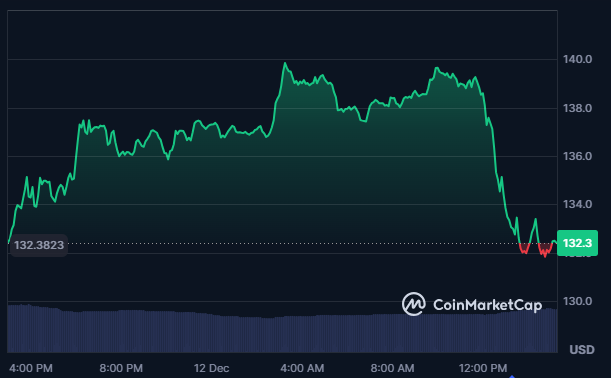
Coinciding with the integration of Firedancer into Solana, the native SOL currency recorded volatility movements: rose from $136 to $140, and then fell to $132, where it is trading at the close of this note.
In January 2025, NoticiasVE had anticipated that Firedancer could be introduced in Solana.
According to its developers, Firedancer seeks to improve three central aspects of network operation: performance, scalability and stability.
What does Firedancer bring to Solana’s operation?
First, having more customers reduces the risk that A failure in a single implementation affects the entire network. It also mitigates centralization risks.
At the time of this note, Agave accounts for more than 81% of Solana validatorswhile Jito 18.38%, and Firedancer 0.13% after its recent launch (around 800 in its entirety).
Next, Firedancer aims optimize the way a validator processes data.
To achieve this, it uses a modular approach that separates different validator tasks (such as packet handling, signature verification, and block processing) into separate components.
This division aims to improve efficiency and reduce bottlenecks in the flow of information in Solana, a problem that this network suffered in the past.
During testing in the beta phase of Firedancer, they indicated that this client could process up to “1 million transactions”.
The new client also works on communication between nodes using Turbine, Solana’s block propagation protocol. Optimizing that flow means blocks can be distributed more evenly and quickly among validators.
In terms of benefits, Firedancer could provide:
- Faster transaction executiondue to more efficient handling of signatures and packages.
- Better fault tolerancesince a second client avoids depending on a single development.
- Ability to absorb peaks of activitywhich is important in periods with a lot of demand for high-traffic applications.
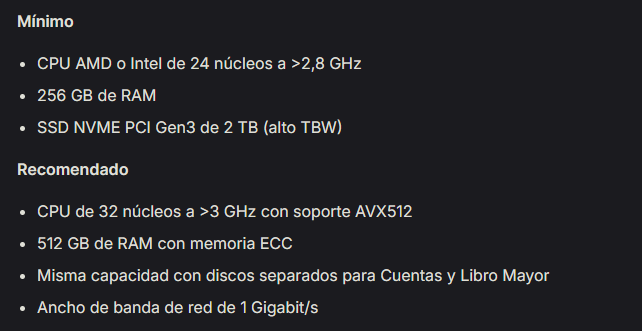
In the following image, extracted from the documents of this new software, you can see the technical requirements to run it:
On the other hand, unlike the other clients Agave and Jito which are written in the Rust programming language, Firedancer is a developer with C and C++.
The first minutes of Firedancer
Through the image below you can review the status of the Firedancer client.
The screenshot of the gui.firedancer.io site corresponds to the monitoring panel of a validator using Firedancer:
The Firedancer dashboard screenshot shows that the validator processes 2,858 transactions per second (TPS), similar to the average exposed by Solana explorers.
That the TPS reported by Firedancer and by browsers match indicates that the client is providing a realistic view aligned with the global activity of the network.
Also, in the bottom section of the image above, titled as “Shreds” (data category), it is observed how the validator using Firedancer manages the fragments into which Solana divides the blocks during their propagation.
There are categories like “Repair Requested, Received Turbine, Replayed Turbine, Skipped y Published”which represent the different states of circulation of those shreds.
Some of these stages are directly tied to the Turbine protocol (such as packets received and forwarded) while others are part of the general maintenance of the validator.
The presence and updating of these metrics confirms that Firedancer is processing, forwarding and repairing data according to the real flow of the network, which demonstrates its operational integration.
Finally, Firedancer comes at a complex time for Solana, since the network currently operates with a loss of almost 70% of the validators it had until three years ago.