
Surely this summer you have lived in your own meats and in your own home. When the heat squeezes, the air conditioning seems the only output, with the cost that this supposes for our pockets. But two Swiss students have come to save our lives and have invented a brick that cools up to 9 degrees without consuming electricity or polluting.
This invention, called Bloc, is manufactured with terracotta and works with solar energy to activate an evaporative cooling system. That is, use water and air to combat heat, without gases or electricity. Precisely with this as a basis, the idea is to improve cities, especially at such critical times as heat waves.
The project has given much to speak, even reaching the final of the prestigious James Dyson Award for their creativity and potential impact. The creators, Andrin Stocker and Luc Schweizer, were inspired by passive refrigeration methods that have existed from a lifetime, such as terracotta jar, the termiters or the ‘wind towers’, which regulate the air without depending on technology.
Regarding its operation, it takes advantage of the properties of the ceramic material to absorb water, which evaporates when the hot air passes through the brick thanks to fan driven by a small solar panel. This evaporation cools the air that crosses the brick, with an impact that can reduce the temperature by up to 9 degrees in hot days.
James Dyson Award
The system consumes about 50 liters of water per day, which can be supplied by the municipal network or through its own system that collects rainwater. For its part, the solar panel generates enough energy to move the fans and the water pump, making Bloc work completely autonomously.
The great advantage of this, as its creators comment, is that it is scalable, that is, it can grow in height and width to be able to place anywhere.
It is known that the next step of the students is to take their prototypes to large -scale field tests, to check how Bloc responds throughout a season, especially in places with high humidity, since this could affect its general operation. In addition, they are improving details so that their installation is even easier and more fast.
Air conditioning errors that trigger your light bill
To the big problem of these hot summers, the little information is added with respect to how to use the air conditioning so that it does not end up bleeding your pockets. Although there is little of those horrible days, and taking into account that now the cold is also coming and, therefore, heating, using it can badly convert that freshness into a headache when the electric receipt arrives.
The first error, and one of the most common, is not to use the window kit well in portable airs. This accessory is created and designed to seal the exit of the tube where the hot air is expelled.
If you install it badly – or you directly forget it – you will be letting that heat enter the room again. The result is that the air works twice, it spends more and the room never becomes fresh at all.
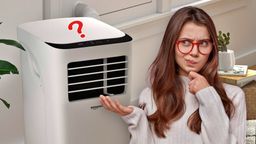
Katie Lilywhite, an air treatment expert, recommends ensuring that the window is well sealed and the perfect lace tube with the kit. If your window is an old thing, there are universal kits and insulating tapes to get a good closure.
Another book error is to forget the air conditioning filter. Over time, the filter is filled with dust and particles, which really completes the air passage. This forces the team to force each other to reach the temperature and consume much more energy. The solution is simple and a cleaning from time to time, preferably every two weeks, it serves. Just rinse it under the tap and let it dry.
The third failure is to lower the temperature to the minimum thinking that it will cool faster. Actually, most air conditioners cool at the same speed, so putting it at 16 ° C only gets it ever going out, consume more and end with extreme cold or even cold. Ideally, according to Chris Michael (Meaco), is to keep it between 22 ° C and 24 ° C during the summer for a fresh atmosphere and without spending a fortune.
Know How we work in NoticiasVE.