
The IBEX 35 closes the week almost in a draw and below 17,100 points. All in a week of volatility and with back and forth movement of the indices in the heat of the news coming from the Middle East and oil. Since the start of the war in Iran, the Ibex 35 has lost more than 5% and has lost more than 1,300 points from its historical highs, at 18,496 points at the end of February. Only in this last session, the selective has moved between a maximum of 17,291 points and a minimum of 16,870 points.
Among the leading values of the session, the red numbers are borne by ArcelorMittal, with a penalty of more than 4% that has taken it to 44.74 euros. IAG (Iberia) followed closely, with falls of more than 2.2% while Fluidra and ACS fell just over 1.9%.
On the positive side, Repsol shares have swum against the current throughout the day with increases of more than 3.2% that take them to 23 euros. For its part, Cellnex gained 2% and Solaria shares settled at around 20.86 euros after rising just over 1.6%.
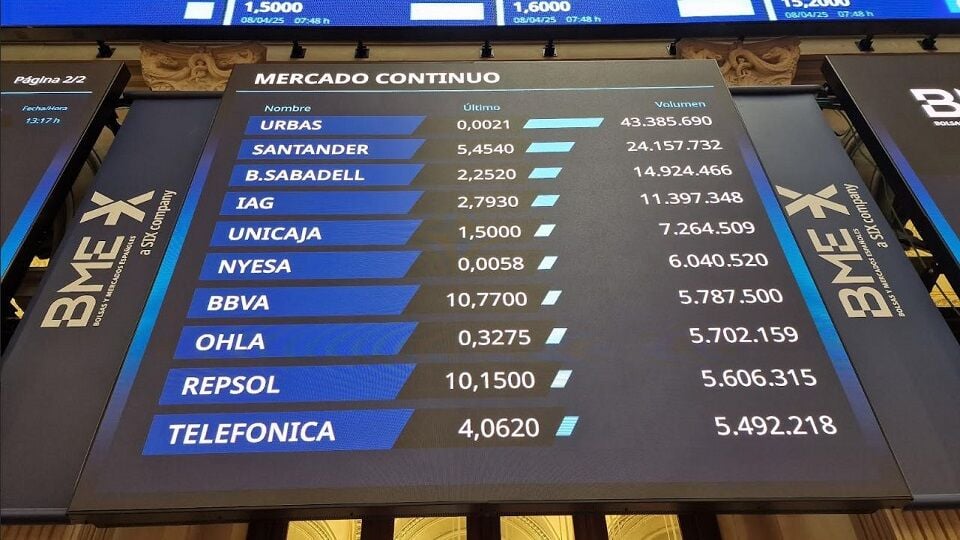
Among the most traded securities of the session, Banco Santander closed with falls of more than one percentage point, to 9.5360 euros, Banco Sabadell fell 0.4%, Telefónica added 1.13%, to 3.5890 euros and BBVA shares lost just over 0.9%, to 13.01 euros.
In the continuous market, the biggest increases are from Soltec, with a revaluation of more than 14%, followed by OHLA and Azkoyen, which have closed with increases of more than three percentage points.
Negatively, Técnicas Reunidas dropped 5.8%, followed by Tubos Reunidos, with a penalty of 4.5%, and CAF, which closed with a drop of 3.5%,
On the corporate side, Repsol seems to be the great refuge value of the Ibex 35 in the face of the strong rise in energy prices. The company, which has been at its highest on the stock market since 2012, has signed an agreement with Venezuela for gas production. In addition, Goldman Sachs maintains its buy recommendation for Repsol and raises the target price from 22 to 24 euros.
In contrast, IAG is one of the great victims of the war in Iran and today it has become known that it has presented a voluntary ERE for 996 workers.
In the analyst recommendations, Citi maintains its buy recommendation for Inditex but reduces the target price from 63 to 61 euros.
UBS maintains its buy recommendation and raises Indra’s target price from 57 to 72 euros.
Amadeus sees how Citi maintains its neutral recommendation and raises the target price from 50 to 55 euros.
European stock markets, Wall Street, oil and other markets
European stock markets close this Friday lower. He DAX 0.7% is left, above 23,400 points, the FT-100 falls just over four tenths, above 10,250 points, the CAC-40 wavers around 7,900 points after giving up just over one percentage point and the Eurostoxx 50 it gives up just over half a percentage point, above 5,700 points. The FTSE MIB fell 0.4% to 44,250 points.
The stock markets are trying to look for some sign that can reverse the volatility generated by the war in Iran, but as long as there is no positive news, it will be difficult for the indices to return to their upward trend.
The closure of the Strait of Hormuz, through which a fifth of the world’s oil passes, has become one of the main assets of the Ayatollah regime in the conflict with the US and Israel, without it currently appearing that there may be a solution in the short term. Today, US Defense Secretary Pete Hegseth has dismissed concerns that effectively closing the Strait of Hormuz is a problem for the United States and the world for much longer.
Neither Hegseth nor Joint Chiefs of Staff Chairman Dan Caine has said how the United States will open the strait to oil tanker and other ship traffic. «The worst scenario that investors are considering is that the conflict becomes entrenched and with it high oil prices, which could end up affecting global growth and lead some economies to stagflation or even recession. On the contrary, if the end of the conflict takes place in a few weeks, we understand that the damage to the global economy will be marginal,» adds Fernández-Figares.
Since the start of the war, oil prices have become the thermometer of the markets. After a small lull during the session, oil has turned upward again. The Brent oil future added 1.7%, above $102.26, and West Texas oil future added 1.6%, to $97.30.
On the macroeconomic agenda this Friday, investors learned the February CPI right at the opening. As published by the INE, the Consumer Price Index (CPI) maintained its interannual rate in February at 2.3% due to the drop in electricity prices, which offset the increase in the cost of restaurants, accommodation services and food. Inflation figures have also been known in France, with a rate of 0.9%.
In addition, before the opening of Wall Street, mixed data on the US economy has been known. The PCE for the month of January increases to 2.8% in annual rate and 0.3% in monthly rate, slightly below the data estimated by the consensus that pointed to an annual figure of 2.9%, with an underlying PCE, which excludes energy and food prices, remaining at 3.1% in annual and 0.4% in monthly, in line with estimates.
For its part, the second estimate of US GDP has been revised downwards to 0.7% from a previous estimate and data of 1.4%.
This has allowed a rising opening on Wall Street, which however has not taken long to dilute to deepen the red numbers of the week. At this time, the future of the Dow Jones remains flat at 46,669.10 points, the S&P 500 it fell more than 0.03%, to 6,646.80 and the future of the NASDAQ 100 lost a little more than half a percentage point, above 24,416 points.
In the currency market, the euro fell against the dollar, up to 1.1443 units, while among cryptocurrencies, Bitcoin added 1.3%, above $71,405.4, and Ethereum rose more than 2.4%, to $2,120.