
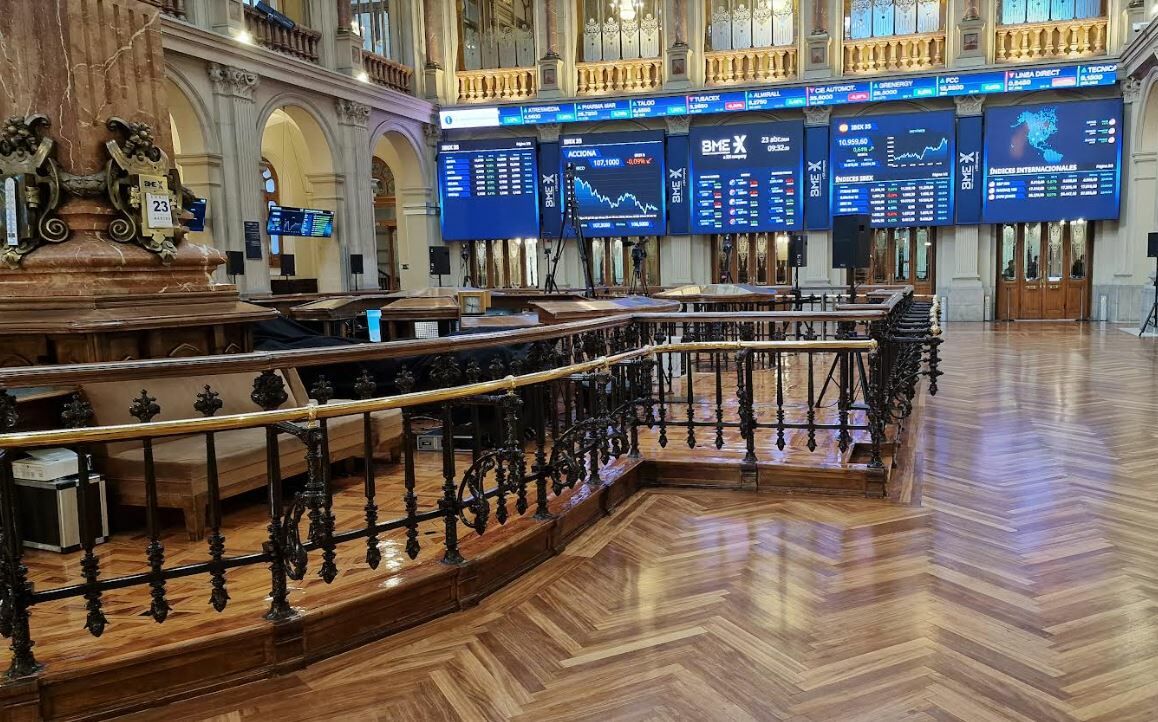
The IBEX 35 rises 0.38% this Monday to reach 18,011 points. At the top of the index is Banco Sabadell, which adds 4.57%, compared to Indra’s 1.79%. On the decline side, Sacyr fell 1.46% and ArcelorMittal fell 1.13%.
The Madrid selective comes from a bullish day last Friday that allowed it to save the week slightly positively (+0.34%), not too far from the historical highs it set on Tuesday at 18,119.20 points (18,271.20 intraday points).
The index has managed to maintain its tone despite the poor reception that the banks’ results have had in general, and which has translated into sharp falls for entities such as Banco Santander or BBVA. This week that begins today will have a more relaxed business agenda in Spain, highlighting only Mapfre’s quarterly report, which will be published this Thursday.
Today, this Monday, Expansion highlights that Banco Santander wants to rely on the recently acquired Webster Bank to accelerate its investment banking business in the US. The president of the group, Ana Botín, anticipates to analysts income synergies in that business area that the acquired entity lacks, this medium highlights.
Iberdrola closed 2025 with a record number of distributed electricity, with 255,976 GW, as the company reported to the CNMV over the weekend. The increase compared to the previous year was 7.5%, driven mainly by the United Kingdom.
CIMIC (ACS) subsidiary Leighton Asia wins contract for data center in Malaysia.
Meanwhile, Repsol will distribute fuel in France with the purchase of Poignat, according to publication The Economist.
In the analysts’ recommendations, Morgan Stanley cuts the target price for Banco Sabadell after the results presented last Friday to 3.45 euros per share, from the previous 3.65 euros. More pessimistic are the Barclays analysts, who cut the target price to 3.20 euros, from the previous 3.30 euros.
In turn, Goldman Sachs raises Solaria’s target price, which goes from 22 euros to 22.50 euros.
In the Continuous Market, good news for Talgo, which has been awarded the manufacturing and maintenance of 20 new high-speed trains for Saudi Arabia Railways (SAR), on the railway line that connects the cities of Mecca, Medina and Jeddah. This new order will add 1,332 million euros to its portfolio, placing it back at maximums of approximately 6,000 million euros. The 20 new trains are added to the 35 that Talgo already supplied in 2018, which operate with total reliability in the desert, and whose maintenance the company is responsible for.
The macroeconomic agenda This Monday is very scarce, so investors are waiting for the important references that will be known in the coming days, especially in the US: tomorrow, Tuesday, retail sales for December will be published; On Wednesday, the December non-farm payrolls report that should have been published last Friday (delayed by the partial government shutdown) will be released; and on Friday the CPI for December will arrive.
“All these figures will help investors get a more precise idea of how the US economy closed the year, especially with regard to inflation and the labor market, variables whose behavior is decisive for the Federal Reserve (Fed) to design its monetary policy,” explains Juan J. Fernández-Figares, director of analysis at Link Securities.
Wall Street, Asia and other markets
Wall Street futures point to a lower opening this Monday, with moderate advances after the strong increases recorded last Friday, with the DOW JONES advancing no less than 1,206 points, or 2.47%, to reach a new historical record at 50,115.67 points. Never before had the index crossed 50,000 points. Also strong advances last Friday for S&P 500 (+1.97%) and Nasdaq (+2,18%).
For the week, the Dow Jones rose 2.5%, while the S&P 500 fell 0.1% and the technology Nasdaq fell 1.84% despite Friday’s rebound.
This week the earnings season on Wall Street will continue with reports from companies such as Coca-Cola Co, Ford Motor, McDonald’s, Cisco Systems or Applied Materials.
The season in Europe will also be intense, with the accounts these days of Siemens, TotalEnergies, Barclays, Michelin, Anheuser-Busch InBev o Unilever.
During the Asian session, the Nikkei 225 index in Tokyo has shot up 4.06% to reach 56,457 points after the incontestable victory of the prime minister, Sanae Takaichi, in this weekend’s elections, which fuels the appetite for more reflationary policies. In China, the CSI 300 advanced 1.63%, while the Shanghai SSEC gained 1.41%. For its part, the South Korean Kospi rose 4.10%.
In raw materials markets, Oil prices rise slightly after initial falls, as tension in the Middle East has eased for now after the talks between Iran and the US. Both countries have pledged to continue talks on Tehran’s nuclear program, reassuring investors worried about supply disruptions. International benchmark Brent oil rose 0.3% to $68.26 per barrel, while US West Texas futures added 0.4% to $63.80.
Investors also remain attentive to gold prices, which have been on a real roller coaster ride in the last week. Today the yellow metal in its spot variety rises 0.67% to $4,994 per ounce. Silver rises 4% to $80.88.
The euro advances 0.36% against the dollar until leaving the exchange rate at 1.1859 dollars for each single currency.
In fixed income, the ten-year Spanish bond offers a return of 3.233%, which leaves the risk premium against Germany at 37.58 points.