
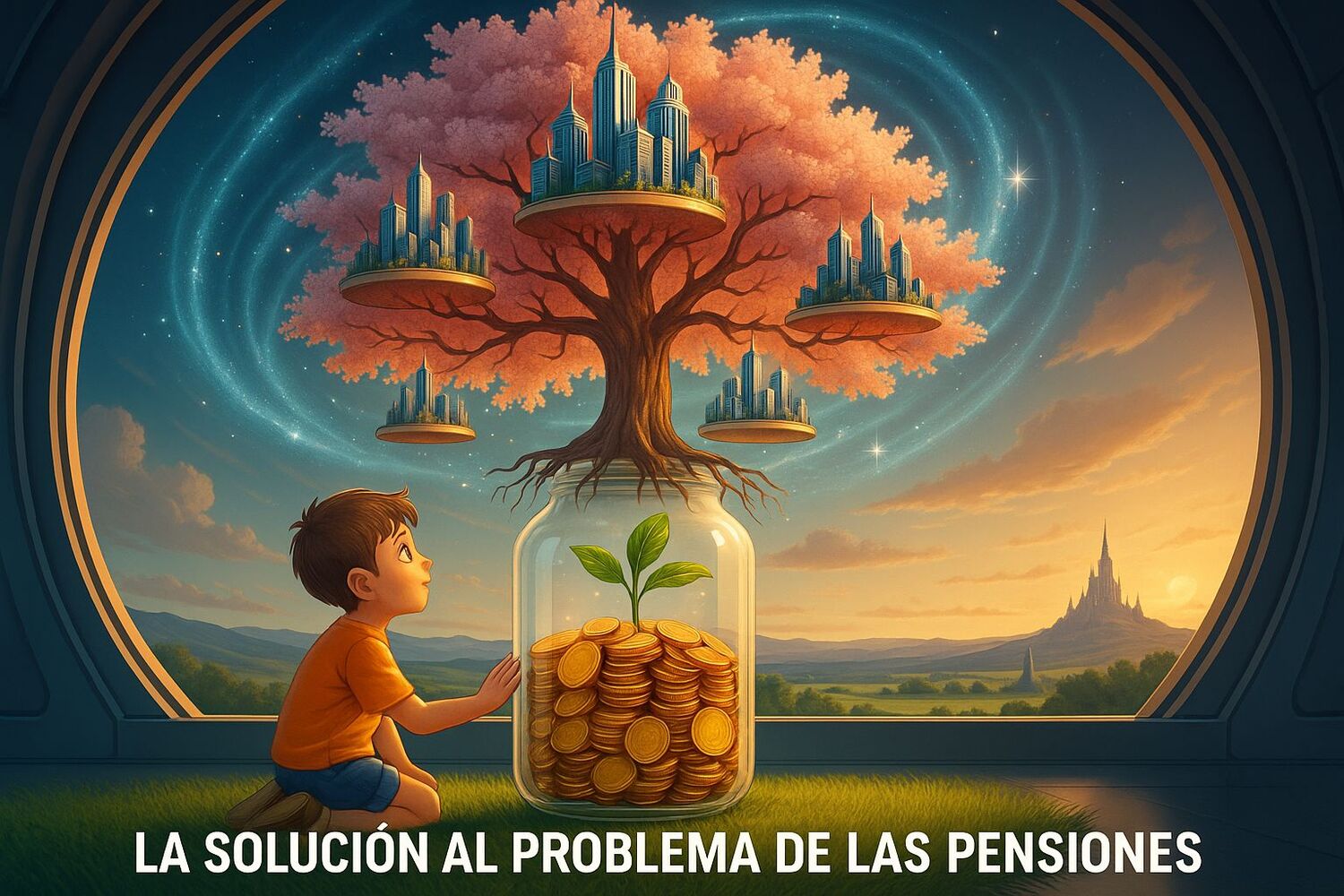
This German plan is not ideal either. Your idea is a monthly state contribution of 10 euros from 6 to 18 years oldand let that go capitalizingbeing inverted. And it remains there providing profitability until you retire. As an idea it is not bad. Let’s see, numbers.
Son 12 years, 10 euros per month. And, what happens if it is invested in the world’s largest index with the average return of the last 90 years? Well let’s see.
Although your contributions have been €1,440at the end of those 12 years, you would already have 2.931,08 €. But be careful, you are 18 years old. You no longer contribute, but you have more than 40 years of working life left. Let’s assume that you retire at 66 years old (which will be older, but oh well). Well let’s do the calculation… You reach the age of 66 with €488,691.22. Awesome. Half a kilogram.

Source: Carlos Arenas Laorga. The blue lines, which are the accumulated contributions, are barely visible.
Well, the inflation He will also have run, of course. Indeed. You are absolutely right. If we discount inflation and we see the real purchasing power of those monetary units, the figure is no longer so spectacular. But it’s still more than good. You would have €71,353.91.
Here are two reflections. One, it’s amazing. Two, it is clear pernicious and devastating effect of inflation. Pertinacious always goes with drought, and galloping with inflation. But it is also possible that inflation is persistent.
WellGermany, to the surprise of many, has decided to plant the seed. But it has fallen short. In view of the data, the pension problem can be solved with capitalization. With education. And, above all, with time.
The current pension model in Spain works as an intergenerational chain of favors. No solidarity system. Today’s workers pay the pensions of today’s retirees, with the promise that someone will do the same for them in the future. A promise that no one guarantees. But, as the demographic pyramid reminds us, there are fewer and fewer young people supporting more older people. The unappealable consequence is an unviable system, sustained by taxes, debt and faith.
In Germany they have decided to do something different. And the most interesting thing is not the results, which are already fabulous, but the message. You have to start investing soon and let compound interest and time do the rest.
Now if this works with 12 years of systematic investing, imagine what could be achieved if we invested not only during childhood, but throughout life. We propose here an even more transformative solution: a lifetime investment plan from 0 to 60 years old. And I say until 60, because you can retire without a problem…
Model assumptions
- Constant monthly contribution: 30 € from 0 to 60 years old.
- Investment in a diversified global fund (MSCI World or S&P 500).
- Profitability annualized (11,24%) net of inflation: 7,42% (according to the last 90 years, with world wars in between and every crisis imaginable).
- Total contributions: €21,590… in a lifetime!
- Accumulated capital at age 60: 2.021.484,68 € o 364.638,77 € of real purchasing power.
- If the contribution rises to €50 per monththe accumulated contributions would be €35,970 and the real capital would arrive on 3.368.782,07 € o 607.609,39 € of purchasing power.
- And if you stay invested until 70yearsI won’t even give you the figures… Well, yes. The accumulated contributions would be €60,000 and the final assets would be 9.787.335,56 € o 1.139.333,64 € of purchasing power.
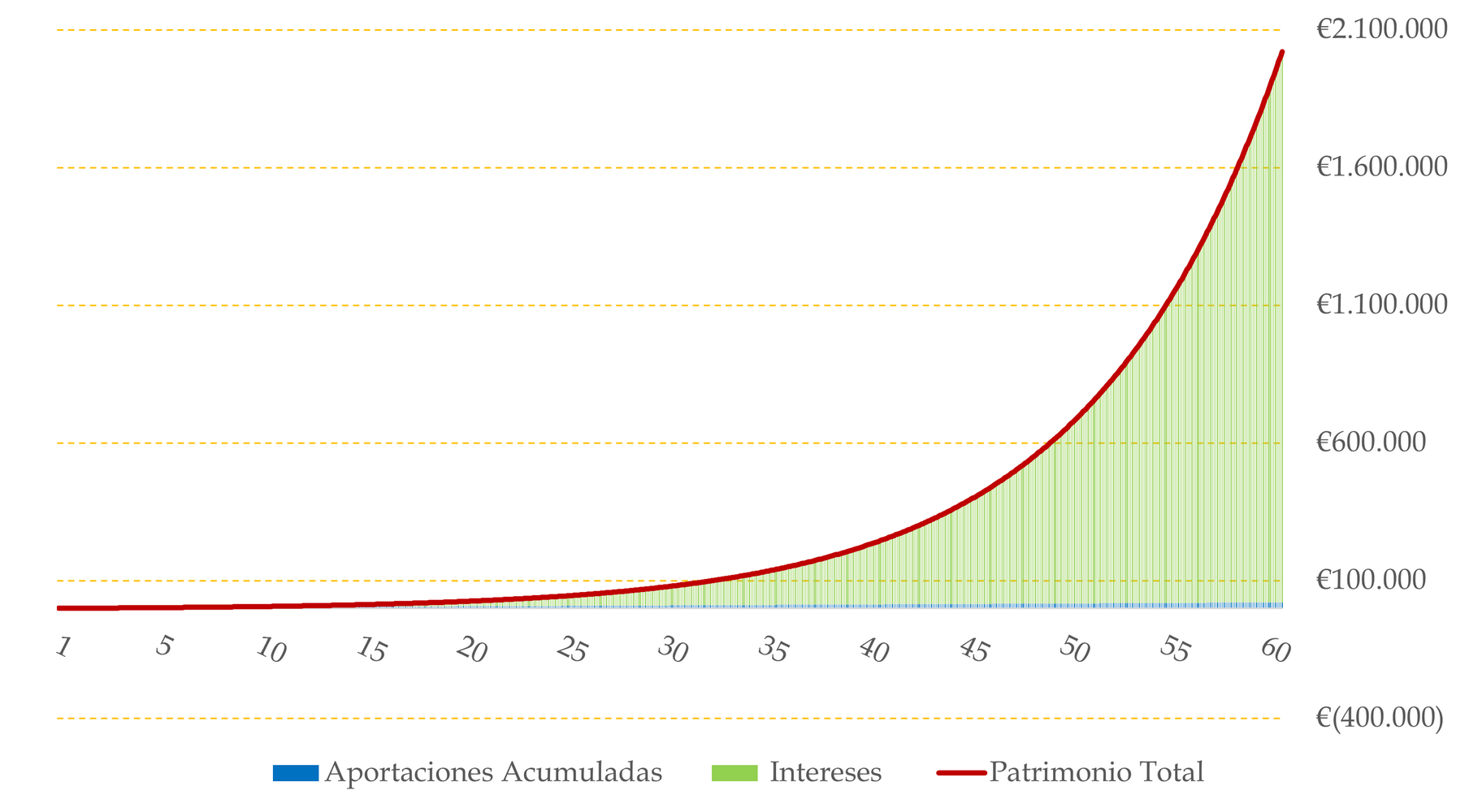
Source: Carlos Arenas Laorga. With the original assumption of €30 per month, you would end up seeing more than €2 million in your account.
Think about it for a second. €30 per month. More than 2 million euros. But it’s not just money, it’s retiring as God intended, it’s education, it’s culture, it’s freedom. And if you want to contribute more, then go ahead.
Teaching a child to invest is not about turning them into a small speculator, but into someone who understands how the world works; that values the opportunity cost; who thinks about the future and long term; who lives virtues such as sobriety, patience, effort, and many others. Obviously, each thing at its own age. Maybe you don’t have to know that you have that account until you are 12 years old.
The German plan get it right when sowing that seed. But it fails to fall short. Only 12 years of contributions. Only €10 per month. Only public capital. We need more. We propose 60 years and €30 of private capital. For that:
- Family contributions: from parents and/or grandparents.
- Automatic contribution systems: like a roboadvisor childish.
- Tax-incentivized accounts (These accounts are not taxed at the end of the period if they have been invested for more than 50 years or their rescue is anticipated for objective reasons).
- Real financial education at school: the only subject that can make you free.
And, of course, a subsidiary part of the state for especially low incomes. Remember that non-contributory pensions represent approximately 1.6% of total pension spending in Spain. That is to say, we are talking about a negligible expense (compared to the current one, of course). Part or all of these €30 could be public for whoever needs it.
Spain remains entangled in paternalistic ideologies. You have to throw them away and think about the best solutions regardless of color. It is not worth squeezing the worker and not offering a viable alternative.
The long-term investment proposal seems the most efficient. Does anyone give more?