
For years it has been discussed what will happen when the last Satoshi is broadcast. How will the miners’ safety budget support? «You have to encourage a commission market,» said some, as if it were something unveiled; «You have to implement a tail emission,» said others; Even Peter Todd has come to collect a kind of tax for inactivity to transactions to finance Bitcoin’s security.
While it is important to project yourself to the problems of the future and think of solutions, the truth is that it remains that, a problem of the future, exactly A problem within 115 yearsmoment for which we have no remote idea about the state in which technology will be general, or specifically bitcoin, and at which time it will be another generation of Bitcoiners that will be alive to address the situation.
But some misunderstood this projection of futures and thought that this commission market that must finance the miners (and could) begin to be built at once, when each block still offers a subsidy of 3.125 BTC to the miners, USD 360,000 every ten minutes at the current price.
Thus, the years have passed and We have paid expensive transactions without need. For multiple reasons, not only to promote the commission market. In the pre-SEGWIT years, the artificial limitation of the block space by the miners (detected by Orangesurf of Mempool.space) caused one of the first peaks of congestion and commissions. Also, the overpag of the exchanges denounced by cryptootics in 2021. Fever for inscriptions and ordinals in 2023.
With the exception of the case of overpag by Exchange, in almost all the occasions that the price of the commissions has increased due to an increase in demand for block space. The number of transactions grows and they compete for being confirmed, paying more to the miners, according to the law of supply and demand. In almost all market cycles, a price increase has been related to an increase in network activity and, therefore, an increase in commissions.
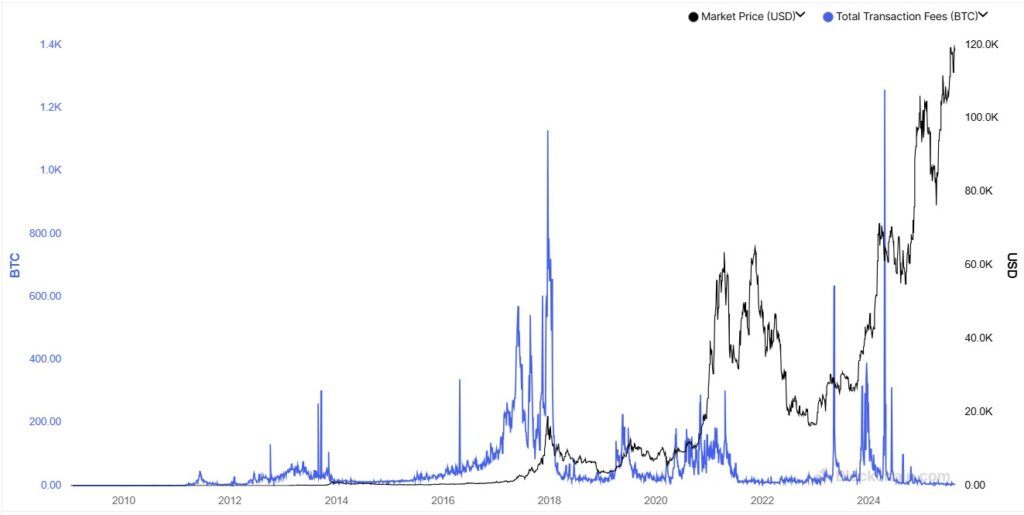
The fall in commissions usually happens to the price drop. But in the case of this cycle, also anomalous for breaking the previous ATH before halving, price growth It has not been accompanied by more transactions, or more expensive commissions.
This is due, in part, to the nature of the actor who is promoting this upward market: the corporate and institutional investor. This market agent is concentrated exclusively on the accumulation of BTC. Unlike the retailer, who has had a low presence in this cycle, his contact with the Bitcoin Network is almost null.
Another factor that may be influencing low activity on chain It is the growth in the use of second -layer networks such as Lightning Network, but the fragmentary and opaque of the statistics of this network does not allow us to confirm it.
The greater adoption of Segwit and a more mature network, with technical improvements and users who know tools to optimize the weight of their transactions, can be among the factors that have lowered the commissions. Also, if you run your own node, you can Configure it even for not paying commissions in a low demand context like the current one; It will remain of the miners process it or not.
Because commissions are not an obligation or a need in the Bitcoin Network. In the consensus rules it is not established that commissions must be paid. In the first days of Bitcoin, it was common to find transactions without commission being processed, because there was no demand for block space. It was later that standards were introduced to avoid spam attacks, but Not being part of the consensus, as they were introduced, they can be modified.
The truth is that this cycle, the transactions grew before the price, during registration fever, and not during the price increase.
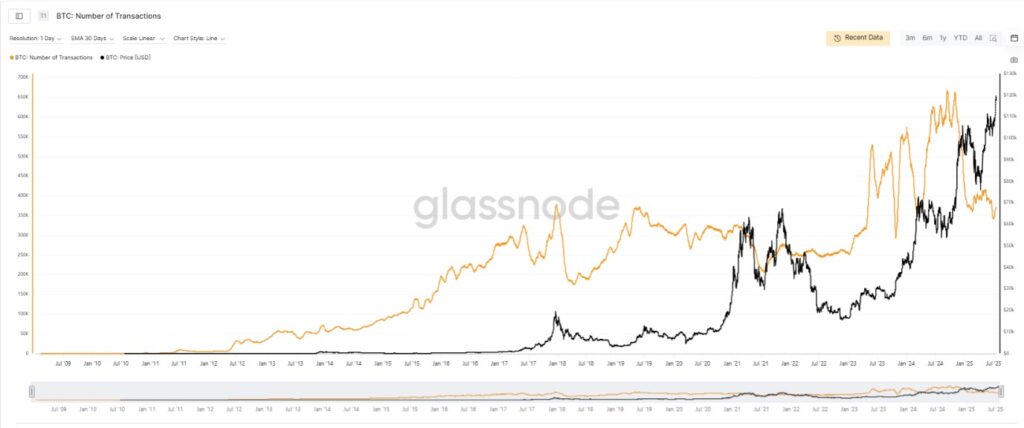
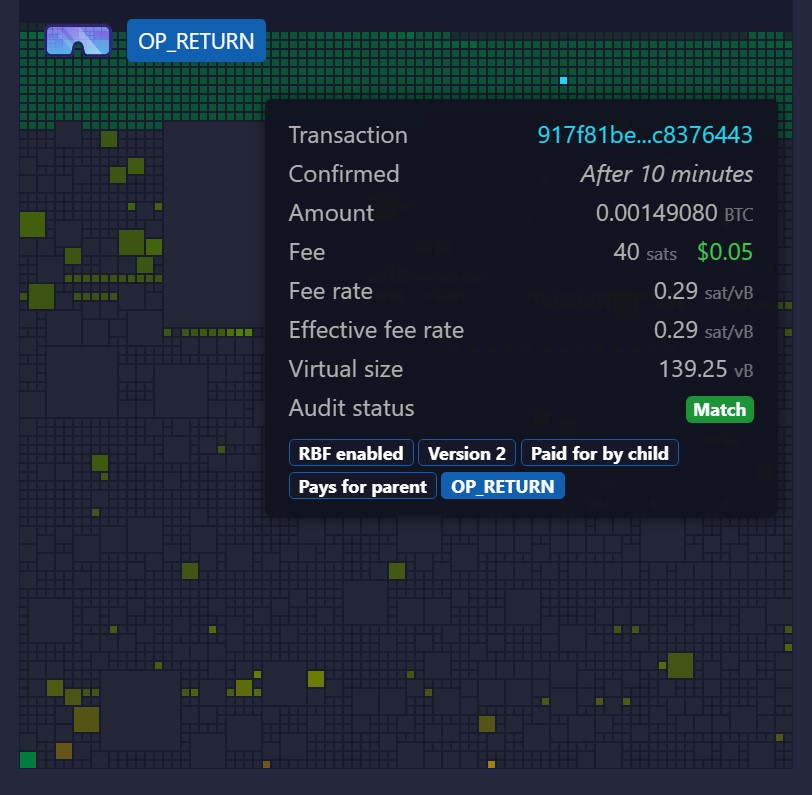
Thus the panorama, we have a very low demand for block space. And if we have a growing offer of miners wanting to confirm transactions, and a practically null demand, Why should we pay more? This does not work the market. Rather, to attract more demand, mining pools have further lowered their prices. And thus the SUB 1 SAT/VB commissions have been generalized.
This is the most recent demonstration that Bitcoin is a free market. F2pool and Mara were the first to accept transactions that pay less 1 SAT/VB, at least since April of this year. And, as competition works in free markets, they have joined this Foundry, SECPOOL, Binance Pool, White Pool, BTCCOM, miningsquared trend. About 85% of Bitcoin hashrate is accepting transactions below 1 SAT/VB.
For the most part, they are users of ordinals, runes, and other people who register arbitrary data in Bitcoin, who pay directly to mining pools to process their cheap commissions, although anyone who uses a wallet who allows the commission to be established could do so. But it is interesting to highlight this fact, then, in the past, one of the main arguments against non -financial transactions in Bitcoin had been that the commissions raised. It seems that the market has momentarily solved this problem with the Sub 1Sat/VB commissions.
As Mesonaut de Mempool has detected, this, this has reported to the mining pools almost 4 BTC that, without the reduction, perhaps they would not have obtained.
Although it seems counterintuitive, some developers, such as Antoine Poinsot, have raised alarms against the offer of summer commissions. Poinsot is the same developer who resurfaced the proposal to eliminate Op_return limits for the registration of arbitrary data, such as ordinals, in Bitcoin, arguing that the limitation was ineffective to prevent unwanted uses.
Sub 1 SAT/VB commissions present some inconveniences. Bitcoin Core has a standard policy established by default that establishes a minimum of 1 SAT/VB through the Minrelaytxfee parameter to disseminate transactions between nodes. This parameter does not modify consensus rules, so any node can modify it without affecting the validity of transactions.
This parameter seeks to mitigate spam attacks on the network, which could saturate the mempo and the resources of the nodes. However, at times like the current one, when there is no demand for block space, such a limit only unnecessarily increases costs for users.
The problem today results from Decronation between nodes. Not fulfilling the predetermined standard, these transactions are not propagated uniformly between the nodes. Bitcoin nodes use the BIP152 (Compact Block Relay) protocol to propagate blocks efficiently, assuming that transactions in a block are already in their Mempools. However, if the miners include sub 1 SAT/VB transactions that the nodes have not seen (because they do not comply with the standard relay policy of 1 SAT/VB), the nodes will not be able to rebuild the locally block. This forces them to request missing transactions, increasing latency and network traffic, which reduces efficiency and could compromise safety in block spread.
Another problem affects light wallets, such as mobile devices, which depend on technologies such as Neutrino to stay synchronized without downloading all accounting. These wallets use compact filters generated by complete nodes to identify relevant transactions. If a node does not include sub 1 SAT/VB transactions in its Mempool (because it rejects them for their relay policy), compact filters will be incomplete, which can lead to false negatives: the portfolio might not detect relevant transactions, causing an inefficient or insecure synchronization.
However, all this derives from the established relay parameter. If that parameter is modified and all nodes begin to accept sub 1 sat/vb transactions, Decronation ceases to be a problem. This is already being discussed among Bitcoin developers, under Glozow’s proposal, one of the main maintainee of the protocol.
In the past, with the rise of ordinals and runes, we have seen how a high demand for block space takes the commissions to the clouds. For those who consider this a spam attack, the relay parameter was not a brake. The economic incentive was enough to pay the commission that was.
At present, it is the miners themselves who are promoting lower commissions to obtain benefit from it. It is natural when the law of gravity of the market is understood: supply and demand. Miners offer block space; If nobody demands it, The price must go down to attract new plaintiffs. They have done so and with them the flow of transactions has increased slightly and, therefore, their profits.
If this is the current nature of Bitcoin, if most users see it as a long -term value reserve and are not interested in making transactions, because the market orders that the prices of the commissions fall. And Bitcoin Core and all other industry participants will adapt to the market, not the other way around.
That is why it makes no sense to try to force a commission market for the security budget within a hundred years. The market is not forced or intervened without consequences. This has been seen by any country with artificial price controls, in which, not only parallel markets are created during its validity, but at the exact moment in which the market is released, prices are triggered.
Bitcoin is the purest expression of the free market, so It will always be the law and demand law that dictates the price of commissionstoday, and in 2140.