
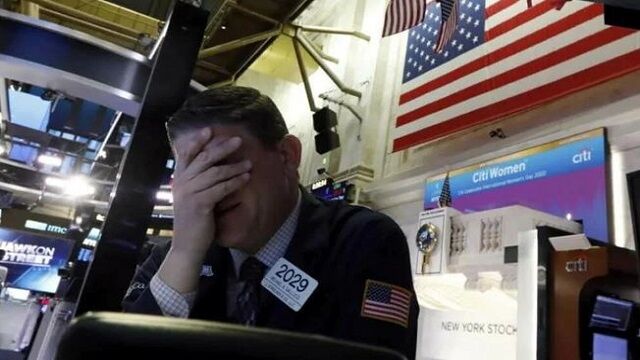
The conflict in the Middle East is beginning to take its toll on financial markets. On Wall Street Concern grows among analysts and economists about the rise in oil pricesa factor that could slow down global economic growth, according to Inés Ferre in Yahoo Finance.
«Downside risks have increased considerably,» he said. Gregory Daco, chief economist at EY-Parthenonin a note published earlier this week. «In this context, we now estimate the probability of recession in a 40%but we emphasize that this could increase rapidly in the event of a more prolonged or serious conflict in the Middle East,» he added.
The economist pointed out that the Disruptions in the Strait of Hormuz and the risk of further deterioration in oil production suggest a more persistent inflationary environment, «extending beyond a temporary spike in energy prices.»
“If the war intensifies with prices of oil above 100 dollars per barrel, higher prices for other key commodities and tighter financial conditions, the Inflation in the US could rise as high as5%while real GDP growth could be reduced by more than one percentage point, significantly increasing the risks of recession,” Daco pointed out.
Inflation, oil and market signals
The latest Consumer Price Index showed annualized inflation of 2.4% from a year ago, while core inflation, excluding the volatile energy and food categories, rose 2.5% year-on-year.
In parallel, the crude oil market continues to show high volatility. On Wednesday, oil prices fell more than 3%, in a context marked by geopolitical uncertainty and information about possible negotiations between the United States and Iran.
West Texas Intermediate (WTI) futures fell to $88 per barrel, while Brent was below $96. Yet, Prices remain approximately 25% above levels prior to the outbreak of the conflict between the United States, Israel and Iran.
Daco also warned of additional risks in sectors such as investment in artificial intelligence and private credit, where “liquidity tensions could lead to solvency problems.”
More firms raise recession risk
It is not the only pessimistic diagnosis. The economists of Goldman Sachs have also raised their probability of recession, from 25% to 30%given the impact of rising energy prices on the global economy.
He chief economist, Jan Hatzius, noted that the upward revision of oil and gas prices could increase global inflation by around one percentage point and subtract 0.4% from global GDP growth. “Although the impact of the energy sector in the US could be more limited, it coincides with a tightening of financial conditions and a lower contribution from fiscal stimulus in the second half of the year,” he explained. “Therefore, we now expect below-trend growth and a rising unemployment rate, and we have raised our 12-month recession probability at 30% (wherea in the second half of 2025),” Hatzius added.
In addition, Hatzius anticipates rate cuts by the Federal Reserve in September and December, while delaying those by the Bank of England until 2027 and foresees new increases by the European Central Bank in April and June.
The increase in uncertainty is also reflected in prediction markets. In Polymarket, the probability of recession in the United States by the end of 2026 has risen from 23% recorded on February 27—before the start of the conflict with Iran—to 35% in the last session.