
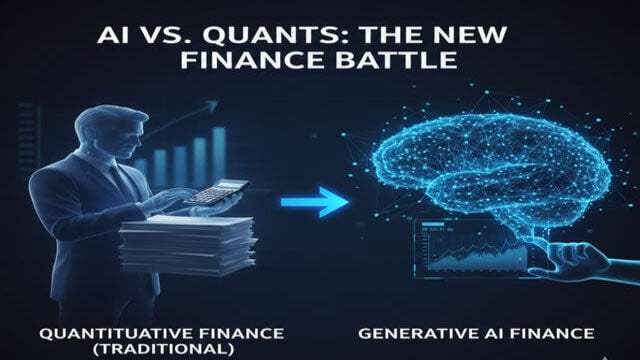
In the corridors of the most prestigious faculties in the world from Exhibition Road in London, where the Imperial Collegeto the laboratories of the MIT Sloan In Massachusetts, the whisper of an identity crisis has become a rallying cry. The traditional «Quant» (quantitative analyst), that architect of mathematical models who dominated Wall Street and the City for decades, is being forced into a Darwinian evolution. The cause: the transition of Quantitative Finance classics towards Generative Finance.
After the leak of the curricular updates of the main Master in Finance (MiF) for the 2026-2027 cycle. It is no longer enough to master stochastic calculus or be a Python virtuoso; Now, the frontier is «Systemic AI».
For the last fifteen years, the gold standard of a Master in Finance was the student’s ability to write arbitrage algorithms or risk models from scratch. Today, Generative AI tools and large-scale language models (LLMs) specialized in finance perform these tasks in a fraction of the time and with a significantly lower error rate in programming syntax.
«We are moving from teaching students to be ‘engine builders’ to teaching them to be ‘spaceship pilots'»says a program director in HEC Paris. The current trend in elite masters is a shift in focus: less time coding and more time in the Data architecture and model validation. The new financial analyst must know how to interrogate the AI so that it generates the model, but, above all, he must know how to detect when the AI is «hallucinating» with biased market data.
The traditional curriculum always had the Black-Scholes model and Monte Carlo simulations as its cornerstone. Although these remain fundamental, business schools are rapidly introducing the study of Transformers (the architecture behind GPT) applied to financial time series.
The competitive advantage of a 2026 graduate is not knowing what a financial option is, but knowing how to train a model that analyzes in real time the sentiment of millions of transactions, geopolitical news and social media flows to predict volatility. Quantitative finance is becoming “predictive and multimodal.”
This technological change brings with it a latent concern that has been intensely discussed in the forums of Oxford Said this week: the value of junior talent. If AI can perform the valuation analysis that previously took a first-year analyst at Goldman Sachs 80 hours, what does the master’s graduate do?
The response of business schools is «Strategic Supervision». The Master in Finance programs are integrating algorithmic ethics and data governance modules. The objective is for the graduate to be responsible for ensuring that their investment fund’s AI model does not violate market regulations or create unforeseen systemic risks. A hybrid profile is sought: a mathematician with the ethical vision of a philosopher and the agility of a data scientist.
Another hot topic is the use of synthetic data. Due to strict privacy laws (such as the evolution of GDPR in 2026), finance masters are teaching students to generate artificial market environments to test their trading strategies. This allows us to simulate financial crises that have never occurred, preparing the algorithms for the «unpredictable.»
For the applicant for a Master in Finance in 2026, the choice no longer depends only on the prestige of the brand. The key question is: How does this program integrate AI into your finance lab?
Schools that remain anchored in the pure teaching of classical econometrics without a layer of applied AI run the risk of graduating obsolete professionals before receiving their diploma. On the contrary, those that, like Tsinghua o WITHthey are fusing computational engineering with financial theory, they are creating the new owners of global capital.
The «Quant» is not dead, but its slide rule has been replaced by a neural network. And in this race, second place is the first loser.
Discover the best Master’s degrees in Finance to take in Spain at the best business schools.