
-
Every 2,016 blocks the mining difficulty is adjusted.
-
Regardless of technical advances, the emission rate remains stable.
The history of money is full of cases where a technical disruption dramatically facilitated the increase in the money supply and caused what used to be a good store of value to become bad money. Bitcoin, through its own technique, solved this historical problem.
Let us take the case of the Rai stones from the Yap Islandsin Micronesia, for having key similarities with the operation of Bitcoin. These huge limestone discs with a hole in the center functioned as currency for centuries on the island.
Being very heavy and difficult to transport, the transfer of ownership was made by making a public announcement to all the inhabitants of the island, just as the gossip protocol of Bitcoin. There was no central notary or validator; Property is protected through public knowledge.
More important than this is that creating a rai stone was difficult and required enormous effort: travel hundreds of kilometers to the island of Palau, extract the limestone, carve it and transport it in canoes (often at the risk of lives).
This difficulty, for centuries, limited its supply and maintained its value. No matter how desirable they were, no one could arbitrarily inflate the supply and devalue them. But this changed when the people of Yap came into contact with Westerners who knew more sophisticated technologies.

Irish-American Captain David O’Keefe, seeing an opportunity to do business with the island’s coconut oil producers, set sail with a large ship, explosives, and other modern tools for the island of Palau to mine his own Rai stones.
And although the chief of the island wanted to decree that the O’Keefe stones were worthless because they had been obtained too easily, soon the inhabitants of the island began to accept them, which in time increased supply and devalued the currency.
In The Bitcoin Pattern, From Saifedean Ammous you can get several similar examples of primitive money, such as aggry glass beads from West Africa or seashells from North America, and they all followed the same fate: the emergence of a new technology made that good with greater salability and more difficult to obtain, became easy to obtain and introduce to the market, which caused it to lose value over time and, finally, to be displaced by more solid money.
That technical innovation facilitates the issuance of currency is something that has not only happened in primitive societies and remote towns. Going from the first coins, like those of Lydia, minted by hammer force, to the rolling mill or the flying press, and finally to the steam engine that powered the presses, represented an enormous leap in the productivity of the coiners.
Even advances in mining make it increasingly easier to extract precious metals like gold compared to ancient ways. These technical advances, together with the invention of modern banking, accelerated the loss of value of currencies:
From 1066 to 1601, the English silver pound was debased by a third. In other words, in this period of more than 500 years, English kings inflated the money supply by a factor of 0.3. By contrast, in the subsequent 200-year period, which saw the rise of modern banking, that factor was on the order of 16. And in the mere 30-year period from January 1973 to January 2003, the US dollar (M1) rose by almost a factor of 5.
Jörg Guido Hulsmann – The ethics of money production
Something curious has happened recently. It was not contact with a foreign people with more advanced technologies that broke the difficulty of issuance and devalued money. It has been technological advance, justified with a new conceptual apparatus that disrupted what had been understood for centuries as the cause of inflation, that has been destroying the value of money, making it increasingly easier to produce.
Since the 14th century, with Nicolás de Oresme, but even more so in the 16th century, with Martín de Azpilcueta and the Price Revolution, generated by the massive influx of precious metals from America, which skyrocketed prices in the European market, inflation and loss of purchasing power was linked to the increase in the money supply. From then on, there was a practically general consensus among thinkers (from Hume, Smith, Ricardo, Mill): perceive inflation as a monetary phenomenon.
It was from the 1930s, after the Great Recession, that there was a shift in the agreement between scholars and political economy officials about what inflation means. Mainly because of John Maynard Keynes, the definition changed to emphasize the “general and sustained increase in prices”, without highlighting the role of the money supply. Keynes described inflation as a process driven by excess aggregate demand, where spending (government or private) exceeds productive capacity, leading to price increases. Later, in academia, this would become a standard thanks to New Keynesian Paul Samuelson.
This conceptual delinking of inflation from monetary issuance, together with the technical advances that have made issuing money as easy as adding a few zeros to the right of a digital database, has given free rein for the world’s central banks to increase their own monetary supplies AND devalue the purchasing power of their citizens. The case of the United States, since Nixon completely broke with the Gold Standard in ’71, is paradigmatic:
The difficulty of Bitcoin
We can see how, historically, the fact that it is increasingly easier to issue currency, both technically and conceptually, has had as a correlate the degradation of the value of money and the loss of purchasing power for its holders.
Con Bitcoin, Satoshi Nakamoto introduced an unprecedented technical solution to this problem.
From the beginning, with the introduction of the Proof of Work mechanism, creating new units of BTC was intended to be an expensive and, therefore, difficult process. By requiring electrical consumption, Bitcoin is anchored to the physical world and the laws of thermodynamics, unlike the addition of digital zeros of contemporary banking.
But, beyond this work, the difficulty adjustments guarantee that, regardless of the technical advances there are, every 2,016 blocks Bitcoin will metabolize that innovation and re-regulate its system to maintain its coin issuance schedule.
Difficulty adjustment is how Bitcoin finds its homeostasis. When Bitcoin was banned in China in 2021, there was a drastic drop in mining power and therefore coin issuance slightly slowed down. 2,016 blocks later, the mining difficulty was adjusted and the issuance schedule remained largely unchanged.
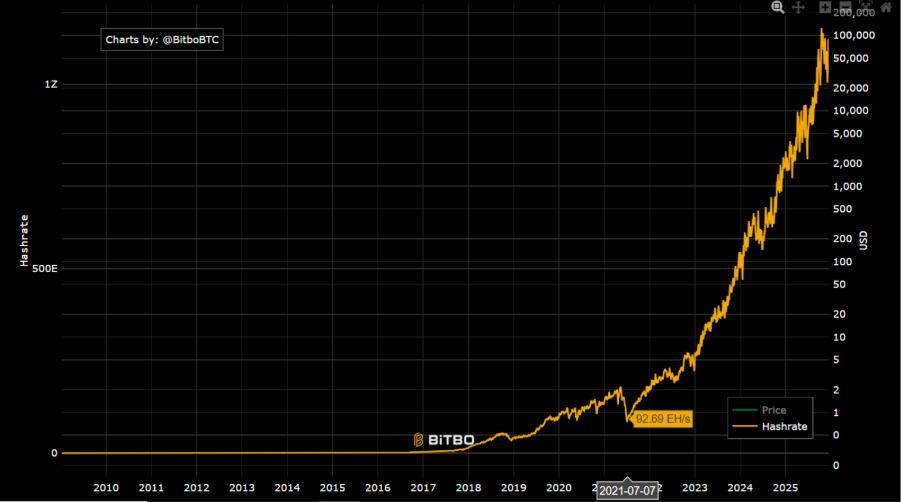
Even with quantum computing and Grover’s algorithm, something that could theoretically dramatically speed up mining power and speed up coin issuance, past the next difficulty setting, Bitcoin would integrate this new power and return to its normal issuance schedule.
In this way, Satoshi solved a historical problem with money: the possibility that technical innovation makes what was previously difficult easy, increases the money supply, and subtracts people’s purchasing power through inflation.
But it also brought a new twist to the contemporary conception that small inflation is desirable and even good, by causing the Bitcoin issuance schedule to decrease to a finite limit, in which no more coins will be issued. This has seeded a change in mentality, which begins in other cryptocurrencies, but expands to the rest of money, that scarcity is a necessary property of good money.
The value of Bitcoin’s difficulty lies not only in making it impossible for the advancement of the technique to devalue the value of money, but also in reintroducing it within economic logic. how valuable it is to have money that is difficult to produce. Difficulty adjustments are not only a technical solution, but also an economic one.
Disclaimer: The views and opinions expressed in this article belong to its author and do not necessarily reflect those of NoticiasVE. The author’s opinion is for informational purposes and under no circumstances constitutes an investment recommendation or financial advice.