
-
BTC price increases triggered the recovery and redistribution of lost BTC.
-
In July 2025, a whale sold about 80,000 BTC.
The number of idle bitcoins (BTC), currencies that have not moved in years, is decreasing.
According to the analysis released by Joao Wedson, CEO and founder of the on-chain analysis firm Alphractal, a relationship is perceived between the price of bitcoin and the number of coins considered out of circulation.
The specialist maintains that many attributed this phenomenon solely to the arrival of exchange-traded funds (ETFs). However, he emphasizes that the real trigger was the surpassing of the psychological threshold of USD 100,000 by bitcoin (BTC). “When Bitcoin reaches this price zone, the economic incentives completely change,” he explained.
In the following graph you can see what Wedson stated. As the price (black line) breaks new highs (such as $100,000), the volume of idle bitcoins (orange area) begins to decline.
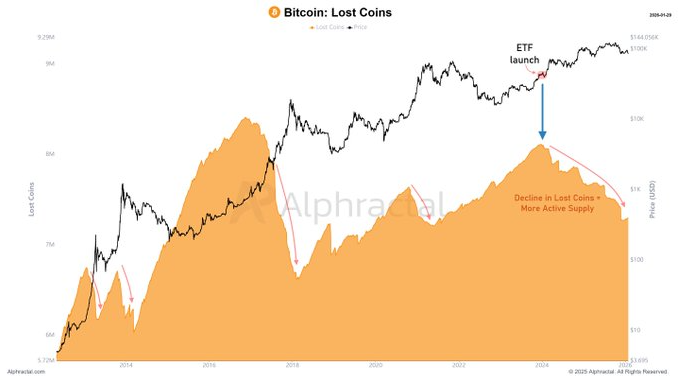
According to Wedson, The increase in economic value encourages historical holders a reactivar BTC.
For example, NoticiasVE reported several cases of Satoshi-era whales who set out to move their BTC. For example, last October, an address that mined about 4,000 BTC In 2009 it sold 150 units, at a value of almost 17 million dollars.
Likewise, in July 2025, another old BTC holder sold about 80,000 BTC, one of the largest bitcoin sales in cryptocurrency history of which there is a record. In September, another case was observed after the sale of more than 1,000 bitcoins.
Another illustrative case is that of the Casascius coins, physical pieces created between 2011 and 2013 that contained bitcoins sealed under a hologram. In 2025, the opening of two currencies with 1,000 BTC each released more than 2,000 dormant bitcoins for more than a decade (about USD 179 million at that time).
Recoveries and effects on supply
In addition to distribution by large holders, another key factor is the deliberate effort to recover BTC that were previously considered lost.
Wedson mentions cases of forgotten hard drivesold backups, abandoned multi-signature wallets, legal custody, inheritances and successions. In the analyst’s words, “currencies that were economically dead came back to life.”
From an economic perspective, the sharp price increase created sufficient incentives for people and companies to spend time and resources trying to recover those funds. Even in extreme cases, such as the frustrated search in a garbage dump for find a hard drive with about USD 760 million in BTC.
In perspective, this revival of whales and ancient coins can continue as long as the price maintains sufficient incentives, but it has a structural limit. A portion of the bitcoins are permanently lost, with no possibility of recovery, such as those whose private keys were destroyed or lost forever.
Estimates place that figure between 3 and 4 million BTC, including about 1 million attributed to Satoshi Nakamoto. This implies that, even as more coins “wake up”, a relevant portion of the total Bitcoin supply will definitely remain out of circulation.