
I want it to be clear from the beginning that this trap is made all politicians of all colors. The last trick goes to the transport minister, but it is a matter for politicians in general.
In just 48 hours, Spain experienced three serious railway accidents, with dozens of deaths and injuries. I do not go into the management of the tragedy or political issues, I want to focus on the data trap.
From the public administrations and, one politician in particular, it was said that investment in the railway network had increased by 90%. And having a grain of truth, I want to raise the issue of an issue that is done many times and that I don’t like one bit.
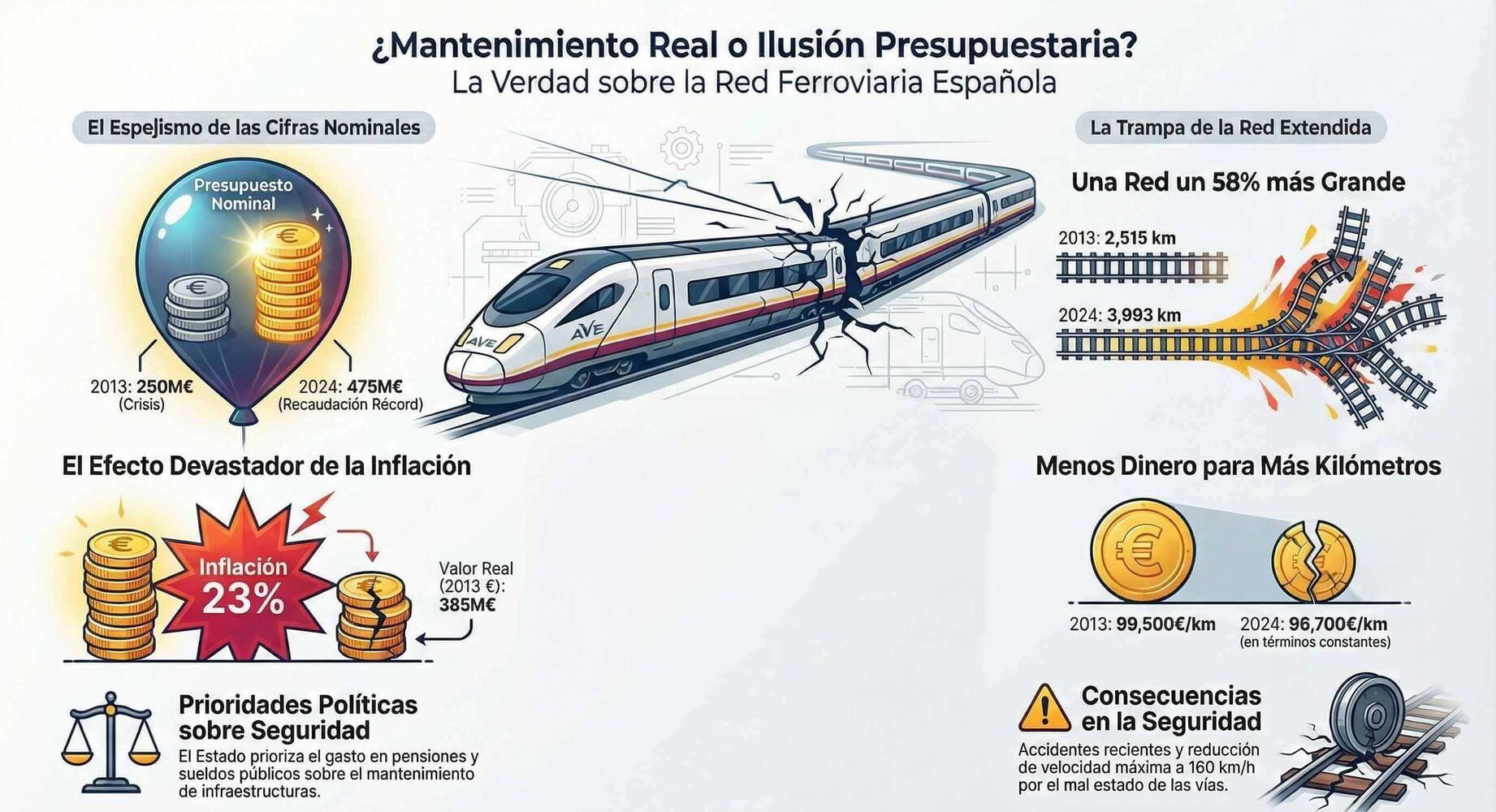
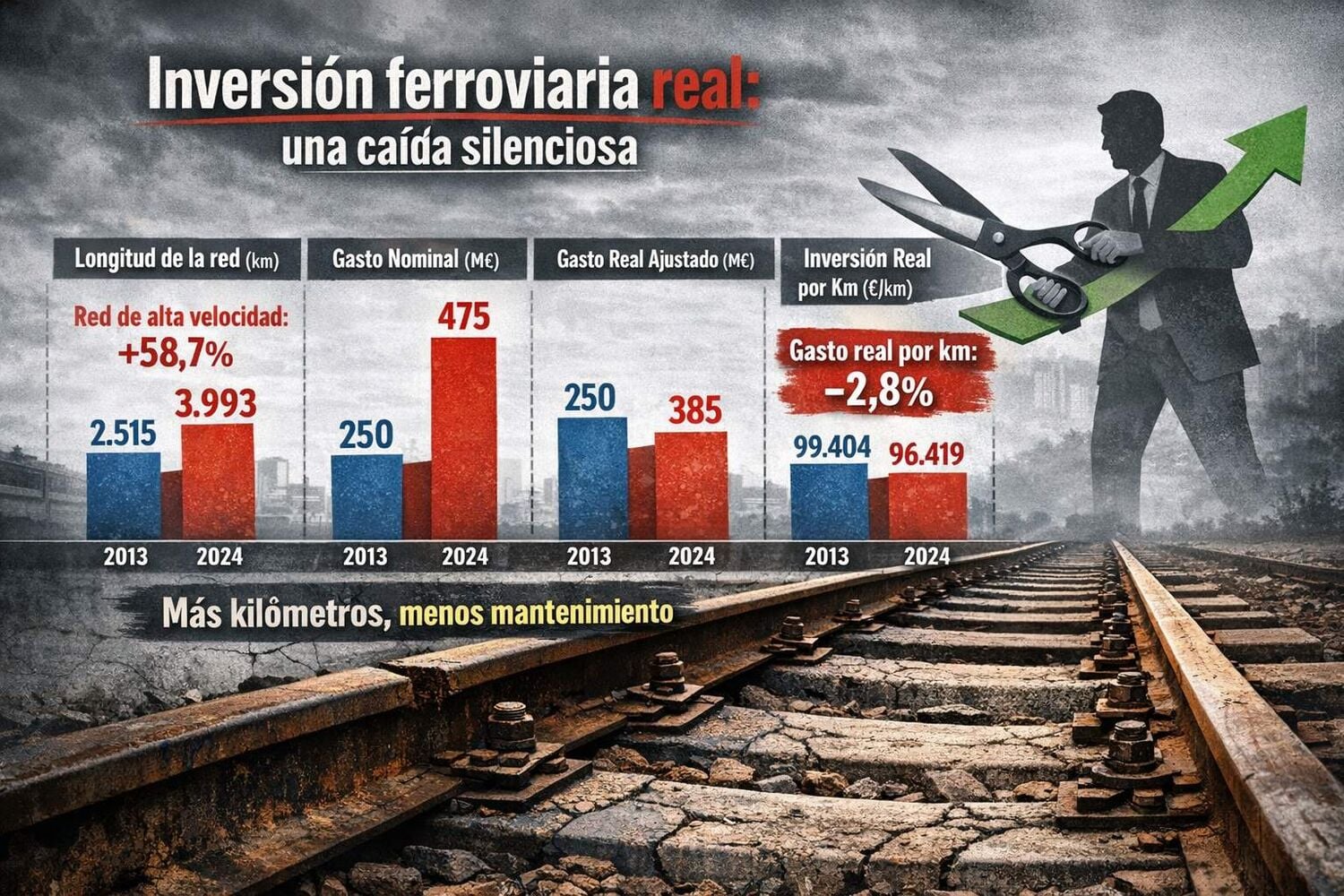
The figures they gave said that We have gone from an investment in 2013 of 250 million euros to one of 475 million in 2024. Up to this point it would seem to be a marvel. But let’s face reality…
The spending on real terms, not nominal ones It’s the first trap. If we discount inflation (and assuming that material costs have risen less than inflation, which is very generous), the expense is no longer 475 million, sino 385. Still, it is an additional 54%which isn’t bad either.
But of course, the kilometers of track have grown. In 2013, the year of cuts, we had 2,515 kilometers of high-speed roads, while in 2024 the kilometers were 3,993.
As it is, the calculation is simple. In 2013, the real investment per kilometer of track was 99,403.58 euros, and in 2024 it was 96,418.73 euros.. That is, a drop of 2.81%.
It’s not my place to say if it’s a little or a lot. I don’t want to get involved in political matters. But it is my obligation to uncover the hackneyed scam of camouflaged data that our representatives use.
Of course, it is more profitable in political terms to be photographed inaugurating a stretch of road than to spend on maintenance, which cannot be seen and does not allow for photos. But it is not responsible to stop spending on maintenance even if it does not allow you to take photos.
It is not worth asking if things go up in euros, but in real euros. And not only in absolute terms, but based on current needs (in this case the increase in kilometers of the high-speed rail network).
|
Year 2013 |
Year 2024 |
Variation |
|
|
High speed network length |
2.515 km |
3.993 km |
+58,7% |
|
Nominal Maintenance Expense |
250 M€ |
475 M€ |
+90,0% |
|
Real Expenditure (adjusted to 2013 euros) |
250 M€ |
385 M€ |
+54,0% |
|
Real Investment per Kilometer |
99.403,5 €/km |
96.418,7 €/km |
-2,8% |
It is as if today you spend 10 euros more on purchases than 10 years ago. But with an inflation of 23% and with 3 more children. Well, obviously, you are spending much less.
And, although I insist on not getting into political issues, I am especially concerned about this underfunding when we are in collection and debt maximums.
The combination of an aging network, insufficient maintenance and record revenue is a ticking time bomb. It is not just about economic efficiency, but about institutional responsibility. In terms of opportunity cost, every euro not invested in maintaining infrastructure is a risk that we assume as a society. And not only for safety, which is the priority, but for the number of contracts that we are seeing paralyzed from our companies abroadwho have no fault in the fact that the cost of maintaining the road has been reduced.
And if we really are prioritizing sustainability and green mobilityneglecting the train—the most emissions-efficient means of transportation—is a glaring contradiction.
This is not about criticizing a minister, but about calling on our political class to treat us like adults. Don’t give us restricted information, please.