
Robotics has advanced by accelerated steps in the last decade. Robots like Atlas, from Boston Dynamics, are already able to run, jump and even perform acrobatics. Tesla, on the other hand, presumes from Optimus, his humanoid robot with industrial aspirations.
There are also robotic arms in operating rooms, exoskeletons for people who are in rehabilitation, autonomous drones and even domestic assistants who learn routines, but not everything in this field is limited to doing tasks as the aforementioned.
A more ambitious research line – and less known – explores if Machines can grow like living beings and strengthen using pieces of other robots. This experiment, known as robotic metabolism, is already underway.
Robots that feed on their surroundings to grow and survive
A team of researchers from Columbia University, in the United States, has designed a system that breaks with the traditional idea of robots as fixed structures. This advance It allows machines to modify their shape and size by incorporating external moduleseven other robots.
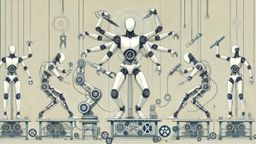
That is, not only are they repaired or expanded, they literally grow. The key is in a type of pieces called Truss Linkssmall structures with magnets that allow geometric assemblies – such as triangles or tetrahedra – that combine under control to form more complex and functional figures.
For now, The process is still led by a central systemwhich means that decisions are not taken by the machine, but the researchers, who define from a computer how the robot should be reconfigured. But the important thing is not in autonomy, but in the principle it represents.
A machine no longer needs a technician to repair or update itif there are pieces available around it – even remains of other devices – can absorb them and reorganize to be more efficient. Controlled, yes, but with a clear direction, which is to build robots that do not depend on anyone to stay alive.
What we call adaptation in biology, here it becomes a type of cannibalism. In the experiments, some structures grew by incorporating leftover modules from others. They increased their size, reinforced their stability or gained mobility. This means that if a robot finds in its environment compatible parts of others, you can integrate them to enhance.
It should be noted that this type of technology is not intended to operate in laboratories or companies, its real potential is found in extreme environments where there is no room for error or possibility of human maintenance. In a space mission, for example.
But you can design A robot capable of using what I find to mutatethe same in a building collapsed after an earthquake, in an underwater cave, or in damaged nuclear facilities where access is impossible. The logic is simple: if a machine has to work in isolated conditions, it will need more than artificial intelligence.
It needs a body that adapts, that is repaired, that survives, and that is just the approach that opens this new generation of modular robots, which are not designed only to move, but to change, as if they were organisms.
The next step: that they think for themselves
Right now, everything that these machines do is perfectly choreographed from outside. They do not make decisions, but Researchers already work in the integration of sensors, decentralized control and automatic learning algorithms.
In the end, if they manage to combine those elements, The robots can not only be rebuilt, they will also know when to do ithow to reorganize your pieces, even what structure adopt based on the task. Imagine that a machine needs to go through a narrow tunnel, it could reduce its size, advance disassembled and, once on the other side, reconfigure with the available parts.
We are not talking about simple automation, but of programmed physical adaptation, and that, with artificial intelligence, is a matter of time. One of those responsible for the project, Professor Hod Lipson, clearly explains it: «The image of robots that reproduce themselves evokes some unfavorable science fiction scenarios.»
But if we are going to delegate to them critical tasks – conduction, defense, exploration – we cannot always depend on humans to repair them, robots must learn to take care of themselves. What a few years ago looked like a scene of Terminatortoday begins to take shape.
Machines that not only execute tasks, but modify your bodythat they do not expect instructions to continue working, but act on themselves to survive in impossible conditions. Robotic metabolism opens a disturbing door, yes, but also inevitable.
Know How we work in NoticiasVE.
Tags: robots