
Mathematician and web developer Melvin Carvalho shared a report in which he accuses members of the Bitcoin Core client of discursive manipulation (gaslighting, in English) and censorship in the debate over removing the data cap from the opcode OP_RETURN.
The mathematician bases his mention on gaslighting in which from Core they maintained behaviors such as “repeat until it is true”, “appeal to authority” and “censor dissent”as well as presenting as “resolved” an issue with broad opposition.
In Core version 30, the limit was extended from 80 bytes to 100 KB for appending data in transactions using the opcode OP_RETURN, a statement that inserts arbitrary information (such as text or references) into transactions, which It generated discomfort in part of the community.
In his report, Carvalho states that the change was presented as a simple relay policy adjustment in the Core node policy, when, in his vision, it modifies the economic function of Bitcoin by incentivizing data storage. In that sense, as reported by NoticiasVE, at the end of last October, almost 40% of transactions they did not move monetary value.
Additionally, the web developer maintains that The enlargement did not have «approximate consensus»since in the official repository there were 423 positions against compared to 105 in favor, a ratio close to 4:1.
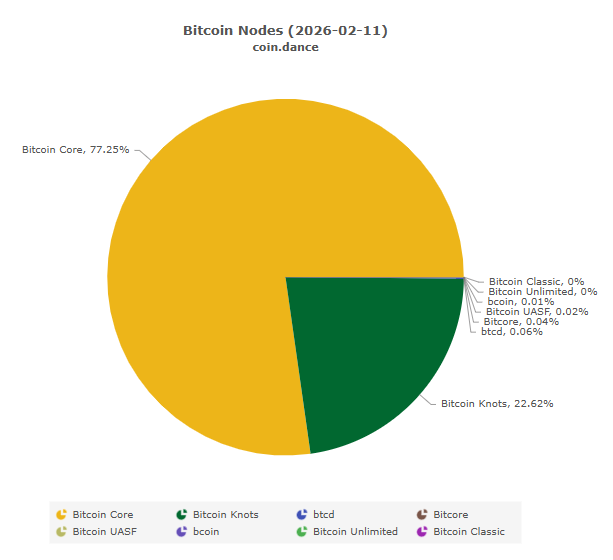
Likewise, Carvalho highlighted the growth in adoption of the Bitcoin Knots client and that “the community response” was the creation of BIP-110, a soft fork proposal to reduce data storage in Bitcoin.
The arguments in favor of extending OP_RETURN and Carvalho’s rebuttals
Carvalho notes that developers such as Pieter Wuille and Peter Todd argue that the OP_RETURN limit was irrelevant because it could be circumvented by data in the witness field, multi-signature schemes, or direct sending to miners, which would render the retransmission policy ineffective; However, he replies that if the filter reduced the visibility of those transactions in the mempool (where they wait for confirmation) So it did have a practical effect and was not merely symbolic.
It also refutes the idea that expanding OP_RETURN is the “lesser evil” in the face of contamination of the set of unspent outputs (UTXO), the database that each node maintains to validate payments.
In his opinion, it is not a question of choosing between «unlimited OP_RETURN» or «UTXO contamination», but of maintain limits and correct specific abusessince going from 40-80 bytes to 100 kilobytes transforms the opcode from data anchor to “a data highway.”
Regarding the risk of centralization, Carvalho questions whether the historical filter has generated private advantages for miners and maintains that there has been no clear evidence of this effect in more than a decade.
On the contrary, he warns that facilitating large volumes of data could attract actors with sufficient capital to negotiate direct infrastructure with miners, reinforcing concentrated dynamics.
Regarding governance, he emphasizes that, although the nodes’ relay policy is not part of the consensus (the rules that validate blocks), the default values of the Core client influence the majority of the nodes, since this software is currently operated by more than 77% of the total nodes, so changing the default behavior de facto alters the flow of transactionsaccording to Carvalho.
Finally, Carvalho alludes to the fact that developers such as Zhao, Adam Back, Antoine Poinsot appeal to neutrality: the software should not judge which transactions are legitimate based on their content.
The mathematician responds that Bitcoin has always applied standardization rules to protect the network, so eliminating a specific limit is not absolute neutralitybut a decision about what uses are encouraged and who assumes their costs.