
The United States has launched a new generation of defense against an ever-growing threat: drones. The L3Harris company has developed the VAMPIRE system, a platform capable of intercepting and destroying unmanned aircraft in a matter of seconds.
Its strong point is versatility, because it can be installed in vehicles, boats or helicopters, adapting to any combat scenario.
Drones have become the most unpredictable enemy in today’s war, since they are cheap, difficult to track and capable of causing serious damage, even with limited means. And an example is the war between Ukraine and Russia, where the use of these devices is constant.
Given this reality, The United States seeks more agile solutions, but above all more economical than expensive traditional anti-missile systems. Therefore, the VAMPIRE was born with that purpose, which is to offer fast, precise and affordable defense.
Here we tell you in detail how this technology really works, what makes it different from conventional weapons and why it is already marking a before and after in the way we combat aerial threats.
What is the VAMPIRE system and how does it work?
The VAMPIRE, acronym for Vehicle-Agnostic Modular Palletized ISR Rocket Equipmentis an autonomous and modular defense system designed to shoot down drones and remotely controlled aircraft. Its main advantage is the ease of installation: It can be mounted on almost any vehicle or vessel without structural modifications.
In a matter of minutes, a truck or boat becomes a fully operational anti-drone platform. In addition, the system combines optical and infrared sensors with artificial intelligence capable of identifying a target, following its trajectory and deciding the optimal moment of attack.
The entire process – detection, analysis and neutralization – occurs in seconds, without the need for human intervention. Its architecture allows it to be deployed in environments where missiles would be unfeasible due to cost or size. In addition, VAMPIRE significantly reduces the cost per drone shot down, making it a much more profitable alternative to classic anti-aircraft systems.
Multi-domain operations: land, sea and air
One of the system’s greatest strengths is its ability to operate in multiple domains. On the ground, the Stalker XR version multiplies its firepower by incorporating up to twelve kinetic munitions, ideal for neutralizing swarms of drones.
Another variant, called Killcode, replaces projectiles with electronic interference, disabling drones without causing explosions.
At sea, The Black Wake version is installed on manned or unmanned vessels, protecting convoys and ports against low-altitude aerial threats. In the air, the Dead Wing model transforms helicopters into drone hunters capable of intercepting targets in flight.
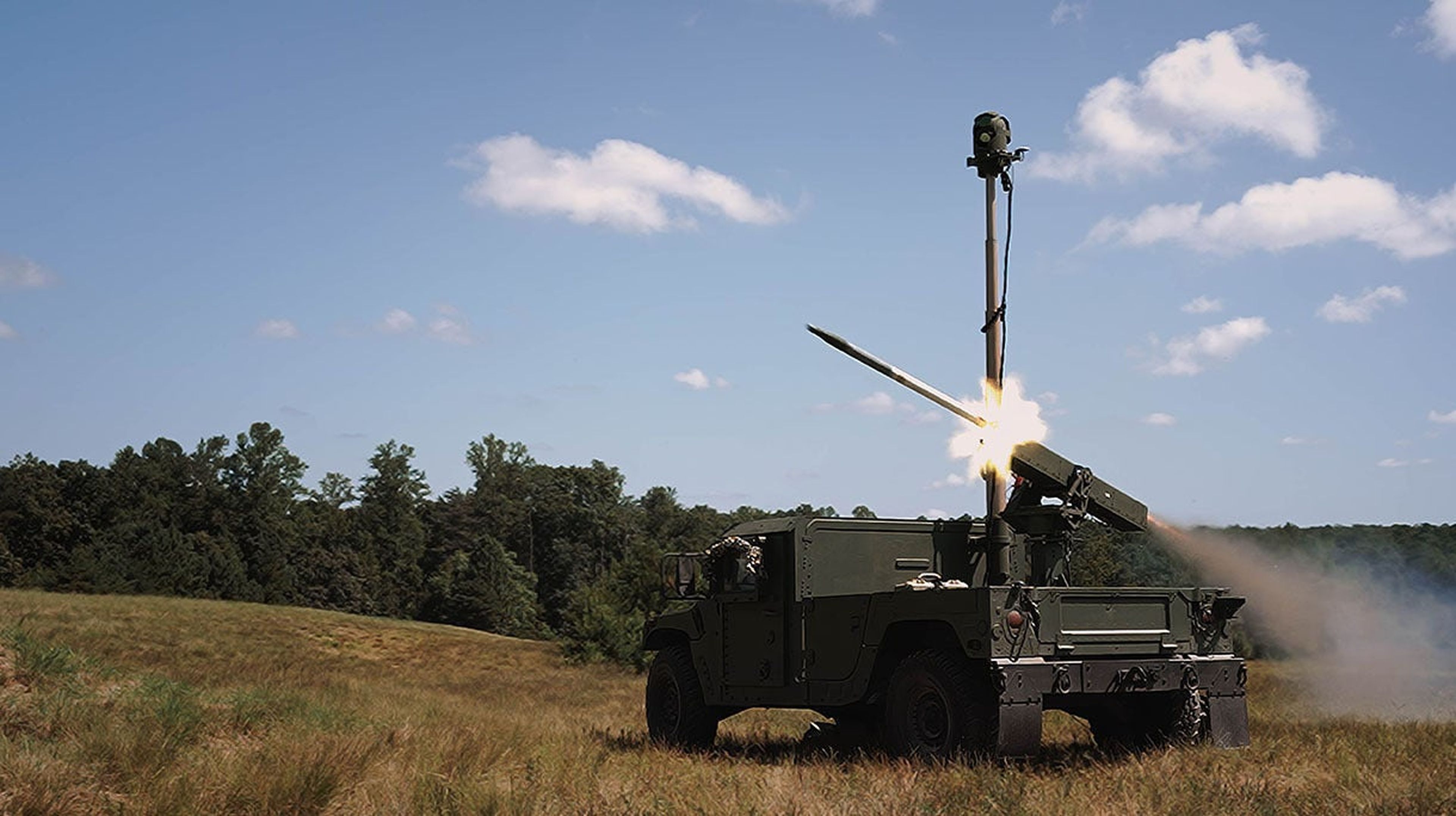
L3HARRIS
The new generation of VAMPIRE incorporates machine learning algorithms that reduce the reaction time between detection and shooting. The more you operate, the more you learn about the flight patterns and behavior of enemy drones, improving their effectiveness over time.
Its modular design not only facilitates installation, it also allows the system to be updated with new sensors or weapons without having to rebuild the platform. This means that the same computer can adapt to future threats without completely replacing itself.
In addition, the combination of AI with thermal and optical analysis makes the system work even in conditions of low visibility, at night or with atmospheric interference. In practice, the VAMPIRE can operate in almost any situation, something essential for highly mobile military operations.
Leonidas and other anti-drone systems
The VAMPIRE is not alone in this race to dominate airspace, and the United States has also developed other anti-drone systems, such as Leonidas, capable of shooting down up to 49 drones at the same time using microwaves.
This technology, manufactured by Epirus, does not physically destroy targets, but rather disables them by disrupting their electronic circuits. It has proven its power in recent tests, where eliminated entire swarms of drones in just seconds. However, its size and cost limit it to more specific scenarios.
VAMPIRE, for its part, is committed to mobility and low maintenance, which makes it more practical for rapid deployments or changing environments. Both represent a clear trend, which is to replace heavy artillery with intelligent systems capable of responding instantly.
The rise of drones has forced us to rethink security strategies, so what was previously solved with long-range missiles, today requires more precise, faster and adaptable tools. In this context, L3Harris offers a solution that combines technology, economy and efficiency.
Get to know how we work in NoticiasVE.
Tags: drones