
-
It ensures that the United States is the «cryptocurrency capital of the world,» Trump reaffirmed.
-
The legislation seeks to protect the bitcoin market from “China control.”
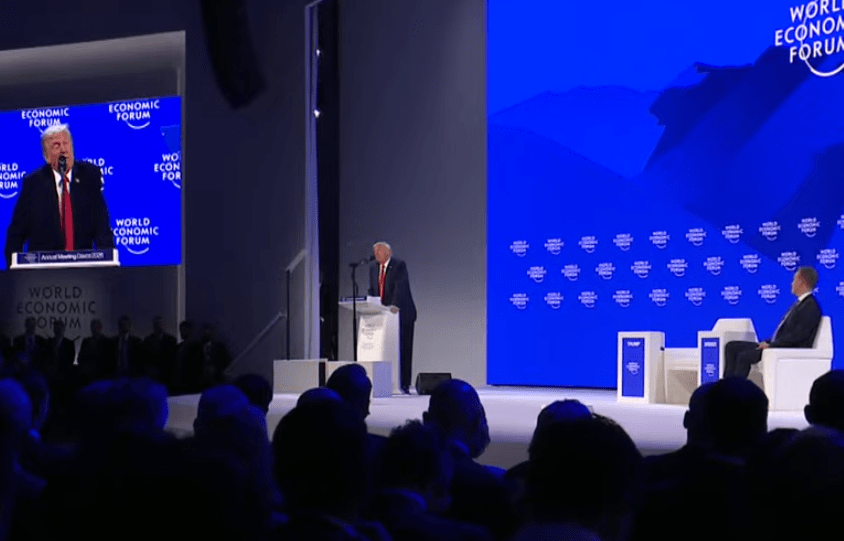
The president of the United States, Donald Trump, used the stage of the World Economic Forum in Davos, this January 21, to place particular emphasis on his laws on the bitcoin (BTC) and cryptocurrency sector.
These are two key legislative initiatives aimed at “ensuring that the United States remains the cryptocurrency capital of the world.”
Before a global audience, and in front of the main managers of the world’s traditional financial system, the president talked about regulation to “give structure to the cryptocurrency market” in the United States.
He recalled the already sanctioned Genius Law and announced the imminent signing of the proposal Clarity Act, on which Congress «is working very hard». His goal, he said, is to “unlock new pathways for Americans to achieve financial freedom” and, crucially, “ensure the US is the cryptocurrency capital of the world.”
The defense of these laws is framed, according to Trump, in a dual strategy. On the one hand, he recognized the «tremendous political support» that these initiatives have generated. On the other hand, he highlighted an unavoidable geopolitical motivation, such as the need to prevent China, a strategic rival, from taking the reins of this emerging sector.
Cryptocurrencies as an “economic pillar”
He added that the previous administration (Joe Biden’s) was totally against it until before the elections, «when they realized that millions of people were voting against them because of cryptocurrencies,» Trump said.
Furthermore, he presented the support for innovation focused on cryptocurrencies as a pillar more of what he called an American economic “miracle.” The president painted a picture of unprecedented prosperity, with accelerated growth and inflation under control, defying predictions of recession and runaway inflation.
In his speech, Trump attributed this success to his policies of tariffs, deregulation and the expansion of fossil fuels. It projected GDP growth of 5.4% for the fourth quarter and highlighted underlying inflation of 1.6%.
Trump contrasted this panorama with the «stagflation nightmare» of the previous administration, which he associated with low growth and high inflation, while his policies, he assured, have achieved precisely the opposite.
Geopolitics with Bitcoin
Trump’s vision in Davos was not limited to US borders, criticized the European model for its «increasing public spendingmass uncontrolled migration and endless foreign imports.
He also questioned what he called the “Green New Scam.” With this he referred to energy transition policies, particularly those focused on renewable energies such as windmills, which he considers a massive deception or fraud.
In this context of global competition, Trump’s bitcoin and cryptocurrency strategy shows that he seeks internal economic benefits, but also to strengthen the US position against its rivals.
The explicit mention of China as an actor that must be surpassed in controlling the digital asset market makes clear the geopolitical dimension of these cryptocurrency laws to structure the local market.
In this way, Trump reaffirmed that regulation and leadership in the field of digital assets are a cornerstone of his strategy to ensure the economic and technological hegemony of the United States.
As part of this message, the Trump administration deployed the USA House in Davos. As NoticiasVE reported earlier, this is a high-profile private space, organized independently, recognized by the State Department. It has sponsors from the cryptocurrency ecosystem, such as Ripple and Hedera, and is showing in Switzerland the broad interest of the United States in the world of digital assets.