
On September 3, an X account managed by the Ethereum Foundation (EF) published a report detailing «28 things that the ecosystem achieved in recent weeks.»
That report synthesizes which considers how MAIN ADVANCES OF THE PROTOCOLranging from digital governance to decentralized finances (Defi) and the adoption of Stablecoins.
Private Chain Voting for Dao
The Aragon Project and Privacy Ethereum platforms implemented an encrypted and verifiable voting system thanks to Zkmaci, a technology based on zero knowledge techniques (zero knowledge, ZK).
This allows decentralized autonomous organizations (DAO) to carry out internal elections Without compromising the privacy of voters.
A DAO is a digital organization model that uses intelligent contracts to make collective decisions. With the use of ZK, DAOs can Protect identity and personal data of its participants and guarantee auditable results, something that brings them closer to more transparent and reliable governance systems.
Stablecoins supply growth
According to the report, the total of Stablecoins issued in the Ethereum main network reached A historical maximum of 160,000 million dollars.
The stablecoins function as a bridge between traditional finances and the cryptocurrency ecosystem, since they maintain their value tied to assets such as the US dollar.
This increase in issuance and circulation reflects that Ethereum remains the Dominant infrastructure for the creation and use of these stable digital assets.
In that sense, data firm data onchain Artemis support Ethereum’s supremacy in the ecosystem of stablecoins.
As seen in the following graphic, since the end of 2019, Ethereum is the chain where the greatest supply of Stablecoins moves, surpassing Tron, Solana, BNB Chain and others:
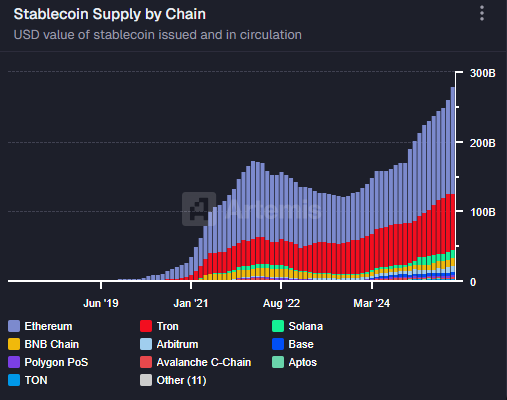
Although the use of the Tron network to especially move the USDT stable grew notoriously in recent months, Ethereum is still the queen in that aspect.
A new real -world asset market (RWA) from AAVE
Aave Labs, one of the most used protocols in Ethereum, launched Horizon RWA, a market that allows institutions take loans in stablecoins using real world assets (RWA) as collateral.
RWA include traditional assets such as bonds, invoices or tokenized goods. Its integration into Ethereum allows these instruments to be used within defi applications, expanding the scope of the protocol beyond digital native assets.
On the other hand, the report also indicated that AVE exceeded 60,000 million dollars in net deposits in the time studied. The growth of AAVE in deposits shows the trust of users in this type of open financial solutions.
The use of PayPal’s stable and uniswap increased record marks of exchanges
El token PYUSD registered 10.7 billion dollars in quarterly transfersa figure much higher than 2.7 billion quarter of the previous year.
The participation of a global company such as PayPal in Ethereum confirms the role of the protocol as an infrastructure for international payments and transfers.
Pyusd’s evolution shows that users They are adopting these solutions in real and everyday environmentsnot only within the cryptocurrency sphere.
On the other hand, UNISWAP, the main decentralized exchange protocol (DEX) in Ethereum registered 719 million operations in one year.
Unlike a centralized exchange (CEX), UNISWAP allows users to exchange tokens directly between them through Intelligent Contracts.
Gemini Wallet launch
Gemini announced on August 14 the arrival of a smart wallet based on passkeys (digital credentials generated by devices), designed For self -ustody In Ether (ETH) and its second -layer networks assets (L2).
Los passkeys They replace traditional passwords, seeking to reduce entry barriers for new userswhile reinforcing the importance of maintaining direct control over the funds.
Ronin Network transition to an Ethereum L2
Ronin Network communicated his August 14 Conversion to an Ethereum L2 networkreincorporating one of the biggest ecosystems of gaming of web3.
Ronin is, among others, the native Axie Infinity chain, a game «play-to-earn» (Play to win) with non -fungible tokens (NFT) that popularized raising and tradeing digital creatures in 2021.
Currently, Ronin is a sidechain (side chain), that is, an independent network that operates in parallel to the main network (Ethereum in this case), but is linked to her through a bridge (bridge) to transfer assets.
Operate through a bridge between a sidechain and the main layer implies risks such as hackeos, failures in bridge safety or errors in smart contractswhich can result in the loss of funds.
By 2026, the team behind Ronin will migrate to an L2 of Ethereum to take advantage of the Ethereum security and liquidityovercoming its current limitations as sidechain.
GRALS UPDATE IN STARKNET
Starknet, an L2 with zero knowledge tests, launched the Gran Update, which points to the decentralized transactions sequencing.
However, cryptonoticia reported hours of hours due to technical failures at the time of implementing the update, requiring adjustments and reflecting challenges between innovation and stability.
Verification of 15 million humans by Worldcoin
According to the report, the Worldcoin project It reached 15 million human identities verified since its launch.
This network uses iris scanners to generate unique Ochain identifications, in exchange for rewards in WLD tokens. The devices capture iris patterns for private keys, provoking ethical debates about privacy.
Thus, the exposed developments, together, reinforce the position of the protocol as a multifaceted infrastructure For financial and social applications.