
-
It is celebrated that Pix and Drex include millions of Brazilians without credit cards.
-
Galipolo ensures that Brazil no longer develops a payment system, but asset token.
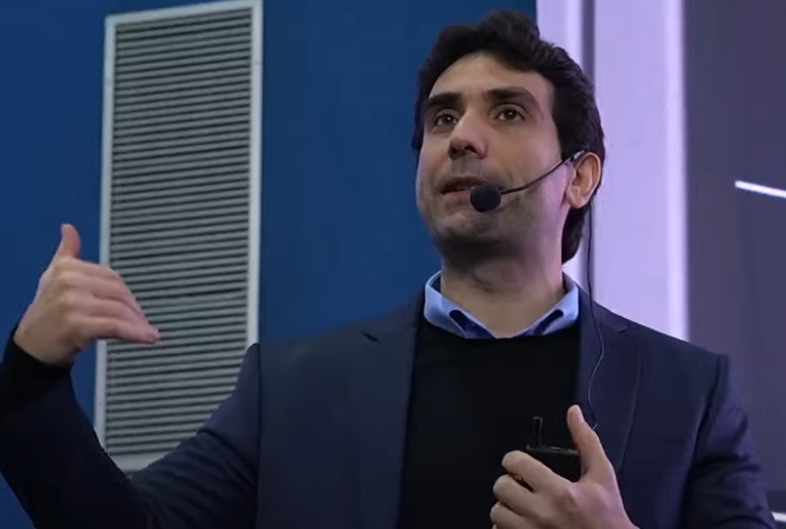
Gabriel Galipolo, president of the Central Bank of Brazil (BCB), said today that while the global powers debate and design their digital Central Coins (CBDC), Brazil has already solved with its PX system most of the problems they seek to solve. The statement tries to position the South American country as a pioneer who marks the rhythm in the revolution of digital payments.
The PX is a network of instant payments that connects banks, fintechs and intermediaries approved under the supervision of the BCB. It is not a distributed accounting book that is shared between thousands of nodes. As Cryptonoticia reported at the time, it is about a system developed with the idea of Compete with Bitcoin.
During the start of the Blockchain in Río Galipolo event, he said that it is essential to preserve the PX as a «digital public infrastructure.» He stressed that this system, launched in 2020, was responsible for the inclusion of millions of Brazilians in banking services.
According to their figures, today, PX represents 76.4% of the population’s preference, reaching 159 million people and 15 million companies.
With this level of adoption, for Galipolo it means that the instant payments system already effectively addresses the main objectives of the CBDC. «I have argued in these debate forums that perhaps solutions such as Pix already address a good part of these problems,» he said, suggesting that many countries could be unnecessarily complicating their development without first having a system of robust instant payments.
His argument does not support the theory, but in what Galipolo catalogs as a success and part of a legacy that «has produced a revolution.» This system allows 24/7 transfers in less than 10 seconds, for free for users. He believes that his mass adoption democratized access to financial services for millions of people and dynamited the dependence on cash.
To avoid confusion, Galipolo clarifies a fundamental distinction when he says that Pix is not a CBDC. He even said that Pix is an infrastructure of payments other than the Drex (real digital system) that has a different purpose.
That Royal Digital Platform, which has been praised by the International Monetary Fund (IMF) and with which in 2023 the first bank transfers were made, «it is much more related to the asset tokenization process», as explained by the president of the BCB, and its end is «to facilitate credits [cuando un préstamo está garantizado por un activo]… and transactions with lower pressure and lower costs ».
With his speech, Galipolo makes it clear that Brazil advances on two fronts simultaneously. On the one hand, consolidate Pix as a solution for payments of the present. On the other, explore, with the DREX, the model that 98% of the world economy already studies closely, a fact that the BCB president himself confirms:
«There is a huge demand for several other monetary authorities to understand what the Central Bank of Brazil was to do … This is something that we must be proud.»
Gabriel Galipolo, president of the BCB.
Brazil’s payment systems still have pending tasks
Galipolo also addressed the criticisms of the security of Pix, describing as «fun and crazy narratives», which cataloged as exaggerated fears about its impact. However, a cyber attack in July 2025 exposed vulnerabilities in the system.
According to Diego San Esteban, president of Latam Open Finance, the attack on C&M Software, a approved Pix intermediary, allowed the diversion of between 400 and 800 million Brazilian reais (approximately 70 to 140 million dollars) of reserve accounts of at least six financial institutions, including BMP and Paulista Bank.
San Esteban’s analysis reveals Pix’s vulnerability, although Galipolo promotes his «maximum security». This payment system, developed by the State, depends on a centralized infrastructure. This fragility exposes the system to significant risks, contradicting security promises and evidencing the need to address their structural weaknesses.
Without referring to cyber attack, Galipolo now spoke about new Pix functionalities, such as the possibility of disputing transactions through bank applications, to guarantee «maximum security.» The Central Bank also announced plans to reinforce audits to intermediaries and establish operational limits in reserve accounts to prevent future incidents.
On the other hand, the Central Bank celebrates that PX allows 60 million Brazilians without credit card to access services such as streaming, promoting financial inclusion. However, this «inclusion» is conditional, since it requires integrating into a regulated banking system that, by design, excludes many.