
In the heart of the South American Caribbean, Venezuela is going through one of the most prolonged economic crises in the region. Between persistent inflation, the collapse of the banking system and international sanctions, Tether (USDT) emerged as a functional alternative to overcome financial difficulties.
Some reports indicate that the Central Bank of Venezuela (BCV) has explored the use of USDT to facilitate payments to private companies and transactions linked to the oil sector, while state signatures such as Petróleos de Venezuela (PDVSA) have transferred part of their dollar income to this stablecoin, generating channels that injected digital currencies directly into the local economy.
According to the Venezuelan economist Asdrúbal Oliveros, The State is making more USDT settlements than in dollars Americans. For the specialist, this mass adoption responds to the combination of international sanctions and the search for operational efficiency.
However, Tether, as a centralized USDT issuer, can block funds in compliance with orders from US authorities, particularly through the Office of Foreign Assets Control (OFAC) of the Treasury Department.
So far, No general orders have been registered of USDT freezing In Venezuelawhich benefits multiple companies, to the Venezuelan state and the same population, since its use for remittances and savings are other pillars of their economy.
During 2023, it is estimated that almost 500 million dollars arrived in the country through digital assets, mainly in small transfers of up to $ 1,000. This mechanism allows Venezuelans to receive money from abroad in a matter of minutes, avoiding the limitations and costs of traditional channels, and facilitating their conversion to Bolivars or USDT for everyday use.
According to Chainysis data, Venezuela is among economies with a significant retail activity in cryptocurrencies. In its regional analysis of Latin America, the firm reports that the country registered 44.6 billion dollars in transactions between July 2022 and June 2025, located in the fourth place in the region, behind Brazil (1.1 billion dollars), Argentina (93.9 billion) and Mexico (71,200 million).
In the last decade, the Bolívar – the official currency of the nation – has lost Value in a worrying way. Although inflation rates have dropped to the 2018 peak – when the country exceeded 1,000,000% -, in 2025 they remain at high levels, with an year -on -year rate that in April was 172%. Given this scenario, keeping money in the local currency is equivalent to losing purchasing power almost immediately.
For this reason, for years Venezuelans resort to Bitcoin (BTC) and USDT to protect their money. Initially they did it on platforms such as the already missing localbitcoins, and now largely through Binance P2P, the exchange system between users of Exchange Binance.
Simple and fast transactions
The lack of currency and the limitations of the banking system have generated a unique phenomenon in current Venezuela: Today, 100 USDT can pay more than 100 dollars in cash. As explained by Financial Educator Orlando Sevilla in statements cited by cryptonoticia, the stablecoin provides advantages that the ticket cannot offer: among them security, ease of movement and global acceptance.
Seville said that USDT allows you to send money to shops anywhere in the world in seconds and without exposing yourself to the risk of loading effective. He also warned that the use of tickets for payments or border changes-for example, on the Colombian-Venezuelan border-implies transportation expenses and operational risks that decrease their effective value.
In a country where transactions in Bolivars continue to be characterized by bureaucracy and recurring falls of banking systems, USDT offers almost instant and global transfersexecuted in networks such as TRON (TRX) or ERC-20, with minimal costs per operation.
Today, paying with USDT has become common in Venezuela. From supermarkets to distribution services, numerous businesses and suppliers accept this stablecoin, which has been consolidated as a fundamental anchor in a crisis economy.
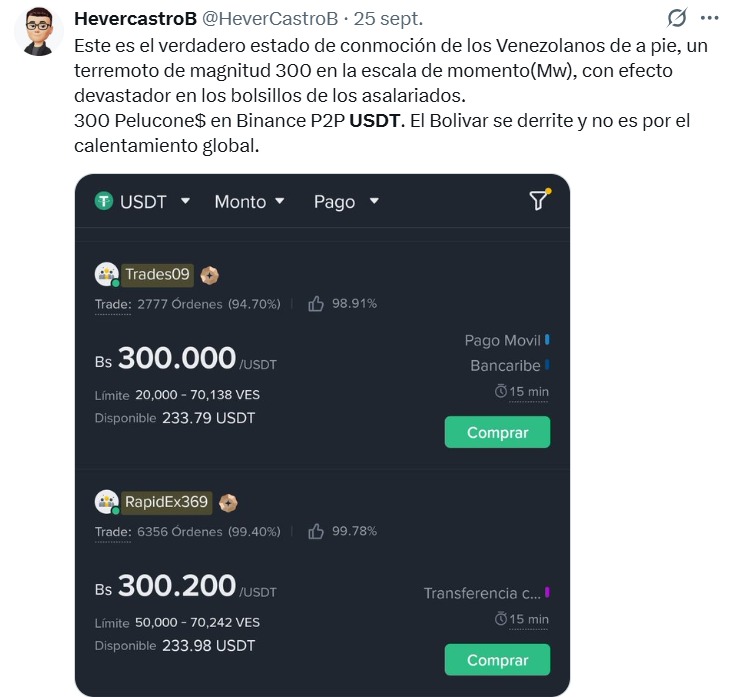
At this point it is important to mention that, in recent weeks, the Bolívar depreciated again, reaching 187.28 bolivars per dollar according to the Central Bank page. Meanwhile, USDT is quoted in the Binance P2P market between 297,780 and 298,650 bolivars for sale, and showing a significant difference in front of the local currency.
The rise of the stablecoin of Tether in Venezuela is not explained solely for its link with the dollar, but also due to the general distrust in financial institutions and the need to have tools that operate beyond political borders.
As the bolivar loses relevance and access to cash is reduced, USDT is consolidated as the mechanism that maintains an economy that survives more for ingenuity than by stability.