
The world faces a panorama of uncertainty and growing competition. This is what the World Economic Forum’s (WEF) Global Risks Report 2026 reveals, which describes an «economic reckoning» in a context of confrontation with interconnected risks that could destabilize societies and economies in the next two years.
The document analyzes global risks across three time horizons (2026, up to 2028 and up to 2036), based on the Global Risk Perception Survey (GRPS) in which more than 1,300 analysts participated.
Instead of a rigid structure of specific forces, the report highlights dominant risks such as geoeconomic confrontation (the number one most likely risk for a material crisis in 2026, selected by 18% of respondents). Also misinformation and social polarization, along with growing economic concerns such as recession, inflation and possible bursting of asset bubbles.
Among the key factors identified are:
1.-Concerns about debt sustainability
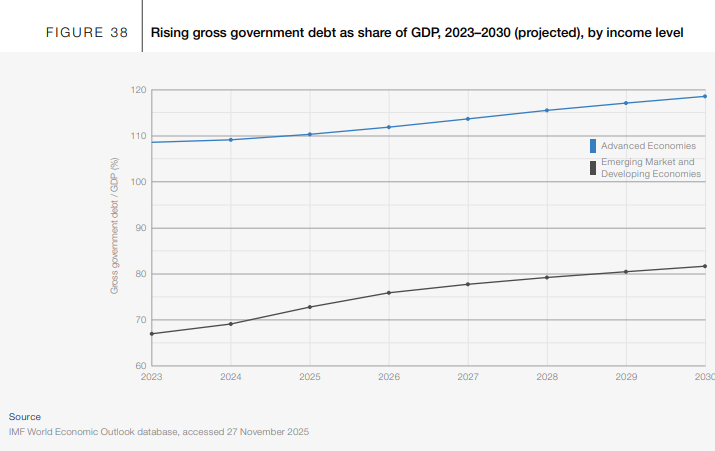
The first area of concern highlighted by the WEF is economic. Global debt has reached a dizzying figure of 251 trillion dollars, equivalent to 235% of world GDP. However, the problem is not only the magnitude, but the «moment of truth» that looms between 2025 and 2027.
In this period, nearly 45% of the sovereign debt of the economies of the Organization for Economic Cooperation and Development (OECD) and a third of global corporate debt will have to be refinanced. The scenario is hostile because interest rates remain at levels not seen in decades and public spending pressures are inescapable.
For many of the analysts consulted by the WEF, this financial bottleneck could increase economic volatility, contributing to a broader adjustment that destabilizes markets and societies, in a context of geoeconomic confrontation.
2.-The erosion of the Central Banks
As the traditional system creaks under the weight of debt, the control of monetary authorities is evaporating. The report warns of a growing trend in emerging economies in which the exodus towards stablecoins is taking place, a point also observed by NoticiasVE.
The report indicates that these accumulated purchases could reach $1.22 trillion by the end of 2028, compared to approximately $173 billion recorded in October 2025. It indicates that, according to this projection, the flows could weaken national financial systems and put the monetary sovereignty of the affected countries at risk, by reducing the ability of central banks to maneuver in contexts of high adoption of these stablecoins.
3.-Geopolitics and the mirage of AI
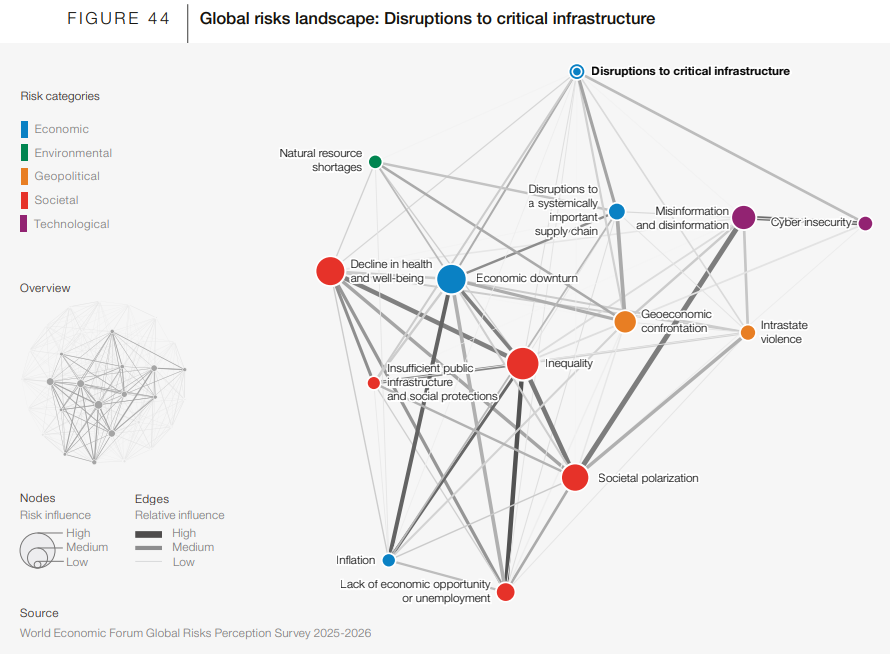
The third factor is the fracture of the global dialogue. Geoeconomic confrontation has escalated to become the most serious immediate risk for 2026, as presented in the document. The use of sanctions, investment controls and capital restrictions as strategic weapons has blocked the possibility of collective solutions, it is added.
In this climate of mistrust, massive investment in Artificial Intelligence—projected at $2 trillion by 2026—is viewed with a mix of hope and skepticism. WEF analysts warn that, if the profitability of these projects does not meet expectations, we could witness the bursting of an asset bubble that would push investors to seek refuge in digital assetsperceived as more resistant to state intervention and persistent inflation.
A «stormy» panorama
The consensus among the more than 1,300 analysts who participated in the Forum survey is bleak. This is because 50% anticipate a «turbulent or stormy» outlook for the next two years. In the long term, the figure rises to 57%.
The report concludes that 2026 marks the beginning of an «era of competition» where protectionism has replaced multilateralism.
Although the World Economic Forum avoids putting an exact date for a systemic collapse, the diagnosis is that the conditions for greater economic and social volatility are already in placedriven by interconnected risks such as geoeconomic confrontation, debt and bubble concerns, and adverse consequences of AI.
The world is not only facing technological changes; requires greater cooperation to navigate this uncertainty, rather than a radical transformation of money or state power, analysts conclude.