
In 2025, against the backdrop of macroeconomic uncertainty and falling interest rates, bitcoin (BTC) is no longer seen as the enemy of banks. On the contrary, it promises to become a key part of the backbone of the global financial market.
Institutional adoption, driven by regulatory clarity following the US elections and insatiable customer demand, It forced traditional banks to respectfully recognize the pioneering digital asset. This, after spending a decade denying it.
The most striking symbol of this capitulation is Jamie Dimon. JPMorgan’s CEO in 2017 called bitcoin a “fraud” and threatened to fire any employee who invested in the asset.
The same Dimon who in the past compared Bitcoin to a pet rock useless, in October 2025 he took the stage at the Future Investment Initiative in Riyadh and blurted out: «Cryptocurrencies are real, blockchain is real… and stablecoins along with smart contracts will be used by everyone.»
He highlighted stablecoins as “the future of remittances and global trade” and smart contracts as self-executing ones that will eliminate intermediaries. This aligned with the launch of the JPMD stablecoin on Base (Ethereum L2) in September 2025. At the time Dimon stated: “I’m not a fan of bitcoin, but the underlying technology [blockchain] It’s inevitable. We will all use it, whether we like it or not.
Weeks after the FII in Riyadh, it was reported that JPMorgan is actively exploring allowing institutional clients use bitcoin and ether (ETH) as collateral for loans before the end of the year, potentially unlocking billions in new liquidity.
Banks get on the bitcoin train
However, Dimon’s It is not an isolated case. Goldman Sachs, Citigroup, Morgan Stanley and Bank of America have followed the same trajectory, moving from moral condemnation to strategic dependence on the asset created by Satoshi Nakamoto.
By September 2025, JPMorgan had raised its position in the BlackRock bitcoin Exchange-Traded Fund (ETF) by 64% (IBIT), to $343 million, while Goldman Sachs surpassed $1 billion in BTC ETF exposure. Thus the paradox was evident that banks, which years ago warned about a bubble, now compete Because they are authorized participants, they offer custody, trading and structured products with bitcoin.
However, this 180-degree turn does not reflect an ideological change, but rather a strategy corporate survival. The stakes were high for Wall Street, which saw the injection of $120 billion into bitcoin ETFs and the expansion of institutional adoption above 35% in the North American market. This made indifference unfeasible, so banks responded by adopting bitcoin to neutralize what they classified as a «threat» and capitalize on it as a regulated financial product.
So, as Matt Hougan, chief investment officer at Bitwise, sums it up: “institutions are patiently optimistic and building confidence.” The phrase, issued after training advisors who manage $50 billion, captures the new consensus that bitcoin is no longer optional, but a necessity for traditional banking.
JPMorgan and its financial engineering with bitcoin
The integration of bitcoin with the traditional financial system does not stop with the purchase of ETFs. Beyond that, banks have begun to deploy your financial engineering machinery advanced.
If custody and ETFs marked the entry of banking, derivatives signal its consolidation. In a move that accelerates this trend, JP Morgan filed with the Securities and Exchange Commission (SEC) on November 25 for a leveraged structured bond linked to BlackRock’s IBIT ETF.
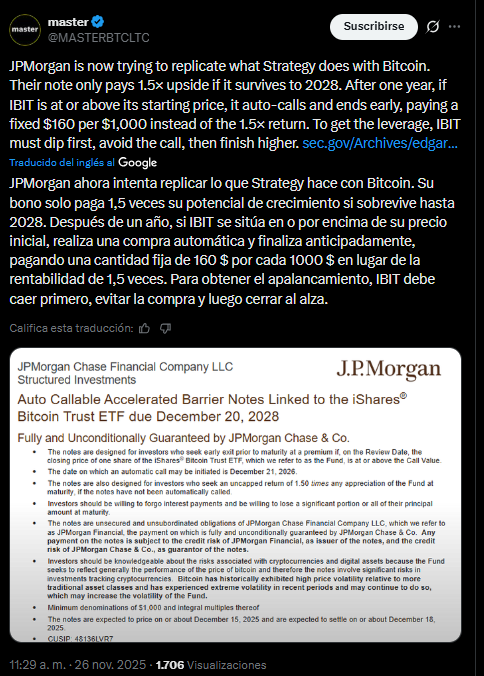
Designed to sync with Bitcoin’s halving cycle (taking advantage of projected scarcity in 2028), the instrument offers a minimum guaranteed return of 16% if the asset reaches its target in 2026. The potential for «unlimited» profits is estimated at 1.5 times the asset’s return through 2028.
However, the structure reveals the cleverness of the house. This is because it is clear that they took the forecast that if the market falls more than 30%, the investor assumes the losseswhile the bank reserves the right to redeem the bonus early to limit the client’s profits and ensure their commissions.
Banks no longer compete
He timing It’s surgical. Following a 16% correction in the price of BTC in November (falling from $102,000 to $86,000 due to retail sales), JP Morgan detected an opportunity to “harvest volatility.”
The bank’s analysts project a rebound towards $170,000 in the next 6 to 12 months, based on the asset appearing «undervalued relative to gold.» For the entity, the devaluation bet is still valid and this bonus is the tool to capture it.
This launch crystallizes the new reality that Banks do not compete against bitcoin, but rather monetize it. While they warn corporate clients about the risks of excessive exposure to the asset. They design their own investment vehicles to capture the “beta” of bitcoin in traditional portfolios.
With more than 200 public companies amassing bitcoin treasuries and ETFs exceeding $100 billion in assets, products like this could amplify institutional flows, completing the transformation and integrating bitcoin into the key cog in the Wall Street machine.
The result is a historical paradox in which the institutions that They tried to suffocate Bitcoin in its cradle and ended up needing its oxygen. to remain relevant. Today, Wall Street has adopted the decentralized asset to transform it into a financial instrument, listed, guarded and lent by the same giants who swore it would never reach that point.
Bitcoin did not ask permission to win this war. He simply waited for the banks to discover that, in the new financial order, ignoring him was no longer an intellectual stance, but a business mistake.
Disclaimer: The views and opinions expressed in this article belong to its author and do not necessarily reflect those of NoticiasVE. The author’s opinion is for informational purposes and under no circumstances constitutes an investment recommendation or financial advice.