
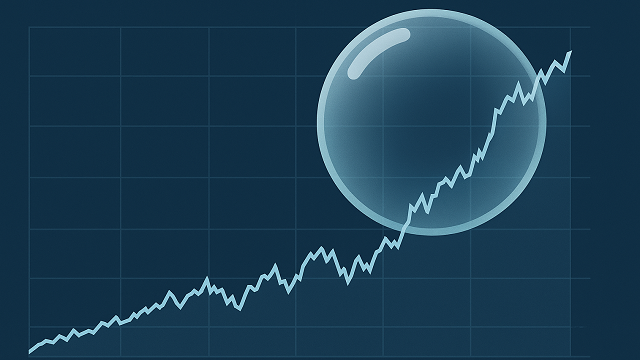
We are at a time when the excesses, especially in valuation, suggest that the American stock markets – and more specifically the technology ones – could be in a certain bubble. We are not in a bubble. That which goes ahead. There are no clear indicators as to whether we are going to crash. At some point we will fall, of course. But prices can be at highs and be sustainable. In fact, this year we have hit (in the S&P 500) all-time highs 33 times. And last year 57 times. If you didn’t invest last year because of that fear, what you would have lost…
To understand why the markets are where they are, we must first answer a key question: is the stock market rising due to multiple expansion—that is, investors are willing to pay more for each dollar of profit—or because earnings per share (earnings per share in Spanish) are actually growing? says Carlos Arenas, fund director of Investment Strategies. See: Bubble?
Within the variable income segment, Pablo Caballer, from the Investment Portfolio Department of Diverinvest I would be looking at «those sectors that are not cyclical, in those companies that are mega companies and that are the market leaders. Before I mentioned the United States and the SP500, position ourselves in those companies that have demonstrated and are demonstrating that they are very resilient, quite oblivious to what is happening in the world, in the macroeconomic environment and with a capacity for reaction and spectacular innovation that what they achieve then is that, Even if a bad year or a few bad months come, they are able to get ahead no matter what happens.” Don’t miss: Protect portfolios like this: less Europe, more Asia and technology
You may be interested in: Upcoming free Investment Strategies courses
Often, when talking about the United States, it is inevitable to talk about the large technology companies that contribute the most to the total return of the index. However, there are more and more voices that look at other types of sectors within the small and mid caps segment. Investors are seeking greater diversification, growth potential and exposure to more specific trends in this segment, especially in a context of economic slowdown, falling interest rates and demanding valuations. To analyze the opportunities currently offered by small and medium-sized companies, Investment Strategies has brought together Victoria Torre, head of Digital Offer at Self Bank, Carlos Aparicio, Managing Director for Spain and Portugal at MFS Investment Management; and Bruno Ruiz de Velasco, Senior Relationship Manager at T. Rowe Price.See: Small & Mid Caps: opportunities in a concentrated market with demanding valuations.
Another theme that is becoming structural in portfolios is that of the defense sector. The change in European military spending is fundamentally structural, driven by a confluence of factors that go beyond temporal fluctuations. The ongoing war in Ukraine has undoubtedly acted as a catalyst for increased military spending, but it is also part of a broader transformation of the global order, characterized by the growing influence of the United States and China as dominant powers. This constantly evolving geopolitical landscape has left Europe feeling more isolated than in the past, creating a pressing need to improve its defense capabilities. “Consequently, we believe that the desire and need to increase defense spending will persist for many years, reflecting a long-term commitment to national and regional security, rather than an ephemeral response to the current situation,” it says. Stian Melhus Ueland – part manager DNB European Defense Fund – DNB Asset Management.
Within the fixed income segment, from M&G, David Fancourt, gestor de high yield of the manager prefers «higher quality debt over lower quality debt, mainly due to the level at which the spreads are. Right now the spreads between issues with a single B and double B rating are quite compressed, so we lean towards double B. There are sectors with considerable dispersion, such as chemicals, which are experiencing certain tensions due to the weakness of the economies and the increase in supply from China, which generates winners and losers within it. Something similar happens with the automobile sector, which is highly exposed to the application of tariffs. There we have found opportunities in issuers that have been punished with strong sales.” You may be interested: «Europe offers the same spread as the US but with lower credit risk»
Although there is talk of opportunity, the one that gold has given, which is once again trading at new historical highs. Central banks, especially those of economies such as China, India, Türkiye, or Russia, have multiplied their purchases of gold. Gold cannot be sanctioned, frozen, or manipulated by a geopolitical decision. Because it does not depend on the fiscal policy of a foreign government. Gold is no one’s liability.
The dollar, however, is. A US Treasury bond is nothing more than a promise to pay from the US government. And, although it is the most powerful economy in the world, its credibility has been eroded with runaway fiscal deficits, and even threats of default every time the debt ceiling is negotiated in Congress. You may be interested in: The new silent gold standard.