
The price of bitcoin (BTC) plummets following the attempt by the President of the United States, Donald Trump, to advance his tariff agenda despite the setback of the Supreme Court of that country.
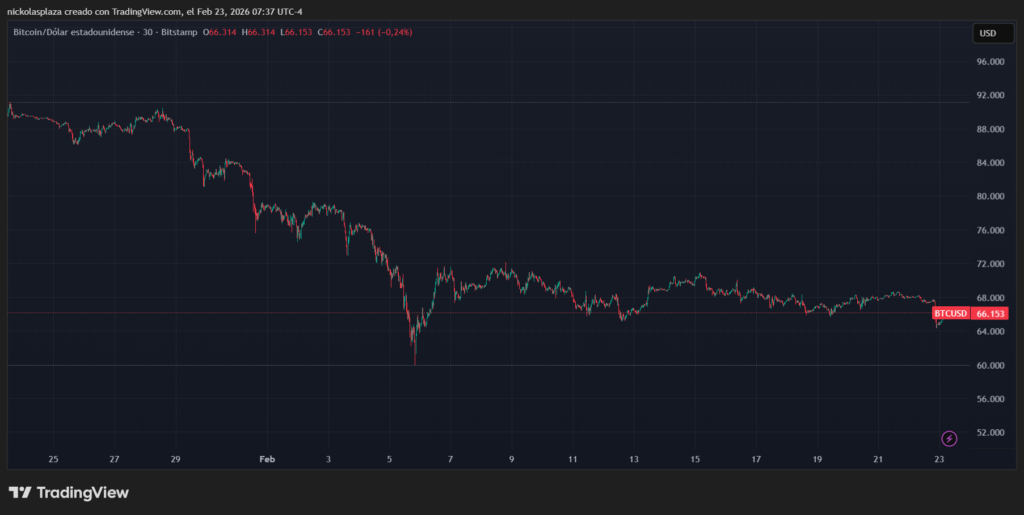
In the last 24 hours, BTC fell from $67,688 to a low of $64,266. This represented a drop of 5%, before bouncing towards $66,297. at the time of this publication.
Thus, bitcoin extends a cumulative correction of around 25% in the last month and 47% from its all-time high of $126,000 reached in October 2025, as seen in the chart.
«The members of the Supreme Court who voted against our acceptable and appropriate tariff method should be ashamed. «His decision was ridiculous, but now the adjustment process begins,» Trump declared on Saturday, February 21.
The next day, February 22, he toughened his tone by announcing: «effective immediately, the 10% global tariff imposed on countries that, many of them, have been defrauding the United States for decades, [sube] at the fully permitted and legally verified level of 15% (…) Over the next few months, this administration will determine and issue the new legally permissible tariffs.
The market interpreted this as an escalation in Trump’s aggressive trade policy. In risk-averse environments—such as fear of an expanded trade war—investors sell off “risky” assets like bitcoin and cryptocurrencies and rotate into traditional havens like Treasury bonds.
Volatility will remain high as long as uncertainty persists. The new 15% tariffs (under Section 122 of the Trade Act) are temporary (maximum around 150 days) and vulnerable to further legal challenges, which leaves open the possibility that they are just a negotiation tool.
All of this stems from the Supreme Court ruling of February 20, 2026, which annulled previous global tariffs considering that Trump exceeded his authority using the International Emergency Economic Powers Act (IEEPA) without explicit congressional approval, as reported by NoticiasVE.
Chief Justice John Roberts wrote the majority opinion, stating that the president needs «clear legislative authorization» for such measures, since «the ability to regulate imports does not grant unlimited power to unilaterally set tariffs.»
Trump has defended these tariffs as key to strengthening the US economy. However, the market reaction reflects doubts about its real implementation and its impacts on the macroeconomy.