
-
Charles Edwards recognizes advances in quantum protection, but says they are slow.
-
Capriole has launched a Quantum Stock Index as a hedge against bitcoin risk.
The investment and financial analysis company, Capriole Investments, estimates that the “quantum discount factor” already reaches 20% in the fair value of bitcoin, based on the proximity of the so-called Q-Day, when a quantum computer would break the current cryptography of the Bitcoin network.
Charles Edwards, founder of the firm, estimates that this risk justifies reducing the fair theoretical price of $120,000 per bitcoin—according to his Bitcoin Energy Value model, which measures the energy invested in mining—to $96,000.
“Bitcoin fair value should decline by 20% today,” report states of the company that was published on February 20, 2026.
For his part, Edwards warns that, without advances in resistant code, This discount would double to 40% in 2027 and reach 60% in 2028since updating the Bitcoin network would take – according to their estimates – about two years for most users. The focus is on the vulnerability of ECDSA, Bitcoin’s signature algorithm, which would require about 2,300 logical qubits to break with Shor’s algorithm.
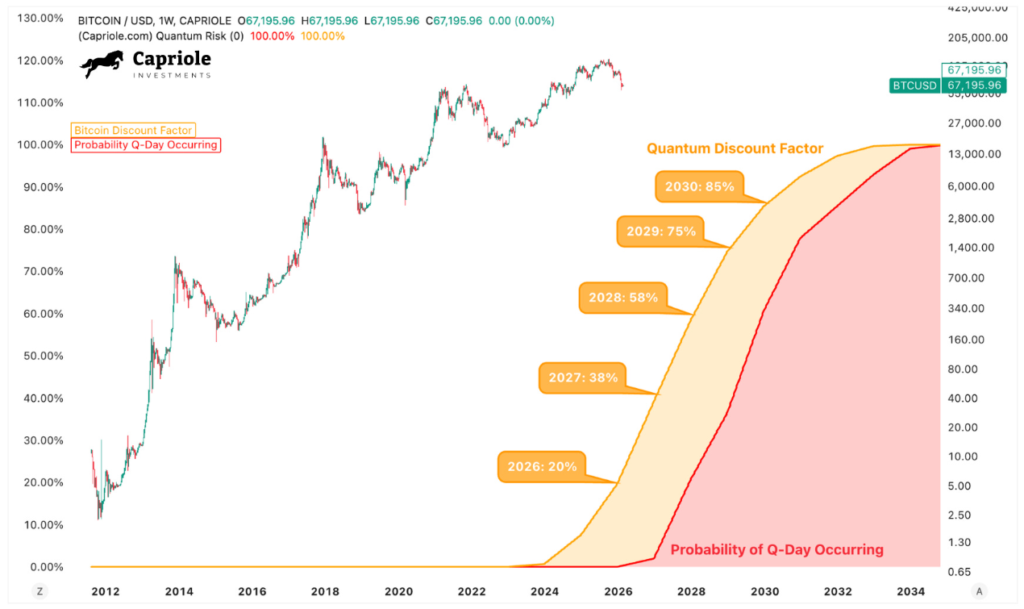
For Edwards, Quantum risk is primarily responsible for bitcoin’s lackluster performance during the last year:
The reason for Bitcoin’s poor performance in 2025 is that it entered the “Quantum Event Horizon.” This is the window in which the time until a non-zero threat of quantum breaking Bitcoin is about the same amount of time it will take to upgrade Bitcoin to be quantum resistant (about 2 years). Precisely for this reason, we saw bitcoin start to underperform and decline through 2025 against all other risk assets and stores of value like gold.
Charles Edwards, CEO of Capriole, an investment company.
General context of quantum advancement
Around the world, quantum computers are progressing faster than Moore’s law, doubling qubits every 18 months. Companies like Google and Quantinuum plan to reach 50 logical qubits in 2025, and already operate in clouds such as AWS or Azure.
The Capriole report indicates that 60% of specialists foresee Q-Day before 2030, affecting not only Bitcoin but also cryptocurrencies based on elliptic curves. In Europe, the European Central Bank discusses quantum risks in 2025 reports, while BlackRock warned in its bitcoin ETFs about this threat.
If Moore’s Law worked for a century without failure, and quantum computing also shows no signs of slowdown or foreseeable technological obstacles, why wouldn’t we expect this trend to continue in the future as well?
Charles Edwards, CEO of Capriole, an investment company.
Key Background on Bitcoin
Bitcoin has taken initial steps against this risk. In February 2026, as reported by NoticiasVE, the BIP360 proposal for anti-quantum addresses was merged, a direct advance linked to the current debate.
Before, in January 2026, Nic Carter criticized the «slow pace» of developers towards quantum computing. Additionally, Michael Saylor, director of Strategy, announced that his company will lead quantum defense, estimating the risk at 10-20 years but urging updates.
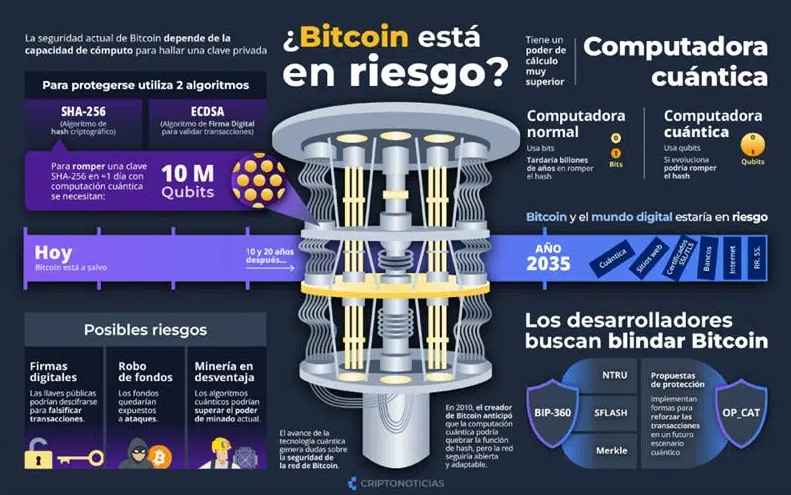
Charles Edwards recognizes the progress made, but assures that they are not happening in the required time:
Bitcoin updates slowly. Code changes must be filtered through the core Bitcoin developer team, tested, improved, reach consensus, deployed, accepted by nodes, exchanges and miners, and achieve user migration. This decentralized process makes approving, implementing, and using new code a laborious task. While this is often beneficial for preserving Bitcoin’s value (such as the principle of a fixed supply of 21 million coins, considered «hard money»), in the age of quantum computing we do not have the luxury of time.
Charles Edwards, CEO of Capriole, an investment company.
Reactions and perspectives of the sector
Capriole’s report generated debate. On the social network However, CoinShares disputes that only 10,200 BTC—less than 0.05% of the supply—face immediate real risk, calling the alarms exaggerated.
These disagreements have consequently fueled discussions about a «dead man’s switch» to freeze vulnerable funds, such as those of Satoshi Nakamoto, although they generate controversy over possible hard forks of the Bitcoin network.
In all this, it is worth clarifying that Capriole is not a neutral player in this «match» and might have some interest in promoting the idea of Bitcoin’s imminent quantum risk.
Let us remember that, as NoticiasVE has made known, the company prepares a Quantum Stock Indexwhich offers it as a protection against the depreciation of bitcoin, a product of quantum risk.
But far from serving as protectionquantum computing stocks have shown great correlation with bitcoinaccording to an analysis by the NYDIG exchange.