
-
Ethereum needs structural changes in signatures, consensus and data to become post-quantum.
-
Bitcoin explores defenses based on hash signatures, with minimal impact on the protocol.
The debate on quantum computing is no longer theoretical within the cryptocurrency ecosystem.
Ethereum’s own co-founder, Vitalik Buterin, warned that, for the network to function without depending on human interventions, must become completely resistant to that technology.
From that premise, this article will review existing proposals in both Ethereum and Bitcoin to prepare for a quantum future.
Ethereum: explicit planning and structural changes
In February 2025, NoticiasVE reported that the Ethereum Foundation (EF) funds research in post-quantum cryptography together with the ZKnoX team.
The focus is on adapt zero-knowledge proof mechanisms (ZK-proofs) and digital signatures that do not depend on elliptic curve cryptography (ECC), vulnerable to known quantum algorithms.
In parallel, within the technical forums of the ecosystem, there are other initiatives:
- EIP-7693 (April 2024): Although it is currently in status closed (closed), stipulates a backward compatible post-quantum migration. The plan establishes the use of zero-knowledge proofs to verify user identity without exposing their private keys to the new hacking algorithms and without the need to change current wallets immediately.
- EIP-7932 (April 2025): proposes laying the foundations for alternative signature schemes within the protocol. Although this is still an early specification, it reinforces the idea that Ethereum seeks to incorporate quantum defense as a native property of the system.
For proposals like EIP-7693 to be viable, they require an infrastructure that supports much heavier signatures and complex verification processes. This is where two pillars already present on the network become relevant.
One of them is Account Abstraction (EIP-4337), which is emerging as a relevant migration tool, since it allows users change your signature logic to a post-quantum one individually and voluntarily.
Second, the architecture of ZK-based second layer (L2) networks and the use of blobs (EIP-4844) not only look for scalability, but provide the bandwidth necessary to support post-quantum signatureswhich are considerably heavier than the current ones.
Signatures, blobs and consensus: what Ethereum would have to change
Last July, Ignacio Hagopian, developer of the EF, explained to NoticiasVE that his organization evaluates adopt signatures Falcona post-quantum algorithm based on lattice cryptography.
So far, it has not been proven that Falcon can be cracked by known quantum algorithms. They are also analyzed signatures based on hash functions as an alternative.
Ethereum uses elliptic curve cryptography that would be vulnerable to quantum at several levels: for transaction signatures, for blobs introduced with the Dencun update that uses L2s, and for the BLS scheme that allows validators to vote in the Proof-of-Stake (PoS) consensus.
According to Hagopian, “all that would have to change” in a quantum scenario.
In December 2024, researchers published on EthResearch a list recording which areas Ethereum should fix and with possible alternatives to adopt. Includes changes to signatures, consensus, data storage, and synchronization.
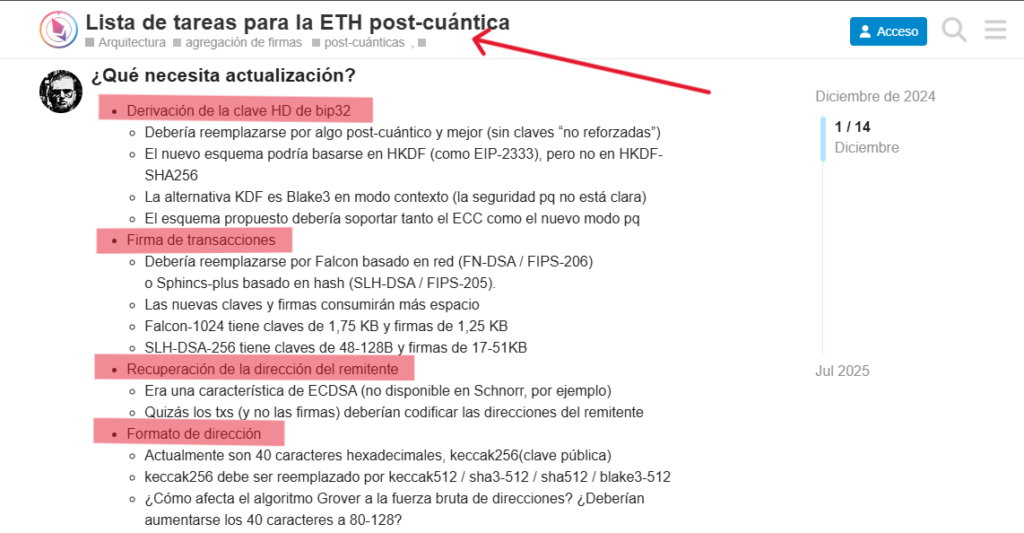
All this structure to cover also implies a greater attack surface for Ethereum.. This makes the network co-created by Vitalik more vulnerable than Bitcoinwhich only uses ECC-based cryptography in transaction signatures.
Bitcoin: cautious experimentation and smaller exchange surface
In Bitcoin, the approach is different. There is no centralized roadmap, but there are multiple proposals and experiments.
In January 2026, NoticiasVE reported the launch of a testnet designed for evaluate quantum protection mechanisms without affecting the main network. The goal is to study key migrations and new types of signatures in a controlled environment.
Hash-based signatures: the preferred route for Bitcoin
In June 2025, Adam Back, Blockstream co-founder, proposed that Bitcoin adopt signatures based on hash functionsan approach aligned with the philosophy of the protocol, which already relies on SHA-256 to protect mining.
In particular, he suggested the use of SLH-DSA, a scheme standardized by NIST (based on SPHINCS+ technology).
However, in December 2025, the Blockstream team published a technical analysis where showed that SLH-DSA is too heavy for Bitcoinwith signatures of 7 to 8 KB (kilobytes). Causing a simple Bitcoin transaction to become very expensive.
From there, they explored optimized variants of SLH-DSA that reduce that size. The adjustment consisted of limiting the number of signatures per key and applying compression and pruning techniques.
With these optimizations, signatures dropped to a range of 3.7 to 4.4 KBmaintaining security based solely on hash functions.
Jameson Lopp’s optional protection soft fork (July 2025)
Jameson Lopp, along with other authors, proposed a backward compatible software update that would allow quantum protection to be introduced in a non-mandatory manner.
This proposal would allow more cautious users to migrate their funds to new protected address structures, avoiding the need to force the entire network into a simultaneous and potentially disruptive transition.
Likewise, Lopp also presented the idea of burn BTC that are vulnerable to quantumto prevent them from being controlled by an attacker who manages to use this technology.
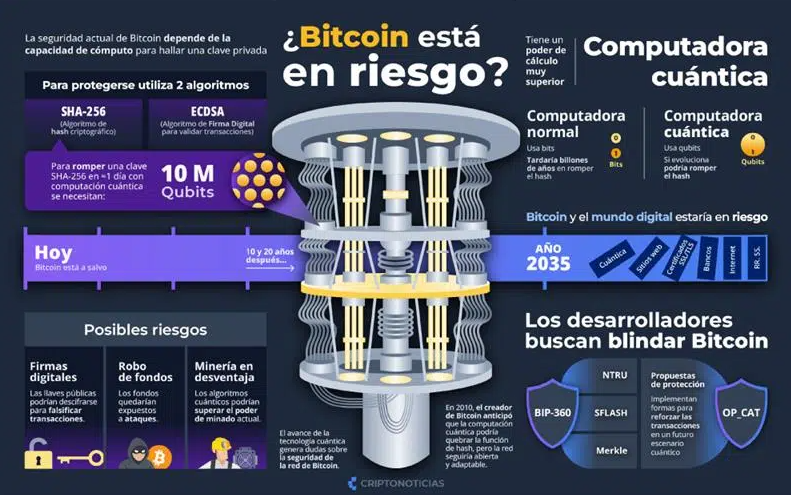
Experimental wallets with post-quantum signatures (June 2025)
Bitcoiner developer Ben Sigman carried out anti-quantum testing on BlueWallet using hash-based signatures (such as Lamport or Winternitz) to protect funds from quantum attacks.
These tests showed that Is it possible to secure coins todayalthough the cost is a greater data load in each transaction and these signatures are single-use.
BIP-360 Proposal (December 2024)
Finally, the BIP-360 proposal introduces the P2QRH (Payment to Quantum Resistant Hash) cryptographic payment method and provides a transaction mechanism resistant to quantum attacks.
Implemented as an optional enhancement, it allows users to migrate their money to a safe zone gradually without affecting the normal functioning of Bitcoin. It is a flexible solution that reinforces the security of current wallets without taking up unnecessary extra space on the network.
What does the future hold for Bitcoin and Ethereum?
Recent data reveals that even the banking sector has begun testing to shield itself from quantum computing. The most optimistic estimates indicate the 2030 as the key year for the arrival of the first commercial quantum computer.
While this is not a competition to determine which network is more secure, it is clear that the quantum resistance It depends, for now, on the pace of developers and private capital investment to consolidate real solutions.