European UCITS ETF flows
Investors in the market ETF UCITS Europeans succumbed to the fear of being left out of the US stock market rally and allocated heavy resources to this region.
US stocks led gains in the third quarter, accumulating net new assets (NNA) worth 20.3 billion euros in the period. In September, investors allocated €9.5 billion to US stocks.
The reallocation towards the US in September was part of a broader trend of investors to take riskswith new net assets (NNA) in equities that exceeded 31,400 million euros, compared to 4,100 million in fixed income.
In fixed income, investors allocated 1.1 billion euros to high yield in September. During the third quarter, investment grade corporate debt led with inflows of €6.3 billion. Investors also added €1.1 billion to government bonds this month, bringing the quarterly total to €2.6 billion, about a third of the inflows into Investment Grade corporate debt.
Equities: US stocks lead the way
Equities: US stocks gained strength again in September, with investors selecting broad market indices such as the S&P 500. Global indices were the second most popular strategy, adding 7 billion euros in the last month and 18.8 billion in the quarter.
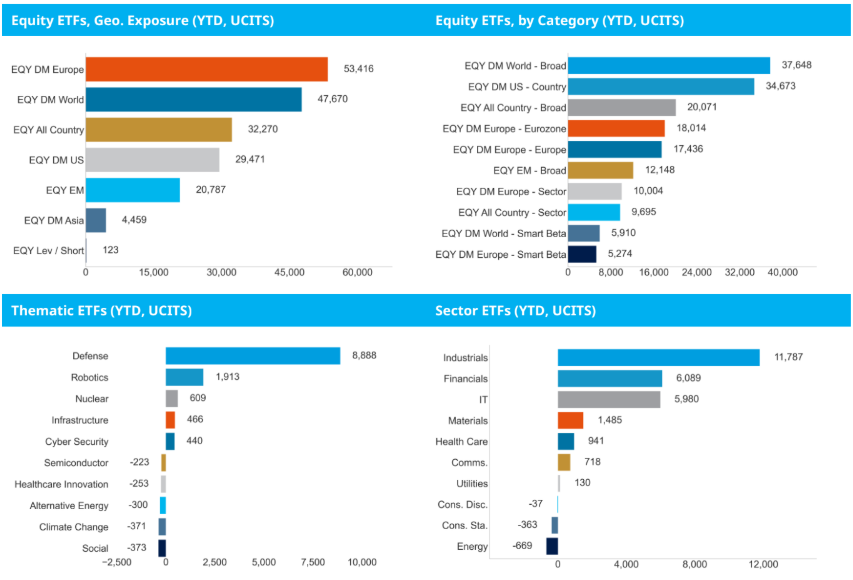
However, so far this year, European stocks continue to lead with €53.4 billion in net new assetsahead of the flows of World (47.7 billion), All Country (32.3 billion) and USA. (29.5 billion).
The interest in broad allocations of emerging markets (EM) It has also grown in recent months. The net new assets variable income emerging markets (EM) They were 4.9 billion euros last month and 9.2 billion in the quarter. This renewed interest in EM is driven by a weaker US dollar and the US Federal Reserve’s plans to continue interest rate cuts. This allows the central banks of the EM reduce rates, while many emerging economies also benefit from strong fiscal support.
In thematic indices, defense strategies maintained their momentum, adding another €474 million last month, bringing the quarter’s total to €1.5 billion and net new assets of the year to 8.9 billion. These inflows are primarily driven by Europe’s commitment to increasing defense spending and allocations are concentrated in this region.
By sector, financial companies added 3,000 million in September, taking the quarter to 3,900 million, with a weight in global and European financial companies.
In smart beta, investors favored income strategies, adding €964 million in September, with net new assets quarterly of 2,300 million. This is a diversification strategy that seeks to balance the focus on growth stocks within the US allocation. Flows into equally weighted indices remained flat in September, but were negative in the quarter with outflows of 1.6 billion.
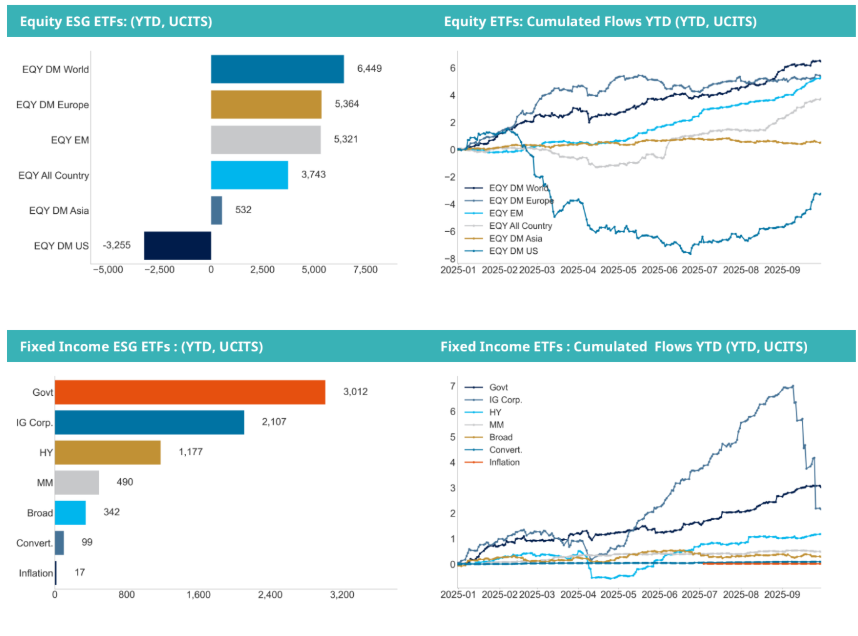
There was a resurgence of interest in ESG equity ETFs, with inflows of €6.5 billion in September, taking the quarterly total to €12.7 billion. However, this represents a low proportion of the total equity allocation.
Fixed income: High yield and emerging markets (EM) attract investor interest
The demand for bonds high yield It has been in both euro and US dollar denominated debt. This demand has been driven by US President Donald Trump’s permissive attitude towards the oil sector, which makes up the majority of issuance of this asset class.
Investors also allocated 1.1 billion euros to government bonds in September, with 457 million going to euro-denominated bonds and 446 million to dollar-denominated bonds. However, in the quarter, investors have strongly favored US debt, adding €2.8 billion to this asset class.
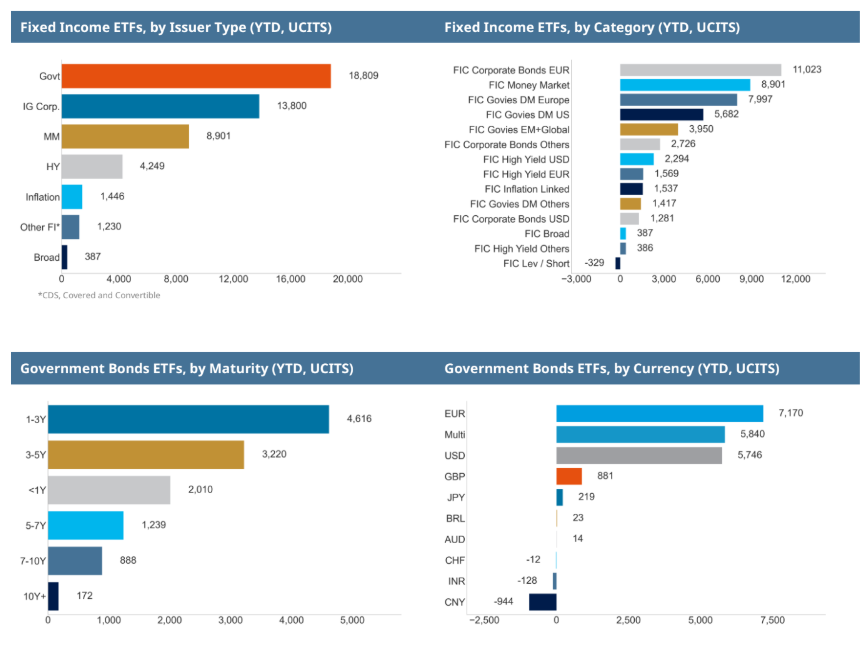
Investors have preferred the short and middle sections of the curve, while withdrawing 473 million euros of bonds with maturities of more than a decade. This year, approximately 30% of inflows into euro-denominated corporate debt have gone to the short end of the curve, up from ~16 % last year. This preference for the short end reflects interest rate expectations in both the US and Europe, where both are likely to cut rates.
As in variable income, the debt of emerging markets (EM) has attracted investor attention due to a weaker US dollar. The debt of EM It earned 515 million euros in September, bringing the quarterly total to 1 billion.
There were exits from corporate debt ESG investment grade in September, although investors added €357 million to government bond strategies ESG.