
The US government is preparing a wide-ranging executive order to reorganize and coordinate federal investment, infrastructure, security and commercialization of quantum technologies.
According to a draft of the order obtained by the Nextgov/FCW site on February 3, the directive titled “Introducing the Next Frontier of Quantum Innovation” would establish a “whole-of-government” approach to quantum information science and technology (QIST). A field that the draft itself defines as a “unique opportunity” both in economic and national security terms.
The central objective is to strengthen the competitiveness of the United States, reduce security and supply chain risks, and accelerate the move from laboratory research to practical applications.
This document places the Office of Science and Technology Policy (OSTP) as the primary coordinator and assigns tasks to Commerce, Energy, and Defense, with participation from the intelligence community and the National Science Foundation (NSF).
In addition to promoting partnerships with industry and allied countries, the text includes measures to protect sensitive quantum research, reinforcing counterintelligence components against risks of espionage and misuse.
The draft order sets 180 days for OSTP, Commerce, Energy and Defense to update the National Quantum Strategy, and requires that, 30 days after it is published, the agencies report how they plan to execute it.
In turn, it proposes accelerating capabilities and infrastructure, including a national effort for a quantum computer aimed at scientific applications (with at least one system housed in Department of Energy facilities). He also highlights an omission: The draft does not incorporate specific provisions on post-quantum cryptography, despite its relevance for the protection of future information.
What does this have to do with Bitcoin?
The connection with Bitcoin is indirect, but sensitive: the technical debate revolves around whether, in a future scenario, quantum computers with sufficient capacity could weaken public key cryptography schemes used to authorize fund movements.
As NoticiasVE has reported, possible paths of preparation are discussed within the ecosystem, such as the future adoption of cryptography resistant to quantum computing and transition mechanisms for users. This is an open debate, without univocal consensus and conditioned by the real pace of development of this technology.
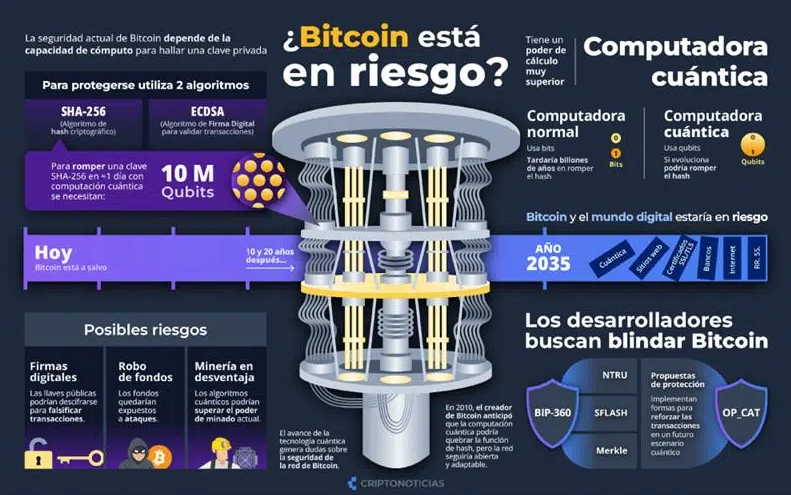
In that framework, a more aggressive quantum policy by the United States, such as the one suggested by this order, can accelerate investment, talent and state coordination in the sector, shortening surveillance timelines for systems that depend on public key cryptography.
Even so, There is no public evidence that quantum computers capable of compromising Bitcoin on a practical scale exist today.so the matter remains in the field of technical preparation and debate on the update route, rather than an immediate threat.
Within this framework, Strategy, the company with the most BTC in its corporate treasury, will launch a Bitcoin security program to coordinate the development of quantum resistance solutions together with global cybersecurity and financial and technology sector communities.
In any case, it should be noted that its CEO, Michael Saylor, minimizes fears about quantum computing.
For him, it is a technology that is still in its infancy and, according to industry consensus, there will be at least 10 years left before it represents a real threat. He also highlighted that Bitcoin is an upgradeable network and capable of adapting to become more resilient.
Meanwhile, the draft executive order suggests that quantum computing is on track to establish itself as a central pillar of the US strategy in science, technology and security, with effects that could extend far beyond academia.