
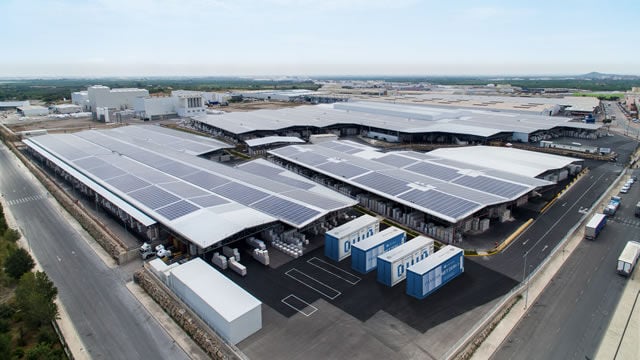
The project developed with Pamesa is defined as a Net Zero industrial energy platform. What exactly does Net Zero mean within Umbrella’s business model?
When we talk about Net Zero Within the Umbrella model we are not only referring to installing renewable generation, but to structurally transform the industry’s energy model.
In the case of the project that we are developing together with Pamesa Grupo Empresarial, we are talking about a integrated industrial energy platform which combines up to 80 MWp of photovoltaic generation, 366 MWh of battery storage and an advanced energy management system capable of optimizing in real time how energy is generated, stored and consumed within the production process.
This approach makes it possible to electrify industrial processes, structurally reduce emissions and provide the industry with greater energy autonomy, supply stability and operational efficiency, also reducing exposure to oil and gas volatility, one of the main risks for European industry in recent years.
For Umbrella, projects like this reflect very well where the sector is evolving. The energy transition is no longer just about producing renewable energy, but about designing intelligent energy platforms that allow the industry to make long-term strategic decisions about its energy management.
What does it mean for Umbrella that a European industrial leader like Pamesa has also decided to align itself at the shareholder level?
It has a very relevant meaning from a strategic point of view. Our relationship with Pamesa Grupo Empresarial has been built over time, project by project, on a basis of trust that has been consolidated with the results. After agreeing on the development of a particularly ambitious industrial project, both parties decided to go one step further and also align our interests at the shareholder level.
That an industrial group of Pamesa’s size and leadership decides to also accompany this project as a partner is a very important validation of our model. It reinforces the company’s shareholder stability and demonstrates that the industry is beginning to see the energy transition as a long-term strategic decision, not only as a regulatory or environmental issue.
For us, it is especially relevant to incorporate a reference industrial partner into our shareholder base that shares a vision and growth horizon.

How does this operation fit into your evolution as a listed company?
It fully fits with the strategic evolution that we have promoted since our departure to BME Growth. In recent years we have evolved towards a more integrated model, focused on energy assets, hybrid solutions and highly complex industrial projects, where technology and intelligent energy management play an increasingly relevant role.
The project Pamesa Net Zero represents this new stage very well. More than a one-off energy installation, it is an industrial energy platform custom designed for a large energy consumer, reflecting how the role of energy within the industry is evolving.
These types of initiatives reinforce our positioning as partner energetic for large industry, a role that we believe will be increasingly relevant in the context of electrification and decarbonization of the industrial sectors with the highest energy consumption.
In our opinion, the next generation of industrial energy infrastructure will be defined by that combination of renewable electrification, storage and intelligent energy management, which will allow companies to improve their energy efficiency and reduce their exposure to the volatility of energy markets.
To what extent are storage and intelligent management the true differential element of the model today?
They are absolutely central. For years the renewable sector has been very focused on generation capacity. However, the big change we are seeing is that the real value is in intelligent energy management.
At Umbrella we have a model that is difficult to replicate because we integrate all the key capabilities of the energy chain within the group itself. This allows us combine renewable generation with advanced storage systems and own energy management technology developed through our technological subsidiary Turbo Energy, optimizing in real time how energy is produced, stored and consumed.
This is especially relevant in electro-intensive industrial environments, where factors such as supply stability, management of demand peaks or the predictability of energy costs are critical for competitiveness.
In this context, the renewable electrification Combined with smart storage allows the industry to reduce its structural exposure to oil and gas volatility, protecting its operating margins.
The operation is articulated through a capital increase. What impact will it have on equity and the balance sheet structure?
The operation responds mainly to astrategic alignment with a long-term industrial partnermore than a liquidity raising operation.
It is articulated through the conversion of a previously existing financial instrument into company shares, which allows Pamesa to be incorporated as a reference partner while strengthening the capital structure.
These types of instruments are common in long-term strategic relationships, because they allow a progressive entry into the shareholding and a natural alignment between both parties.
From a financial point of view, the operation contributes to strengthening the company’s own funds and reinforcing the stability of its shareholder base, key elements for a listed company in a growth phase like Umbrella.
How do these long-term projects contribute to greater predictability of future income?
These types of projects provide visibility and solidity to Umbrella’s positioning in the industrial field. In this case we are talking about a contract for the design, execution and connection of a large-scale industrial energy infrastructure, a particularly relevant project due to its size and technical complexity.
For us it has a strategic value because it demonstrates Umbrella’s ability to develop complex energy projects in high-demand industrial environments, a segment in which we see great growth potential as companies advance their electrification processes and financial shielding against oil and gas price fluctuations.
What are the next steps that the company is going to take to continue evolving after the formalization of Pamesa?
The Pamesa project represents a very relevant step, but it is part of a broader strategy. Our aim is to continue scaling the model of industrial energy solutions, developing energy platforms that are increasingly integrated and adapted to the needs of large energy consumers.
The industry is facing a profound transformation of its energy system, driven by the electrification of processes, regulatory pressure on emissions and the need to reduce its exposure to energy volatility.
In this context, we believe that the smart storage and data-driven energy management They are becoming a critical infrastructure for industrial competitiveness.
That is why we are going to continue strengthening our technological capabilities, expanding our presence in industrial projects and consolidating our position as partner energy for large industrial groups in Europe.