
Venezuela is currently registering a financial operation that recalls dynamics seen in 2014 and 2015, called the «exchange bicycle» and the «quota scraper.» Now it occurs due to the existence of a differential between the cost of acquiring currency in national banks and the exchange price of the stablecoin USD Tether (USDT) on person-to-person (P2P) platforms.
The process of the new “exchange bicycle” is based on an arbitration cycle where the user acquires foreign currency (virtual only) in national banks, for an average of 430 bolivars, and transfers them to international debit cards issued by local banks to purchase USDT. Subsequently, it sells these assets in P2P markets at a higher rate, which ranges from 570 bolivars per USDT, according to data from P2P.Army.
By liquidating the digital assets, the operator obtains a surplus in bolivars that allows him to restart the purchase at the bank. This helps you capture an immediate profit differential which evokes the old quota «scraper».
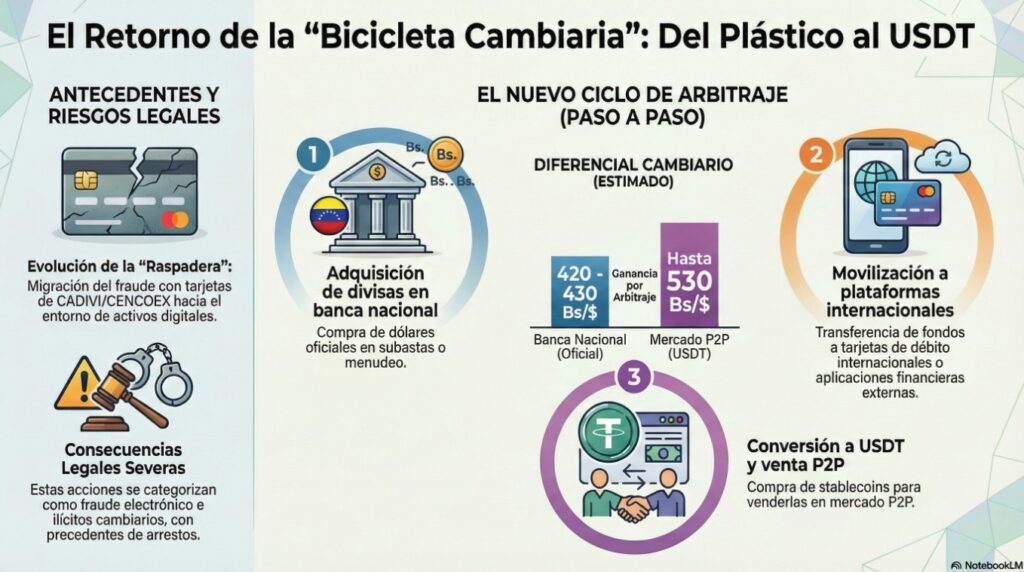
It must be taken into account that the liquidity of the dollar is not guaranteed and that users have a daily purchase limit of $1,000, a monthly limit of $4,000 and $8,500 per year. In addition, allocations are being given in most cases in virtual dollars.
This scenario takes place in a context where There is availability of dollars in some Venezuelan banking institutions. This is a product of the flow of foreign currency from the marketing of crude oil in agreement with the United States.
What is the “quota scraper”?
The practice described above is reminiscent of the so-called «raspadera» or «raspa quota», which consisted of the use of credit cards with quotas in foreign currency assigned for international consumption.
This was carried out under the schemes of organizations now defunct in Venezuela, such as the Currency Administration Commission (CADIVI) and the National Center for Foreign Trade (CENCOEX). The intention was obtain the money or «quota» in cash and take advantage of the exchange differentials. For this, the beneficiaries simulated purchases at points of sale abroad and, in exchange, received the cash.
These amounts ranged from USD 300 to USD 5,000, depending on the destination of the trip. Many of these «scratch cards» were made in Cuba, a country that in 2014 saw a significant influx of Venezuelan travelers interested in obtaining their tickets in cash.
It is important to highlight that these actions were classified as illegal foreign exchange and electronic fraud. The practice led to severe legal consequences during its rise in years such as 2014.
In that period, arrests of people were recorded for the improper use of credit cards and quotas granted by the State. And cases of citizens captured by authorities at airports and banking entities were documented, under charges of fraudulent obtaining of foreign currency.
Paying “just for sinners”
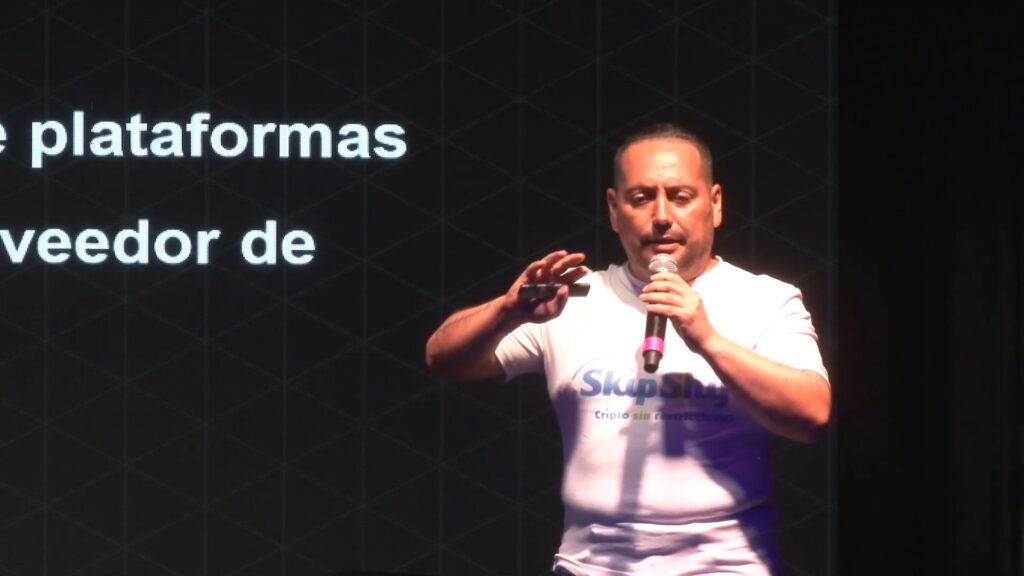
Daniel Peláez, trader and specialist in P2P markets, analyzed in dialogue with NoticiasVE the exchange phenomenon that is occurring in Venezuela from an educational and conceptual approach.
Peláez assured that «when a person buys electronic dollars at a rate close to the official rate and after converting them into USDT, sells it in the P2P market at a higher rate, technically we are facing an operation that can be classified as arbitration.»
However, the economist also delved into the concern generated by the visibility of these practices, which he understands as speculation, for the health of the digital ecosystem in Venezuela.
What worries me is that today, given the strategy of banks such as Banco de Venezuela, which is providing a card to make purchases of electronic dollars; People are using that opportunity to be able to buy dollars at the official rate, taking those dollars to the crypto market, converting them into USDT and selling those USDT through P2P platforms back to bolivars, obtaining a differential. The problem is that it is not being done by people who are dedicated to arbitration, it is being done by a group of people who are speculating and when there is massive and notorious speculation, obviously that can set off alarm bells.
Daniel Andrés Peláez, Venezuelan economist and trader.
Peláez warned that this situation, which has been causing a lot of «noise» in recent weeks, could lead to the closure of tools that are vital for other purposes. As you see it, the government can restrict P2P platforms, making Venezuelans pay “just for sinners.”
«In the end, the people who do P2P, the people who use P2P as a tool to solve these digital money exchange problems, will be harmed,» he lamented.
An arbitration method not recommended
Peláez concluded his analysis by emphasizing that he does not recommend this cycle of arbitration operations in Venezuela. This is because, according to his vision, will bring challenges to the sector.
«I personally am not recommending that arbitration cycle. Because I know that this is going to bring us problems, and the more massive it becomes, the more it worries me,» he insisted. And remembered that There are already people talking about it on social media.
«A lot of people saying, ‘Look, do it this way, convert it through this platform,’ and that’s where the complication is, and that’s what has me a little alarmed,» he added.
The exchange bicycle is beginning to gain speed in Venezuela. Even with risks, the use of multiple tools to circumvent the country’s controls is becoming normalized.
For analysts like Peláez, this puts at risk an entire ecosystem that has managed to establish itself in Venezuela. However, it is a dynamic that takes off due to a determining factor. This is the use of the bolivar as a spending vehicle and USDT as a form of savings.
The above puts pressure on the demand for stablecoins or “hard” currencies, leading Venezuelans to go out, determined, to look for them. Even in the digital field.